
Mecca defence pact and call for unity: Bangladesh must decide promptly
Jamaluddin Bari
Today is 12 Rabi’ al-Awwal, 1448 Hijri. It is the birth and death anniversary of Hazrat Muhammad (PBUH), the world’s greatest blessing and the bearer of an exemplary ideal for people of all ages. According to historians and researchers of the Seerah, 12 Rabi’ al-Awwal in the ancient Arab lunar calendar corresponded to August 29, 570, in the Gregorian calendar. The formal calculation of the modern Hijri calendar began with the migration of the Prophet (PBUH) from Mecca to Medina in 622 AD, 12 years after he received prophethood. According to the Gregorian calendar, that was in September 622. The birth and upbringing of the final and greatest Prophet, Hazrat Muhammad (PBUH), and the revelation of the words of the Holy Quran to him over 23 years through the angel Jibril (AS) are among the most significant events in world history.
However, Islam did not begin with Prophet Muhammad (PBUH). Essentially, the central theme of monotheism in the three major religions commonly described as Abrahamic religions, which have revealed scriptures, is the same. Belief in Hazrat Adam (AS), the first father, and Hazrat Ibrahim (AS), the father of nations, as well as in Hazrat Musa (AS), Hazrat Isa (AS) and the final and greatest Prophet Hazrat Muhammad (PBUH), is an integral part of the faith of every Muslim. This is why Jews and Christians, whose original scriptures have been subject to distortion, cannot naturally accept the unaltered Holy Quran of Muslims.
The history of the past 1,500 years before the World Wars demonstrates that only Islamic guidance, teachings and values can lead people of all religions in every part of the world under the banner of equality, peace and coexistence with full security and dignity. Islam came to the Middle East, Africa, Europe, Central Asia, Persia and Indochina during their dark ages as a beacon of a greater civilisation. During the age of the barbaric Vikings, Muslims came to Europe with the light of a new civilisation. Before the arrival of Muslim sultans and the Mughals, India was not a single sovereign state. Muslims conquered the many divided Indian kingdoms and transformed them into a unified sultanate, shaping undivided India
The struggle between truth and falsehood is eternal. The conflict between Islam and other religious beliefs is not so pronounced, but Islam’s position is completely opposed to irreligious, amoral consumerist thinking, the capitalist world order and war-mongering imperialism. Islam embraces a welfare-oriented philosophy that stands against interest-based economics, the concentration of capital and a war economy. Therefore, superpowers that became global leaders through interest-based economics cannot tolerate or embrace Islam. Despite advocating human welfare and equality, communism of Marx and Engels in Russia and Eastern Europe faced collapse within 70 years because it had no connection with belief in the hereafter, accountability and spirituality. This is where Islam’s superiority lies.
All vested-interest groups in the world have identified Islam as their principal opponent and enemy and have openly, secretly, publicly and covertly conspired against Islam, misleading and diverting the objective of establishing an Islamic state based on the Constitution of Medina.
Taking advantage of Muslim divisions, the Ummah was weakened so that it could not resist or protest against the theft of resources by Western warmongering imperialists. It is the energy resources controlled by Muslims that have kept the wheels of Western advanced technology, aviation, industrialisation and economy running. The primary objective of colonial exploitation and the post-colonial system of control was to maintain exclusive control over the energy resources and raw materials of the Middle East, Asia and Africa.
The beginning was the First World War, although the war itself began with rivalry among Europe’s royal powers. After Archduke Franz Ferdinand of Austria-Hungary was killed by a Serbian nationalist extremist at a railway station in Sarajevo, Austria-Hungary, Germany, France, Russia and Britain became involved in the war due to mutual defence treaties among European countries. The secret objective of the war was the Ottoman Caliphate, which had ruled Europe for hundreds of years. Although the war ended in 1919, France, Britain and Russia had already divided vast portions of the Ottoman Empire’s land and maritime territories among themselves under a secret agreement in 1916.
In exchange for assistance from the British Jewish community and bankers in financing the war, British Foreign Secretary Lord Balfour, in a short letter to Rothschild, a leader of the Jewish community at the time, had promised to establish a Jewish homeland in Palestine even before Britain established control over Jordan, Lebanon, Palestine and Iraq, which had fallen within its share. That promise, known as the Balfour Declaration, was the first imperialist plan to establish a Jewish state in Palestine. But there was no practical possibility of establishing a Jewish state there with a population of less than 10 per cent.
With Anglo-American and Western military support, Haganah militias landed in Palestine by sea in May 1948 and carried out massacres to establish the state of Israel. For Palestinian Arabs, this is remembered in history as the day of the Nakba, or catastrophe. Israel did not look back after that. With the unconditional support of the United States and the West, it imposed major wars on the Arabs in every decade, seized hundreds of kilometres of Arab territory and expanded the area of the Israeli state several times over the past seven decades. Israel’s occupation and Western control and exploitation of the Middle East, once part of the Ottoman Empire, continued uninterrupted.
Then, like an unexpected disruption, came the Islamic Revolution in Iran in 1979. Islam does not support the dominance of any oppressive superpower. The main opponent of the 1979 Iranian Islamic Revolution was not the Western-backed Pahlavi Shah, but his patron, the United States. Iranian revolutionary students seized the US embassy in Tehran and held more than 50 American citizens hostage for 444 days. After several US military commando operations, including Operation Eagle Claw, failed to free the hostages, the Americans were released under the Algiers Accords in January 1981. The demand that the United States return Reza Shah Pahlavi, who had fled during the revolution and was granted asylum in the United States, was the main reason for holding the Americans hostage.
For 1,500 years, conflict and confrontation have continued between Islam and other civilisations. Five years after the Prophet’s death, Muslim commander Abu Ubaidah (RA) laid siege to Jerusalem. In the presence of Caliph Umar ibn al-Khattab (RA), the Christian ruler of Jerusalem handed over the city’s keys to the Caliph, who then took control of the city. During the two centuries of the Crusades, Jerusalem remained under Crusader control for eight decades. However, during the Third Crusade, Sultan Salahuddin Ayyubi defeated the Christian forces decisively at the Battle of Hattin in 1187 and recaptured Jerusalem, establishing Muslim rule there. When Christian Crusaders captured Jerusalem in 1099, they carried out a brutal massacre. In contrast, when Ghazi Salahuddin recaptured Jerusalem, he demonstrated extraordinary forgiveness, peace and magnanimity. This is the teaching of the Prophet of Islam.
Until the First World War, or for nearly 750 years, Muslim authority remained intact over Jerusalem and the entire Middle East. After the Second World War, Israel was used as a proxy in the Middle East to consolidate the capitalist control system of Anglo-American imperialism. Meanwhile, Zionist Jews became controllers of the US deep state and political-economic system through their control of the banking sector, media and corporate finance. This has raised the question in world politics for a long time as to whether the United States controls Israel or Israeli Zionists control the United States.
The Iranian Islamic Revolution became a major challenge to US control over the Middle East. Therefore, in addition to seeking regime change in Iran and installing a compliant ruler to make imperialist exploitation easier, Israel and the United States have worked for four decades on a grand plan to establish Greater Israel. After the joint Israeli-American attack on Iran, Netanyahu reportedly said enthusiastically that this had been his dream for four decades. That dream has already turned into a nightmare. A century of secret agreements and imperialist control has begun to collapse like a house of cards in the face of the unprecedented resistance and retaliation of Islamic Iran.
The most important positive aspect of this war is that the call for broader Muslim unity has gradually begun to become visible by breaking the web of conspiracies aimed at Muslim disunity and division. The war imposed on Iran by nuclear-armed Israel and the United States has backfired on them. Iran has destroyed the air defence systems of Israel, the United States and the West and left Israel devastated. The Americans had imposed thousands of crores of dollars in defence contracts on the petrodollar countries of the Middle East and established military bases in various countries, claiming that they would provide security against Iran’s growing military threat, while burdening these countries with hundreds of crores of dollars in annual military expenses.
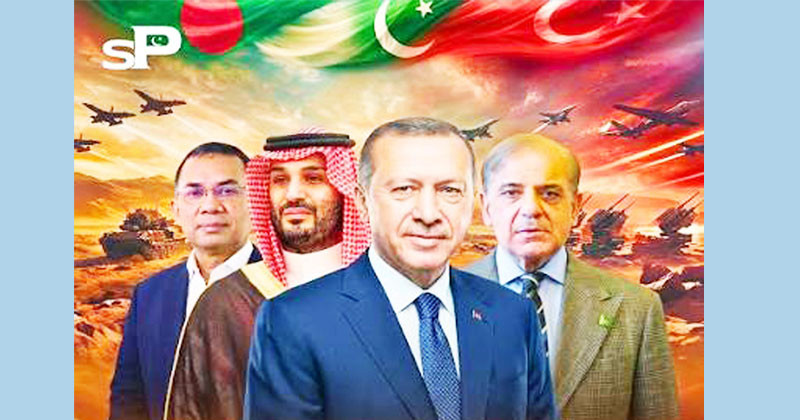
By reducing these bases to rubble, Iran has demonstrated that the United States cannot provide security to any Arab country, including Israel. In light of this reality, a broader military alliance among major Muslim countries, including Saudi Arabia, Türkiye and Pakistan, is reportedly emerging through the Mecca Pact. Iran has also reportedly responded positively to the prospect of joining this alliance. By breaking the web of Zionist conspiracies and eliminating Muslim disunity both internally and internationally, a new world order will now emerge.
Bangladesh has also been informally offered the opportunity to join this alliance. Just as the security of Palestine, Lebanon, Syria and Jordan has been threatened by the Greater Israel plan, Bangladesh’s independence and sovereignty are similarly at risk because of the alleged Akhand Bharat plan of Hindu nationalists. Bangladesh must therefore move forward by making an independent and courageous decision to ensure its own security.