
Nepal in Race Against Time: 9 Chinese Tunnel Experts Join Desperate Rescue Efforts
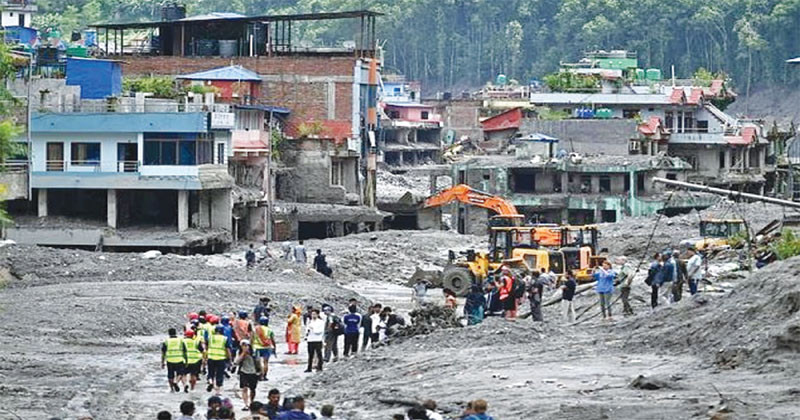
The death toll from devastating flash floods in Nepal and Tibet has risen to 750. More than 3,000 people are still missing. At the same time, the water level of the Bhotekoshi River in Nepal is rising, raising the risk of new floods. More than 100 workers are trapped in a tunnel of a hydroelectric project in Nepal’s Rashua district rescuers have inserted a pipe into the tunnel and started supplying oxygen. After that, preparations are being made to remove the soil and debris and launch a rescue operation. Nine Chinese tunnel experts have arrived in Nepal to join the race against time to rescue the trapped alive.
Rescue operations have been put on alert as floodwaters rise again. Rescue operations have been temporarily suspended due to the risk of flooding from a newly formed lake in an area of Tibet. More than 3,700 people have been rescued in Nepal so far. Thousands of families are still waiting to find their missing relatives after the disaster. Meanwhile, the situation has taken a dire turn after the recent catastrophic floods and mudslides caused by avalanches in the China-Nepal border region. It is feared that many workers are trapped in tunnels of several hydroelectric power stations in Nepal in this disaster. Nine Chinese tunnel experts have arrived in Nepal to join the race against time to rescue survivors from the tunnels at this critical moment. The Chinese government sent this special rescue team after receiving a direct urgent request from the Nepalese government on Saturday. The first five members of the nine-member team of experts flew by helicopter from Tibet’s Jirang County to the disaster-stricken area of the hydropower project in the Nepalese border region. The remaining four experts have joined them to further strengthen the rescue operation, China’s state-run Xinhua news agency reported. In addition, two large Y-20 transport planes of the Chinese Air Force landed at Kathmandu’s Tribhuvan International Airport on Sunday morning with 50 tons of emergency relief supplies. The consignment includes 13,200 emergency supplies, including tents, blankets, sleeping bags and first aid kits.
Current situation inside the tunnel: More than 100 workers are believed to be trapped in the tunnel of Nepal’s ‘Trishuli-3A’ hydroelectric power station, which was submerged in floodwaters. Nepali soldiers and engineers have managed to drill a small pipe through the mud to keep the oxygen supply inside the tunnel running. Although light, sound and air are sent inside through the pipe, no response or reliable communication has been established from inside so far. Due to the huge pile of mud and rocks, opening the main entrance of the tunnel has become extremely risky and complicated. Chinese experts are now working on technical techniques to create a path for people to enter there.
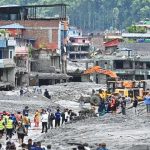
Pictures of the terrible damage: The Himalayan mountains on Wednesday morning. The flash floods and devastation were triggered by a glacier collapse on the Lirung mountain range. The number of missing people in the two countries has exceeded 3,000 since the disaster, including 933 Nepalese power workers and 261 foreign tourists. According to the latest information, 752 bodies have been recovered in Nepal so far, while 16 people have died in the Tibetan part. Rescue operations are being repeatedly hampered by heavy rains and rising river waters. Nepal’s disaster management authority has ordered rescue teams to exercise maximum caution. As the hope of rescuing those trapped in the tunnels dwindles with time, Chinese and local rescuers are now literally in a race against time.
Crying for medicine and water: The crisis is not only in limited medicine but also the main sources of drinking water supply to the hospital and the surrounding areas have been destroyed due to the floods. Local residents and hospital authorities used to collect water from a canal of the Trishuli Hydropower Project. But that too was destroyed in the floods. In addition, the main water pipeline that was leaking was also washed away in the floods. As a result, the affected people are forced to use dirty and unsafe water.
For Rekha Devi Gosai, a resident of Trishuli Bazar, surviving the flood that day was the first test. Even though she survived the journey, the crisis has not yet ended. She suffers from diabetes, high blood pressure and thyroid problems. She has to take medicine regularly every day. When the flood washed away his house and four shops, she did not get a chance to save the much-needed medicine. Her car, motorcycle and other belongings were also washed away in the flood. She has now taken shelter with his family in a camp near Trishuli Hospital. Although his life was saved, she is not getting the necessary medicine to survive at the hospital. Ms. Rekha Devi’s son Mr. Raghubir said his mother has to take medicine regularly, but the hospital does not have it. She has not been able to take medicine for three days.
It doesn’t end here. Mr. Raghubir’s sister-in-law went into labor while she was in the camp. But Trishuli Hospital is not capable of providing maternity services. In such a situation, there was no way to go to Kathmandu. Raghubir said that after repeated pleas, she was airlifted to Parapokar Maternity and Gynecology Hospital in Thapatli, Kathmandu on Saturday morning. This reality is not only for Ms. Rekha Devi or Mr. Raghubir, but many other displaced people are facing a similar situation. After losing their homes and belongings in the disaster, patients suffering from complex diseases are still not getting medicine. Kapila Pariyar is taking care of her 62-year-old mother in the Kolani shelter camp. Her 16-year-old brother Mr. Avinash and 43-year-old sister-in-law Ms. Shanti were swept away in Wednesday’s floods. They are still missing. Ms. Kapila said, “My mother has asthma and needs two or three medicines, but we are not able to get all of them. We are struggling to meet our basic needs,” she said. We can’t even buy bottled water. We have no money, no clothes and nothing to buy in the Kolani market. Doctors have warned that people with chronic diseases should not be forced to stop taking their essential medicines. However, Trishuli Hospital itself is facing a shortage of medicines. Hospital pharmacist Maheshwar Yadav said that medicines commonly used for high blood pressure, including atenolol and losartan, are not available. The hospital’s insurance program is not operational due to the lack of internet. Our medicines are also running out.
Meanwhile, all the bridges in the area have collapsed, cutting off the hospital’s communication with the district headquarters. As a result, patient transportation has become difficult. Dr. Rajendra Lama said that helicopters are not available in times of emergency. If a patient needs to be sent to another hospital for better treatment, there is no other way except by helicopter. Added to this is the deterioration of the law and order situation. Dr. Lama said that only seven to eight policemen are deployed in and around the hospital, which is very inadequate. ‘Looting has started in broad daylight. Additional police are needed immediately,’ he said. Taking advantage of the disaster, black market syndicates are also active. As a result, the prices of daily necessities have now skyrocketed, said Dr. Rajendra Lama.
Villages are wiped out, rows of photos of missing people in hospital: Photos of missing people are being pasted one after another on the walls of Tribhuvan University Teaching Hospital in Kathmandu, the capital of Nepal. Hanging on the wall on raw glue are the smiling face of a schoolgirl in uniform, a picture of a beautiful child, a portrait of a newlywed couple in wedding attire, or a picture of a young man standing on a mountain. These are some of the photos of thousands of people who are missing after an entire village was wiped out in a devastating flash flood in the Himalayan region.
Four days after the disaster, hundreds of people are still flocking to the police desk of a hospital in Kathmandu to register the names of their missing relatives. With communication with the affected areas completely cut off, many are pleading for information by pasting pictures of the missing on the hospital walls. After the flood completely wiped out Jaydada village in Rasua district, Yuvraj Lama was pasting pictures of his sister, brother-in-law and their two children on the wall. He said through tears, “We are stunned, there are no words to express our pain and despair. Our main effort is to find one-year-old Sijan. He was so innocent and sweet; it is impossible for us to think that he is no longer with us. But their entire village has been wiped out, so there is no hope that any of them are alive.”
Sources: The Guardian, South China Morning Post, Kathmandu Post, Reuters.