

Severe beach erosion from Nazirartek to Kalatali defies geobags
- Demand to link the town protection embankment or a sustainable road to Marine Drive
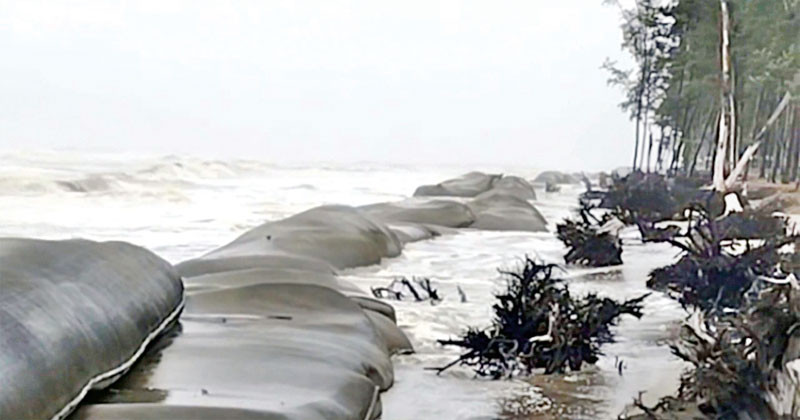
Severe erosion has appeared along Cox’s Bazar beach from Nazirartek to Kolatoli. Over the last few years, vast stretches of sand, including at Labani Point and other areas, have been swallowed by the sea. Although geo-bags have been placed to check the erosion, locals claim these have not produced the desired results.
Meanwhile, the Marine Drive road from Dolphin Circle to Kolatoli’s Belly Hatchery has remained unfinished for a long time. As a result, traffic on the narrow road frequently causes congestion. On the other hand, because Marine Drive remains incomplete, the area experiences tidal flooding, causing tourists to lose interest in Cox’s Bazar’s beach.
Mr. Mafizur Rahman, a businessman at Labani Point, said that over the past five to six years he has watched roughly 400 to 500 feet of sandy beach disappear before his eyes. Where chairs and umbrellas once served tourists, waves now crash.
An on-site inspection found that geo-bags have been damaged by wave action in various places, and sand has shifted from underneath them, creating hollow spaces. This raises fears that the beach will shrink further. Mr. Abdur Rashid, a resident of Nazirartek, said the erosion is gradually advancing toward the pine groves and other structures, and that if this continues, much of the area could be swallowed by the sea. The sea erosion has also affected tourism and beach-dependent businesses.
Businessmen say that during high tide, chairs, umbrellas, and other equipment have to be moved away, disrupting normal business. Marine scientist Mr. Abdul Kaiyum said the risk of erosion is increasing due to climate change as well as the destruction of natural sand dunes and coastal vegetation. He believes geo-bags alone cannot provide a long-term solution.
In his view, alongside geo-bags, the restoration of natural sand dunes, conservation of coastal vegetation such as ipomoea, sea creeper, and screw pine, and adoption of integrated coastal management are all necessary.
Cox’s Bazar Deputy Commissioner Mr. Md. A. Mannan said that work is underway to identify erosion-prone areas and prepare a DPP (Development Project Proforma) for a permanent project. Once government funding is secured, permanent measures will be taken through the project.
Known as the world’s longest natural sea beach, Cox’s Bazar is not only the country’s leading tourist destination but also an important part of the livelihood and economy of thousands of people. Hotels, restaurants, transport, small businesses, and various tourism services have grown up around the beach.
Locals fear that if the sandy beach and dunes continue to shrink this way, it will threaten not only Cox’s Bazar’s natural beauty but also the tourism industry and the livelihoods of thousands of people who depend on the beach. They demand that, instead of temporarily installing geo-bags every year, science-based research, integrated planning, and nature-based long-term initiatives should be undertaken.
In the words of locals, there is no more room to delay protecting Cox’s Bazar’s sea beach, because the sand eroding today could, in the days ahead, extend the erosion toward pine groves, roads, structures, and settlements as well. All concerned are therefore demanding swift, effective, and sustainable measures to protect one of the country’s most important tourism assets.
They also say some people are needlessly citing environmental concerns to block various development projects in Cox’s Bazar, hampering development.
According to informed circles, this erosion could be prevented by linking a sustainable road or town protection embankment with the Marine Drive road from Nazirartek to Kolatoli’s Belly Hatchery.
On this matter, Cox’s Bazar Sadar MP Mr. Lutfur Rahman Kajol said geo-bags are producing no benefit in preventing erosion, and are polluting the sea. He said the government has therefore taken an initiative to build a sustainable road to protect the environment of the area, enhance its beauty, and simultaneously protect the town. Initially, work has begun on a 1.8-kilometre stretch of road from Sugandha Point, funded by JICA.