The Padma Barrage mega project is expected to bring benefits to 163 upazilas in 26 districts. Its implementation will bring about economic transformation and development in 24 southwestern districts of the country, said Water Resources Minister Shahid Uddin Chowdhury Anee. The Padma Barrage could provide solutions for water security, food security and environmentally sustainable development in Bangladesh, said water resources and climate change expert Prof Dr Ainun Nishat. The project is expected to play a transformative role in the environment and agricultural systems. It plans to generate 113MW of hydropower. Roads, power transmission lines and gas pipelines will be installed over the barrage, allowing it to serve as a multipurpose corridor. The project is expected to enable additional annual production of around 2.39 million tonnes of rice and 234,000 tonnes of fish, while creating around 122.5 million person-days of employment.
A New Horizon of Development: Padma Barrage
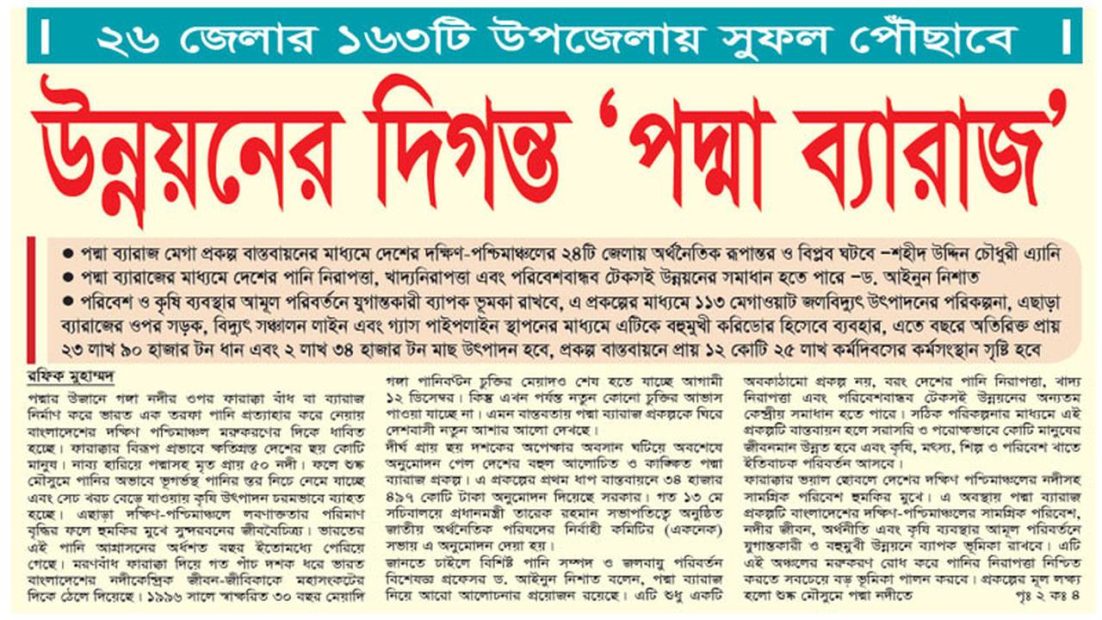
The construction of the Farakka Barrage on the Ganges upstream of the Padma and the withdrawal of water by India have pushed Bangladesh’s southwestern region towards desertification. Around 60 million people in the country have been affected by the adverse impacts of the Farakka Barrage. Nearly 50 rivers, including the Padma, have become almost dead due to the loss of navigability. As a result, groundwater levels are falling during the dry season due to water shortages, while higher irrigation costs are severely affecting agricultural production. Rising salinity in the southwestern region is also threatening the biodiversity of the Sundarbans.
Five decades have already passed since the beginning of the impacts of the Farakka Barrage. The 30-year Ganges Water Sharing Treaty signed in 1996 is also set to expire on December 12. However, there has so far been no indication of a new agreement. Against this backdrop, the Padma Barrage project has raised new hopes among people.
After nearly six decades of waiting, the long-discussed and anticipated Padma Barrage project has finally received approval. The government has approved Tk 34,497 crore for the first phase of the project. The approval was given at an Executive Committee of the National Economic Council (ECNEC) meeting chaired by Prime Minister Tarique Rahman at the Secretariat on May 13.
Prof Dr Ainun Nishat, a prominent water resources and climate change expert, said more discussion is needed on the Padma Barrage. According to him, it is not merely an infrastructure project but could become a central solution for the country’s water security, food security and environmentally sustainable development. If implemented through proper planning, the project could directly and indirectly improve the quality of life of millions of people and bring positive changes to agriculture, fisheries, industry and the environment.
The overall environment of the southwestern region, including its rivers, is under threat due to the impacts of the Farakka Barrage. In this context, the Padma Barrage project is expected to play a transformative and multifaceted role in changing the region’s environment, river systems, economy and agricultural system. It is expected to play a major role in preventing desertification and ensuring water security in the region.
The main objectives of the project are to address water shortages in the Padma during the dry season, revive river systems and improve overall water and environmental management in the southwestern region. According to project documents, around 2.9 billion cubic metres of water will be stored in the barrage to be constructed at Pangsha in Rajbari, which will significantly strengthen water management in the region.
The project is expected to play an important role in improving agriculture and irrigation, controlling salinity, protecting the Sundarbans, addressing navigability problems, increasing fish production, protecting groundwater levels, achieving Sustainable Development Goals (SDGs) and addressing the adverse impacts of climate change.
Water Resources Minister Shahid Uddin Chowdhury Anee said construction of the Padma Barrage is expected to begin between January and March next year. He said implementation of the Padma Barrage mega project would bring economic transformation and development to 24 southwestern districts and open up opportunities for multifaceted development in the region. He said the project would bring an agricultural revolution to the region while increasing electricity and fish production and introducing various opportunities and facilities involving modern technology.
The implementation of the Padma Barrage project is expected to address river navigability problems and help maintain year-round inland water transport, significantly reducing business and trade costs. Under the project, controlled water flows will be ensured in the Ichamati-Mathabhanga, Gorai-Madhumati, Chandana-Barashia, Baral and Ichamati river systems during the dry season from January to May.
At the same time, water supply will be ensured for the Godagari Pump House, the Ganges-Kapotaksha Irrigation Project and the Rooppur Nuclear Power Plant. Irrigation facilities will be ensured for around 2.88 million hectares of agricultural land in various districts, including Kushtia, Faridpur, Jashore, Khulna, Barishal, Pabna and Rajshahi.
The project plans to generate 113MW of hydropower. Roads, power transmission lines and gas pipelines will also be installed over the barrage, allowing it to serve as a multipurpose corridor.
According to the project proposal, the project could enable additional annual production of around 2.39 million tonnes of rice and 234,000 tonnes of fish. Around 47,950 workers will have employment opportunities during construction, while approximately 927,000 direct and indirect jobs will be created.
There are also plans to construct seven satellite cities and modern rural townships on 3,450 acres of land for around 150,000 families. The project could generate economic benefits of around Tk 8,000 crore annually and contribute approximately 0.45 percent to the country’s GDP growth.
At the same time, it is expected to reduce salinity in Satkhira, Khulna and Bagerhat and help restore the ecological balance of the Sundarbans and coastal areas. The project is expected to affect around 37 percent of the country’s total geographical area, with benefits reaching four divisions, 26 districts and 163 upazilas.
Towards the end of the interim government’s tenure, the project was sent to the Planning Commission for approval in January after nearly six decades of discussions. Although an initiative was taken to present it at the ECNEC meeting on January 25, officials advised against hurried approval due to the project’s high cost.
The total cost of the project has been estimated at Tk 50,443.64 crore. However, the Project Evaluation Committee recommended implementing it in phases and proposed approval of Tk 34,497 crore for the first phase.
The initial target is to complete the project by June 2033 with government financing. Under the project, a 2.1-kilometre-long main barrage will be constructed with 78 water discharge passages, 18 downstream control structures, fish passages, a navigation lock and riverbank protection embankments.
Three water intake structures will be constructed for the Gorai, Chandana and Hisna rivers. As part of river management, 135.6 kilometres of the Gorai-Madhumati system and 246.46 kilometres of the Hisna river system will be dredged and re-excavated.
The barrage will create a 165-kilometre-long reservoir without requiring major additional land acquisition. This is expected to create new opportunities for tourism, fisheries and local economic activities. Alongside hydropower generation, there is also potential for solar power generation along both banks of the river in the future.