Mahi’s National Costume on Global Stage Fails to Reflect Bangladesh’s Majority Culture
Bangladesh’s representative Samira Khan Mahi took part in the national costume segment of the 75th Miss Universe competition, aiming to showcase the country’s heritage and culture on the international stage. However, netizens have criticised her outfit and styling, alleging that they reflected the culture of a different religion and a neighbouring country rather than mainstream Bangladeshi culture. The presentation has sparked widespread criticism and debate on social media.
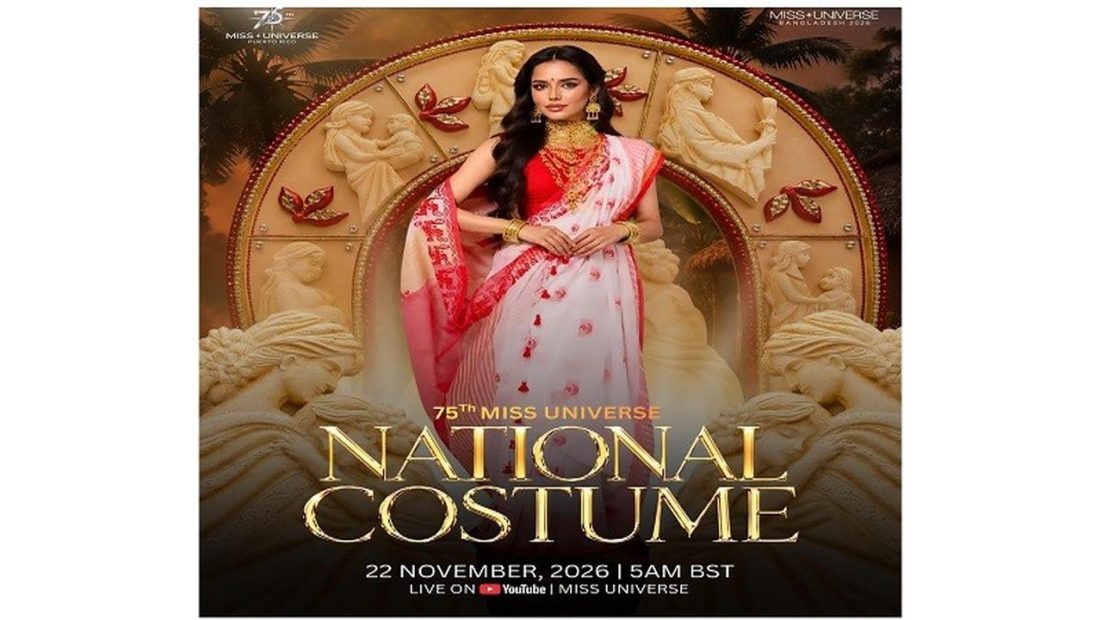
The national costume segment was held at 5:00am Bangladesh time on Sunday (November 22). Ms. Mahi appeared on stage wearing a red-and-white saree and carrying a distinctive circular artwork on her back. The outfit was based on the theme “Motherhood — A Universal Bond of Love”.
Ms. Mahi wore a 16-yard ready-to-wear red-and-white saree made from khadi fabric from Cumilla. The saree was designed by designer Biswajit Majumder. Embroidery and block printing were used to feature the water lily, Bangladesh’s national flower. She also wore gold-coloured jewellery, including a sitahar, a kanthahar, bangles and jhumkas, designed by Tanvi Kabir.
The circular artwork she carried on her back consisted of nine sections made from wood, foam and shola, a lightweight material made from the stem of the shola plant. The artwork depicted different stages of a woman’s life, from childhood to motherhood and old age, when she rests in her daughter’s lap.
Tanjia Zaman Mithila, Miss Universe Bangladesh 2025, reportedly played a significant role in the styling and design of the costume. In a Facebook post, Ms. Mahi described the outfit as a tribute to her mother and motherland. She wrote that every symbol in the costume carried the timeless story of motherhood.
However, Ms. Mahi’s presentation triggered strong reactions among Facebook users soon after it was unveiled. Many argued that the outfit and styling overlooked the traditions and cultural identity of the country’s majority population while representing Bangladesh on the international stage.
A Facebook user named Jim Talukder commented, “The theme is beautiful, but the styling looks like Hindu culture. The saree would have looked better in a different colour.”
Another user, Khadija Islam, criticised the outfit, writing, “It looks like she has gone to represent India. This is clearly the styling of a Durga idol.”
A user named Labannya Prabha questioned the costume’s design, writing, “This look and use of colours represent not mainstream Bangladeshi culture, but rather the culture of a particular religion and a neighbouring country. To represent the country, a more beautiful and traditional look could have been created using the water lily, a farmer’s traditional hat, a gamcha, a handloom saree or Jamdani. The country has not been represented properly through this outfit.”
Another user, Meherin Rahman, expressed frustration, writing, “Last time, it seemed like she was representing Thailand, and this time, it looks like she is representing India.”
Overall, the choice of a controversial design instead of highlighting Bangladesh’s distinctive heritage, Jamdani or the traditional cultural identity of the country’s religious majority has raised questions among viewers and culture-conscious citizens about the taste and sense of responsibility of the organisers and those involved in the presentation.