Why AI cameras fail to control battery run auto rickshaws
Dr. Ajoy Kanti Mondal
I went out for a morning walk recently. I noticed that vehicles at the Hotel Intercontinental crossing in the capital moved in an orderly way, following traffic rules. All vehicles followed the traffic light signals at set intervals.
I saw the same scene at several important crossings, including Kakrail, Motsho Bhaban, Banglamotor, and the road near Karwan Bazar. Traffic is usually light in the early part of the day. Traffic police rarely stand at the signals during these hours, and even when they do, they look far from busy.
That early morning, I found it a bit unusual to see vehicles obeying traffic signals without any police present. This surprised me at first. I soon learned that artificial intelligence cameras had been installed at several important roads and crossings in traffic clogged, chaotic Dhaka.
These cameras have changed the old picture at these roads and crossings. They detect signal violations, stop line crossings, wrong way driving, lane violations, and illegal parking. The system issues cases automatically based on what the AI camera detects.
This has built a habit of following rules among drivers on these roads. Drivers now obey signals mostly out of fear of getting a case. As a result, traffic moves in an orderly way at the crossings where these cameras stand.
I felt glad to see this technical progress in the country. Developed countries have used this kind of technology for a long time. Still, seeing it arrive here gave me hope that we are moving forward, slowly, in technology based public service.
It would be fair to call this one of the clearest visible results of AI technology so far. In the past, red and green lights on Dhaka’s roads carried little weight, and vehicles ignored them freely. Traffic police had to take a very firm stand to manage traffic.
Now, camera monitoring has brought order to vehicle movement on these roads. Drivers stop at the marked lines. At crossings with AI cameras, motorcycle riders, private car drivers, and CNG auto rickshaw drivers all follow the rules more than before.
The biggest success of this technology is the change it has brought to driver behavior in Dhaka. Earlier, a police officer had to stand at every crossing all the time to stop drivers and enforce the rules. Now cameras, software, and a central monitoring system work together to collect violation data.
Among drivers, the fear of getting caught breaking the law now works better than the mere presence of police. The government says AI cameras have started at a few important crossings in the capital, and plans are already underway to expand their use soon. I welcome this initiative from the government.
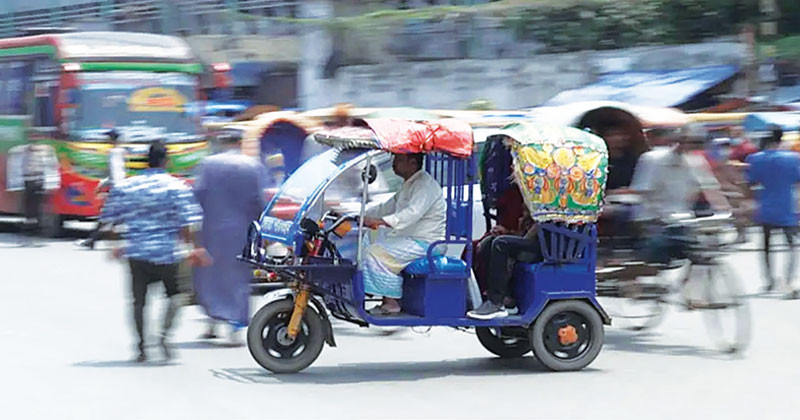
However, one issue stands out inside this success story. Battery run auto rickshaws, easy bikes, and other unregistered vehicles create the biggest problem. These battery run auto rickshaws carry no registration number, their drivers hold no license, and no fitness test exists for these vehicles.
Because of this, these vehicles often ignore every signal and break traffic rules freely, even at crossings with AI cameras. I saw this exact scene on the ground. While all other vehicles stood still at the signal, battery run auto rickshaws slipped through gaps and moved on, breaking every rule.
This raises a question. Are battery run auto rickshaws simply outside the reach of AI cameras. Or can these cameras not stop them at all. People familiar with the system say cameras catch these violations often, but the database holds no registration data for these vehicles, so no effective action follows.
For other vehicles, the camera can match a caught violation with the vehicle’s registration and owner details. This system does not work for battery run auto rickshaws. Since these vehicles have no valid number plate or registration, the system cannot issue a case automatically even after the camera detects them.
Because of this, these vehicles have become a major headache on roads covered by cameras. It is fair to say people will not gain the full benefit of AI cameras until this problem gets solved. Solving it is now an urgent need.
The AI camera database needs full information on all battery run auto rickshaws. Before going further, let us look at how an AI camera actually works. A modern AI camera works through several steps.
First, it records images or video of vehicles moving on the road. Next, it identifies each vehicle in the footage, whether it is a car, bus, motorcycle, rickshaw, or auto rickshaw. It then classifies the vehicle type more precisely, such as private car, bus, truck, motorcycle, CNG, or battery run auto rickshaw.
The system tracks the same vehicle across multiple video frames to trace its path. If the camera can read the number plate clearly, special software reads the letters and numbers on it. It then checks this number against a government database to verify the owner, registration, and other details.
The AI decides whether the vehicle ran a red light, drove the wrong way, entered a restricted zone, or broke any other traffic rule. In the final step, once the system finds full and accurate data and proof, it takes legal action against the vehicle, either automatically or through the authorities. This entire process happens quite fast, which is why the database needs full data on every vehicle.
From my experience living in China, I can say that an automated traffic system brings real comfort to a country’s people. The system encourages citizens to follow traffic rules for smoother movement on the roads. Anyone who breaks the rules faces quick and visible punishment.
This builds strong public awareness about following traffic laws. As soon as a signal changes, vehicles stop in the right direction and pedestrians cross safely and in order. This is a common sight on every road in China.
In big Chinese cities like Beijing, Chengdu, and Shanghai, AI systems analyze traffic in real time and adjust signal timing automatically. Lanes with heavy traffic get longer green light time, while empty lanes get less. This cuts drivers’ waiting time and reduces overall congestion by a good margin.
In most Chinese cities, buses and other public transport communicate directly with traffic infrastructure to keep a steady pace, much like a metro train. AI cameras and multi camera systems catch helmet violations, crosswalk rule breaks, and wrong way driving automatically and in real time.
Today, many busy Chinese cities use AI powered humanoid robots to manage traffic. These robots record violations automatically, in addition to signaling like a human traffic officer. Many crowded cities use police drones and an Intelligent Digital Policing System to collect accident data and license plate information automatically and act right away.
The main reason China’s traffic system runs this smoothly is that every vehicle falls under digital monitoring. This lets the government bring any rule breaking vehicle under the law within moments, whenever it wants.
In short, an effective automated traffic enforcement system needs a unique digital number for every vehicle. This number should hold all the details of that vehicle. If any category of vehicle lacks this system, the automated traffic system will fail there, no matter how advanced the AI camera becomes.
This is exactly what has happened with battery run auto rickshaws. The idea of giving these rickshaws a QR code has come up recently. But applying this QR code system to every battery run rickshaw will be quite challenging.
The biggest challenge in bringing this technology into use is raising driver awareness and bringing a huge number of rickshaws under one central database. Various estimates suggest that 5 million to 8 million battery run auto rickshaws currently run in the country. Registering this many unregistered vehicles at once is no simple task.
Still, bringing rickshaws under digital traffic and AI technology is a timely and forward looking idea. It can play an important role in easing traffic jams and restoring order in public transport in a megacity like Dhaka.
Every legal rickshaw should get a unique QR code and an RFID tag, meaning a Radio Frequency Identification tag. Through this QR code and RFID, AI traffic cameras can easily identify the rickshaw owner, the driver, and the rickshaw’s home area.
Rickshaws should not run on every road in Dhaka. The city should divide areas into specific zones instead. Authorities should ban battery run auto rickshaws on main roads and take proper steps to enforce that ban.
The AI system should automatically watch whether any battery run auto rickshaw leaves its assigned zone and take legal steps when it does. Rickshaws parked haphazardly on roads remain a major cause of traffic jams.
AI powered sensors could help create digital stands for rickshaws. Drivers could get a notification in advance once a stand reaches full capacity. Like ride sharing apps, a central or zonal app could serve rickshaws too.
This would let passengers find a rickshaw easily, and drivers would not need to roam the streets empty and add to congestion. Rule breakers should face fines or restrictions on their license or ID card through a digital system.
Placing AI cameras at only a few crossings cannot solve Dhaka’s traffic jams for good. Road management, vehicle registration, driver licensing, lane management, and law enforcement all need to work together within one system alongside the technology.
The government should take proper steps to expand AI camera coverage on Dhaka’s roads in stages. If the entire road system of the capital comes under this technology, traffic congestion in Dhaka should ease considerably.