
Public Participation Falls in 11-Party Alliance’s Long March
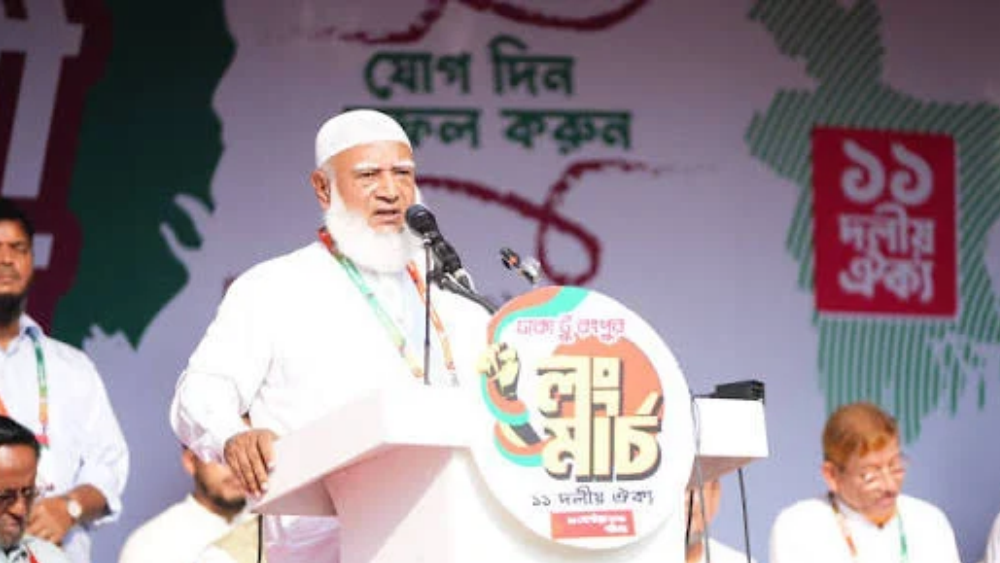
The Jamaat e Islami led 11 party alliance’s long march toward Rangpur, held over its eight point demands, ended on September 19. This came after an earlier long march toward Chattogram on September 5, making it the alliance’s second major program.
In the march toward northern Bangladesh, the opposition alliance added an important regional demand, implementation of the Teesta master plan. But turnout for this program was somewhat lower than before. Around one and a half thousand vehicles had taken part in the Chattogram march, while the Rangpur march saw at most 500 vehicles.
According to Jamuna Bridge toll plaza sources, the main convoy of the long march reached the toll plaza on the bridge’s eastern end, toward Tangail, at 12:32 PM that day. The vehicles then paid toll and began crossing. Convoy vehicles crossed through various lanes toward northern Bangladesh until 12:47 PM.
Some vehicles also crossed separately before the main convoy arrived, and a few more vehicles carrying long march stickers crossed after the main convoy had passed. In total, toll plaza sources said between 430 and 450 vehicles with long march stickers crossed the bridge. Around 50 more vehicles may have crossed without stickers. Altogether, at most 500 vehicles took part in the long march convoy.
Alliance leaders, however, claim the Rangpur bound program drew more public response than the Chattogram march. They say nearly five hundred thousand people gathered at the closing rally at Rangpur Zilla School grounds. They also say vehicles joined the convoy from various districts along the way from Dhaka, pushing the number past a thousand.
But there is a wide gap between the alliance’s claims and the data. According to Jamuna Bridge toll plaza records, the long march convoy had at most five hundred vehicles.
On the earlier route to Chattogram, the convoy crossed the Meghna and Meghna Gumti bridges between Munshiganj and Cumilla on the Dhaka Chattogram highway. The Roads and Highways Department collects toll jointly for these two bridges. Based on its toll collection data, agency sources say a little over 600 vehicles from the 11 party alliance’s long march paid toll and crossed these bridges. Around 200 more vehicles crossed without stickers. In total, the Chattogram bound convoy had more than 800 vehicles.
This data also shows that participation dropped significantly in the second long march compared to the first.
The Rangpur bound long march program held particular importance for the 11 party alliance. In the 13th national parliamentary election, Jamaat won 17 of Rangpur division’s 33 parliamentary seats, and the National Citizen Party, NCP, won 2 seats, giving the alliance 19 seats combined. BNP won 13 seats, and one seat went to an independent candidate. Given this, public engagement in the Rangpur march was expected to be even stronger, but that did not happen.
The long march has also drawn various criticism in political circles. The country’s law and order situation is already fragile. Many believe the Awami League wants to make the situation murkier to pave the way for its return. In this context, many feel that the 11 party alliance’s street program on the highway is indirectly helping the Awami League serve that interest.
Mr. Rashed Khan, the Prime Minister’s political assistant, said Jamaat e Islami is running the long march program to destabilize the country through a secret understanding with the Awami League and India. He said the Awami League wants to create an unstable situation in the country, and that this kind of program by Jamaat gives the Awami League an opening to take to the streets, adding that efforts are underway to heat up the situation.