Bangladesh and China moving toward building a shared future
Md. Shahadat Hossain
China celebrates its National Day every year on October 1. In 2026, the People’s Republic of China will celebrate its 77th founding anniversary. For me, China’s National Day is not just a state celebration. It is a chance to look back at the change and progress of a country whose transformation I have watched closely for almost four decades, and to think about what lessons and possibilities it holds for Bangladesh.
I first went to Beijing in September 1988 as a student of the Chinese language. At that time the institution was called the Beijing Language Institute, now known worldwide as the Beijing Language and Culture University (BLCU). China was then pushing its reform and opening up policy even further. The China I saw then and the China I see today look completely different to me.
Mr. Mao Zedong laid the foundation of the People’s Republic of China. Mr. Deng Xiaoping’s reform and opening up policy opened the door to China’s huge economic potential. That national transformation continued under the leadership of Mr. Jiang Zemin, Mr. Zhu Rongji, Mr. Hu Jintao and Mr. Xi Jinping, through the combined effort of countless Chinese officials, scientists, entrepreneurs, members of the People’s Liberation Army and ordinary citizens.
The results are visible today in China’s infrastructure, manufacturing, high speed rail, ports, digital economy, renewable energy and progress in artificial intelligence. In 2025, China’s GDP grew by 5 percent to more than 140 trillion yuan. Still, numbers alone cannot explain China’s rise.
I have traveled across many parts of China, from Beijing, Shanghai and Shenzhen to Guangzhou, Kunming, Xi’an, Chongqing, Harbin, Hainan and Guizhou. I also had the chance to visit the trading hubs of Yiwu and Wenzhou. I saw the remarkable transformation of cities and infrastructure, and I also saw the ambition, discipline, perseverance and hard work of ordinary Chinese people.
My understanding of China grew deeper through my professional experience. As an interpreter, I got the chance to work with top Chinese leaders including Mr. Jiang Zemin and Mr. Zhu Rongji, and I also had contact with senior figures of China’s People’s Liberation Army (PLA). Later, while serving as a UN military observer and team leader, I worked with peacekeepers from many countries, including Chinese colleagues. These experiences taught me that China’s development is not just a story of economic success. It is also a story of long term planning, human resource development, institutional continuity and national confidence.
A new chapter in Bangladesh-China relations
Bangladesh and China established diplomatic relations in 1975. President Mr. Ziaur Rahman played an important role in developing ties between the two countries. Later governments also contributed to expanding this relationship. In June 2010, then Chinese Vice President Mr. Xi Jinping visited Bangladesh. In October 2016, he made a historic state visit to Bangladesh as President of China. Over the years, cooperation between the two countries has grown in trade, infrastructure, investment, defense, education and people to people ties.
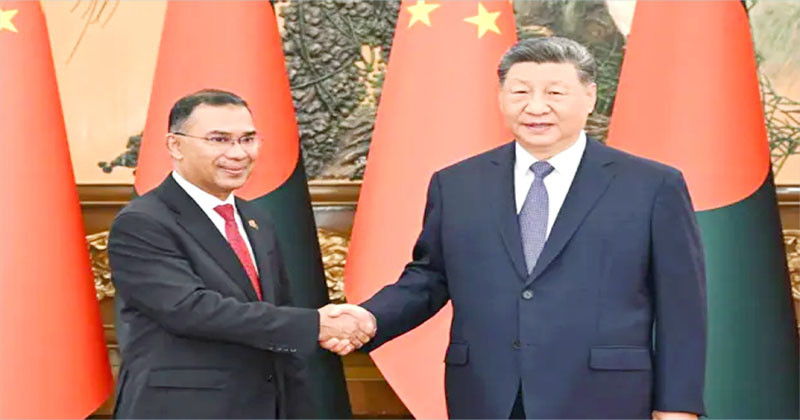
June 26, 2026, marked the start of an important new chapter in Bangladesh-China relations. On that day in Beijing, Chinese President Mr. Xi Jinping met with Bangladesh’s Prime Minister Mr. Tarique Rahman. The two leaders jointly announced the decision to build a Bangladesh-China community with a shared future for the new era.
The joint declaration between the two countries covered cooperation in connectivity, trade, industry and supply chains, green development, digital technology, artificial intelligence, agriculture, health, education, technical training and defense. It also gave importance to ports, water management and stronger people to people ties. The key question for Bangladesh now is how this new framework will bring real benefits to the lives of ordinary Bangladeshis.
Making mutually beneficial cooperation visible
Mutually beneficial cooperation should mean creating more opportunities for Bangladeshis in education, employment, travel, business and trade, healthcare, skills development and participation in technology driven growth. To reach this goal, Bangladesh should further expand direct air links with China, build stronger sea connectivity, and, when conditions allow, work to establish an overland link between Bangladesh and southwestern China through Myanmar.
Bangladesh has long dreamed of faster and more effective connectivity between Dhaka and the headquarters of the country’s eight divisions. China’s experience in developing high speed rail could prove valuable here. Still, the story of development cannot center on infrastructure alone. The biggest investment must be in people.
China’s cooperation in training Bangladeshi teachers to teach the Chinese language in the country’s schools, colleges and technical institutions could build a linguistic and professional bridge for a new generation. In this regard, a proposal could be considered to set up a large Bangladesh-China technical and Chinese language training center with residential facilities. Such a center could offer Chinese language education alongside training in technical skills, technology, industrial safety and entrepreneurship.
Another important initiative could be a Bangladesh-China Research and Development Center (CBRDC). Bringing together government, universities, research institutions, think tanks, business communities and technical experts, this center could work on important areas such as water management, agriculture, connectivity, technology, health, artificial intelligence, climate change and regional cooperation.
A Bangladesh-China complex outside Dhaka could also be considered. It could serve as a permanent platform for business, exhibitions, banking, tourism, culture, sports and people to people exchange. These are not simply infrastructure proposals. They are investments in the relationship between the two countries.
From friendship to a path of shared development
Bangladesh needs China’s investment, technology, skills and market access. At the same time, a stable, connected and economically dynamic Bangladesh, sitting at an important junction of South and Southeast Asia, can also be a valuable partner for China. So the next stage of this relationship should move beyond project based cooperation alone, toward joint development, knowledge sharing and technology transfer.
A genuine mutually beneficial partnership should create jobs for Bangladeshis, strengthen local institutions and build local capacity. At the same time, it should open new opportunities for Chinese businesses and investors in Bangladesh’s growing market. Prime Minister Mr. Tarique Rahman has invited Chinese President Mr. Xi Jinping to visit Bangladesh. A visit by President Mr. Xi Jinping at a mutually convenient time could give strong momentum to this new stage of bilateral relations.
I first saw China in 1988, when the country’s transformation was only just gathering deeper momentum. Today, as the People’s Republic of China marks its 77th founding anniversary, Bangladesh has the chance to learn from China’s experience while strengthening its own path of development.
The idea of a “community with a shared future” should not remain just diplomatic language. It should mean classrooms that create new opportunities, technology that raises productivity, businesses that create jobs, infrastructure that brings people closer together, and exchanges that help Bangladeshis and Chinese people understand each other better. From witnessing China’s rise to building a shared future together, this should be the next chapter of Bangladesh-China relations.