Cultivable Land Could Drive an Agricultural Revolution in the National Economy
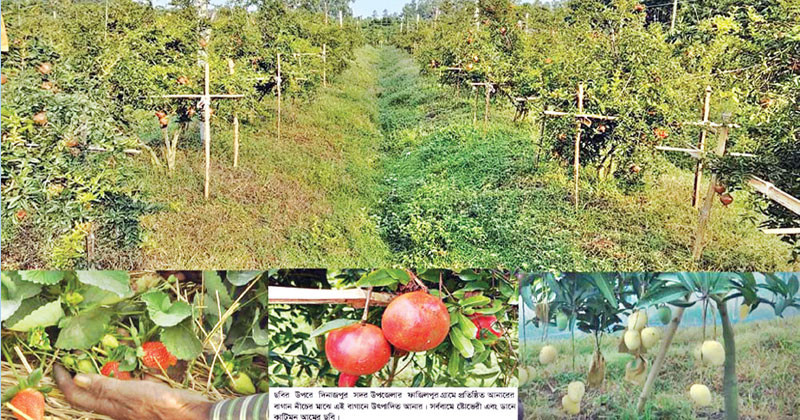
In the morning, they work in the fields wearing lungis, T-shirts or tracksuits. In the afternoon, they move around with their families in modern clothes, riding FZ motorcycles or travelling by car. This picture is now common among young women and men up to the age of 40 in rural areas. Even more surprising is that many of them do not own land. They lease land from landowners, known locally as joddars, on long-term agreements and develop modern crop farms. As a result, fewer people are rushing to industrial areas in search of jobs. Instead, industrial owners or their representatives are coming to rural areas.
Farmers’ self-employment activities have forced industrial entrepreneurs to turn towards villages. This has become possible because more educated unemployed youths are joining agriculture. With modern farming techniques and better use of time, an agricultural revolution has taken place in the agriculture-dependent Dinajpur region. Just like ATMs operated by commercial banks, pieces of farmland in rural areas have turned into “agriculture booths.” Instead of using a card, farmers go to their fields with sickles and machetes, harvest vegetables and earn cash. In this way, farmers are earning cash not only from rice, wheat and maize but also from early varieties of crops.
A visible example is that markets are already full of winter vegetables even though winter is still one and a half to two months away. At the same time, green IRRI-Boro rice plants are spreading across fields as far as the eye can see. Prime Minister Tarique Rahman’s statement, “If farmers survive, the country will survive,” is now being understood by farmers with little formal education as well as their educated children. As a result, agriculture is turning into an industry and farmland into factories. What is now needed is government support and cooperation. For this, close monitoring is needed not only from the agriculture department but also from economic and industry-related government offices at the field level.
The agriculture-dependent Dinajpur region is seeing bumper production of IRRI-Boro rice, Aman rice and maize. Farmers are happy as they are receiving fair prices. However, marginal farmers and their dependants do not want to remain dependent on two or three specific crops a year. Their livelihoods had become seasonal because they depended on annual crop cycles. Now, instead of relying on yearly income, farmers and their semi-educated and highly educated children or dependants are moving towards a system where they can earn cash every week, going a step beyond receiving a salary every month.
By producing early vegetables and different varieties of crops according to the season, they have ensured daily income. Alongside green rice plants across the fields, cauliflower, beans, tomatoes, okra, leafy vegetables and many other known and lesser-known vegetables are also being cultivated. These crops are working like commercial banks for rural people. Whenever a family needs money, they can go to the field, harvest as little as five kilograms of cauliflower, tomatoes or other crops and sell them to get the money they need. Like an ATM booth, money comes out of the land when they use their sickles and machetes.
Md. Mostafizur Rahman, deputy director (training) of the Department of Agricultural Extension in Dinajpur, told Daily Inqilab that Dinajpur, known as a food-grain hub, is now busy with early winter vegetable cultivation using modern methods. He said farmers are earning higher profits by marketing early varieties of winter vegetables. Moslem Uddin, a farmer from Nashipur village in Sadar upazila, said he started cultivating early varieties of vegetables on his 45 decimals of land this year in three sections. He has cultivated early varieties of cauliflower, cabbage, Kathali eggplant and tomatoes. He said the land has been cultivated with a drainage system, allowing rainwater to drain easily. He said, “I have already started selling early varieties of cauliflower, eggplant and radish in the market. I am also getting good prices.”
A visit to Shibnagar, Aladipur, Khayerbari, Daulatpur and other areas of Fulbari upazila showed that farmers have already started cultivating early winter vegetables. Farmers are busy planting and caring for seedlings of beans, radish, cauliflower, cabbage, eggplant, bitter gourd, bottle gourd, red amaranth and other vegetables.
Surat Ali, a farmer from Aladipur village in Fulbari upazila, said he has cultivated an early variety of cauliflower on 30 decimals of land this year. He said he has already spent Tk 18,000 and the total cost will reach around Tk 25,000 by the time the crop is marketed.
Farmer Mr. Harun hopes to harvest the cauliflower for the market within 15 to 20 days. He said, “Last year, I sold cauliflower worth Tk 130,000 from this same land. I am hoping for something good this year. Along with cauliflower, I have also cultivated beans and cucumber. The vegetable yield has also been good.”
Mominul’s Success with Katimon Mango
The story of Mr. Mominul, who became a lakhpati by cultivating Katimon mangoes in the Mangalpur area of Biral upazila, is somewhat different. He is a government employee by profession and does not own any land. He leased five acres of land for 15 years. He paid Tk 200,000 in advance as the lease money and planted Katimon mango trees across the entire area. He has to pay the lease money every year. The trees began producing fruit after four years. In the first year, the entire crop was almost consumed by visitors who came to see the new variety of mango. Even so, the amount he managed to sell covered the cultivation and maintenance costs.
After that, he did not have to look back. Within the next three years, or seven years in total, he recovered the cost of the trees and other expenses. He still has eight years remaining on the lease. Mr. Mominul, an ordinary landless government employee, is now known in the district as “Katimon Mominul.” His mangoes have been exported to several European countries. Mainly Bangladeshi expatriates involved in business are taking his mangoes abroad. He said, “I do not go anywhere. Brokers and big businessmen from Dhaka and different areas come to me. They pay in advance and book the mangoes produced in my orchard.”
Asked about his success, he told Daily Inqilab that it had become impossible for his salary to cover even the educational expenses of his children. He said, “I received advice from a friend about mango orchards and vegetable cultivation. But I did not have my own land. I looked for landowners who did not cultivate their own land. They leased the land to local marginal farmers for cultivation under annual contracts. When I approached them, they agreed. However, there was a condition that I would have to return the land along with the mango trees after the contract ended. That means the landowner would become the owner of the mango orchard planted by me on the land.”
He added, “When I discussed the matter with my friend who advised me, he explained that I would recover the entire investment within 10 years. For the remaining five years, I would only count the profits. However, this required training in the relevant cultivation method. Following his advice, I received short-term training with the assistance of the agriculture department on planting and caring for Katimon mango trees. That is how I became Katimon Mominul. Many people, both big and small, now come to me for advice. Not only Katimon mangoes, but dragon fruit, pomegranates and various vegetables are also being produced on contract-leased land.”
Md. Afzal Hossain, deputy director of the Department of Agricultural Extension in Dinajpur, said the target for vegetable cultivation in the district’s 13 upazilas this season has been set at 26,650 hectares. Of this, the target for early vegetable cultivation is 7,150 hectares. In addition, the target for potato cultivation this year has been set at 36,250 hectares. The target for Aman rice cultivation in Dinajpur district has been set at 539,000 hectares. Of this, the cultivation target is around 272,000 hectares in Dinajpur alone, 137,000 hectares in Thakurgaon and 130,000 hectares in Panchagarh.