Pakistan Govt Cracks Down on Long March for Imran Khan’s Release
The Shehbaz Sharif-led government in Pakistan has implemented stringent measures to block a planned long march toward Islamabad on Sunday, September 27. Organised by the opposition Pakistan Tehreek-e-Insaf (PTI) party, the demonstration demands the immediate release of jailed former Prime Minister Imran Khan. To prevent protesters from gathering in the national capital, security forces have blockaded major arterial routes, effectively sealing off key access points and disrupting movement across the region.
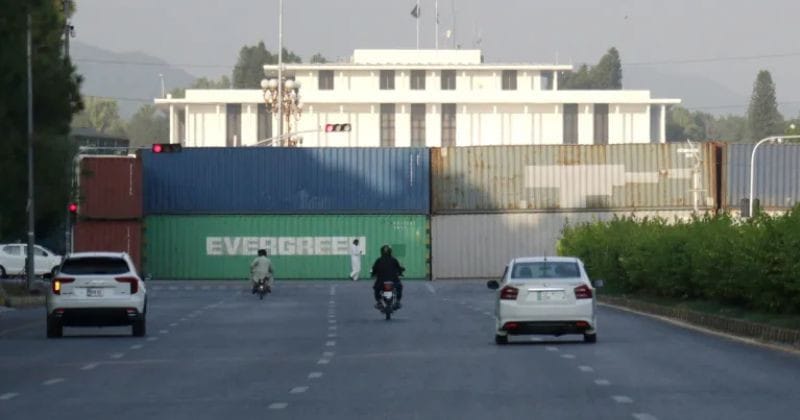
Authorities have indefinitely closed primary highways connecting Islamabad with Khyber Pakhtunkhwa province, including the Peshawar Motorway, Hazara Motorway, Dera Ismail Khan Road, and the Grand Trunk Road at Attock. To reinforce these blockades, over 2,000 heavy shipping containers, filled with sand and stone and welded together, have been positioned strategically. Additionally, around 19,000 police officers from Punjab and Sindh have been deployed, with several local educational institutions closed to accommodate their lodging.
Political observers note that the administration is treating this routine opposition protest as an existential challenge to its authority. Lahore-based political analyst Mr. Habib Akram stated, ‘This move by the government is not merely proof of their fear of the opposition, but rather they have turned this protest into a battle for their own survival.’ Alongside the physical blockades, state agencies have intensified clampdowns on opposition figures, arresting Mr. Imran Khan’s three elderly sisters and at least six PTI lawmakers under the Maintenance of Public Order ordinance.
Conversely, the Pakistani government maintains that these proactive measures are necessary to uphold law and order amid broader national security concerns. Officials point to recent militant attacks in Khyber Pakhtunkhwa that resulted in casualties among police and military personnel as justification for the heightened security state. Meanwhile, opposition representatives continue to accuse the ruling coalition of using state apparatus and repressive tactics to suppress public grievances and stifle democratic political expression.