
Order Placed for 11 Boeing Aircraft
- PM meets Pezeshkian, discusses Muslim unity and trade ties
- UN chief Guterres outlines five proposals to combat climate change
Prime Minister Mr. Tarique Rahman is having a busy schedule in New York while attending the United Nations General Assembly session. Along with joining the main session, he has held several important bilateral meetings on the sidelines.
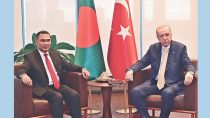
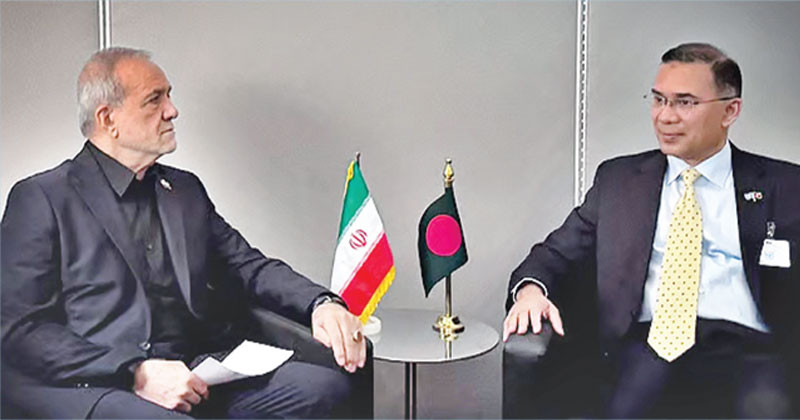
He met with Iranian President Mr. Masoud Pezeshkian. The two leaders held positive discussions on the current geopolitical situation in the Middle East and on strengthening unity and trade ties within the Muslim world. Prime Minister Mr. Rahman earlier held meetings with the President of Turkey and the heads of state of Bhutan, Haiti, and the Maldives.
Under a trade agreement with the United States, Biman Bangladesh Airlines has placed an order to purchase 11 Boeing aircraft. The order includes five Boeing 787 10 Dreamliners and six 737 8 jets.
The 81st session of the UN General Assembly in New York marks a new chapter in Bangladesh’s diplomatic history. Prime Minister Mr. Rahman’s participation on the world stage was not merely ceremonial. It served as a strategic opportunity to present a new, democratic, and progressive Bangladesh to the world.
Prime Minister Mr. Rahman has described Bangladesh as one of the most climate vulnerable countries in the world. He said this vulnerability is putting the country’s food security at risk. He called on the international community to take collective rather than individual action to address the crisis.
He made this appeal at a high level meeting on climate action and just transition, organized by UN Secretary General Mr. Antonio Guterres on Wednesday local time. Earlier at the UN session, Prime Minister Mr. Rahman had presented five proposals for the dignified repatriation of Rohingya refugees. He also delivered a speech in Bengali at the UN session on Thursday afternoon local time.
Five Proposals on Climate Change
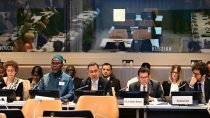
A high level meeting was held on Wednesday at the Trusteeship Council of UN headquarters at the call of Secretary General Mr. Guterres. The meeting focused on strengthening international cooperation to address climate impacts, ensure climate justice, and achieve a sustainable and fair energy transition. Prime Minister Mr. Rahman presented his government’s action plans, including tree plantation programs and canal excavation projects.
At the event, the Prime Minister said Bangladesh contributes less than 0.5 percent of global greenhouse gas emissions, yet remains one of the most climate vulnerable countries. He said 12 to 18 percent of coastal areas could go underwater by the end of this century due to rising sea levels, affecting the livelihoods of millions.
He said climate related damage costs Bangladesh about 1 percent of its GDP each year, and food security is under serious threat. He added that Bangladesh aims to meet 20 percent of its electricity demand from renewable energy by 2030.
Mr. Rahman said Bangladesh is expanding green industries, including jute products, eco friendly transport, waste to energy production, and circular economy initiatives. The country is also working to build a national carbon market. He stressed that Bangladesh cannot achieve these goals alone and called for collective action based on the principle of common but differentiated responsibilities.
The Prime Minister then presented five proposals to address the crisis. These call for reducing global greenhouse gas emissions to keep global warming within the 1.5 degree Celsius limit set by the Paris Agreement. They also call for predictable and accessible adaptation financing for climate vulnerable countries.
The proposals further call for fair access to climate smart technology, expansion of renewable energy through financing and technology transfer, and full implementation of the loss and damage fund with regular replenishment.
Mr. Rahman said Bangladesh has allocated about 3.19 billion US dollars for climate adaptation in this year’s budget, but remains at risk of major losses without international support. He said the country plans to plant 250 million trees over the next five years and is excavating about 20,000 kilometers of rivers and canals for water conservation, flood risk reduction, and groundwater recharge. He also mentioned ongoing work on the master plans for the Padma Barrage and Teesta Barrage.
Representatives of various governments, heads of state, international organizations, multilateral development banks, businesses, and civil society took part in this high level UN meeting.
Agreement to Purchase 11 Boeing Aircraft
As part of its fleet modernization and expansion plan, Biman Bangladesh Airlines has ordered 11 more Boeing aircraft, including five Boeing 787 10 Dreamliners and six 737 8 jets. This brings Biman’s total orders with Boeing this year to 25 aircraft, following an earlier order of 14 Boeing 787 Dreamliner and 737 MAX aircraft.
The new agreement was announced on the sidelines of the UN General Assembly in New York on Wednesday, in the presence of senior officials from Bangladesh and the United States.
Biman Chairman Mr. Rumee A Hossain said the additional aircraft are being purchased to modernize the fleet and expand the airline’s network. In a statement released by Boeing, he said the agreement marks an important step in renewing Biman’s fleet and expanding its network, based on the airline’s own fleet planning needs. He said the flag carrier aims to expand its network and capacity to meet the travel needs of Bangladeshi passengers, expatriates, business travelers, and the tourism sector.
The signing ceremony was attended by Bangladesh’s Minister of Civil Aviation and Tourism Mr. M Rashiduzzaman Millat, State Minister for Foreign Affairs Mr. Humayun Kabir, Chairman of the Investment Development Authority Mr. Chowdhury Ashik Mahmud Bin Harun, and senior US officials including Commerce Secretary Mr. Howard Lutnick.
Prime Minister’s Adviser and Spokesperson Mr. Mahdi Amin said the government signed an important agreement with US aircraft maker Boeing, under which Biman Bangladesh Airlines will purchase 11 more Boeing aircraft. He said senior US government representatives present included Commerce Secretary Mr. Howard Lutnick, Deputy Secretary of State Mr. Christopher Landau, Under Secretary of Commerce Mr. William Kimmitt, and Assistant Secretary of State for South and Central Asia Mr. Paul Kapur.
Mr. Amin said Bangladesh is purchasing aircraft based on actual demand. He said the country’s aviation sector is expanding with plans for new routes, which requires additional aircraft. He added that the Boeing delegation later held a courtesy meeting with the Prime Minister.
Meeting with Iranian President
On the sidelines of the 81st UN General Assembly session, Iranian President Mr. Pezeshkian held talks with Prime Minister Mr. Rahman. The two leaders had positive discussions on regional geopolitics and on strengthening Muslim world unity and trade relations.
State Minister for Foreign Affairs Mr. Kabir told a briefing in New York that the two leaders met on Wednesday. He said the meeting covered the Middle East conflict, regional stability, the safety of expatriate Bangladeshis, remittances, sea transport of Bangladeshi goods, and concerns over a potential energy crisis.
Mr. Kabir said the presence of Iranian President Mr. Pezeshkian at a neutral forum like the UN is significant. He noted that about 8 million Bangladeshi workers are employed in Middle Eastern countries, and the ongoing conflict there is affecting their remittances, which is a serious concern for Bangladesh. He said Bangladeshi cargo ships are currently stranded in the Strait of Hormuz.
He added that Bangladesh has requested a swift diplomatic resolution to the conflict so that ships stranded in Hormuz can resume movement, and to avoid a deep energy crisis.
Meeting with Gates Foundation CEO
Gates Foundation CEO Mr. Mark Suzman held a courtesy meeting with Prime Minister Mr. Rahman on Wednesday morning local time at the Prime Minister’s residence in New York. According to the Prime Minister’s press wing, the meeting covered public health, child health, immunization programs, affordable vaccines, preventive healthcare, and modernization of the overall health system.
The discussion also covered expanding healthcare services at the upazila and district levels, hiring and training 100,000 health workers, creating international employment opportunities for these trained workers, and building an AI integrated digital public health care system.
At a press briefing held Wednesday evening at 7 PM New York time in the lobby of the Hyatt Grand Central New York hotel, officials shared details of the day’s events. Speakers included Prime Minister’s Office spokesperson and adviser Mr. Mahdi Amin, State Minister Mr. Humayun Kabir, Ms. Shama Obaid Islam, Press Secretary Mr. Saleh Shibli, and Additional Press Secretary Mr. Atiqur Rahman Rumon.
Mr. Amin outlined the Prime Minister’s schedule, noting that on the second day of the visit, he took part in multiple meetings covering health, agriculture, the Rohingya crisis, climate change, regional stability, and bilateral relations.
Mr. Amin said the meeting with the Gates Foundation also covered expanding cooperation in health and agriculture, using technology for farmers, boosting agricultural productivity, and building vaccine production capacity in Bangladesh.
He said Bangladesh currently hosts more than 1.2 million Rohingya refugees, and reduced international support for them is increasing pressure on the country. He said greater international cooperation is needed.
Mr. Amin also said the Prime Minister held a meeting with the Prime Minister of Croatia, discussing ways to strengthen bilateral ties in trade, investment, and migration.
He confirmed that the Prime Minister also met with the Iranian President. On climate change, he said the Prime Minister presented Bangladesh’s position on securing financing for climate vulnerable countries. He mentioned plans to reduce carbon emissions through river and canal excavation, tree plantation, increased use of renewable and solar energy, and adoption of electric vehicles.
Asked about the roles of China and India in Rohingya repatriation, Mr. Amin said Bangladesh is engaging with relevant countries and partners at both bilateral and multilateral levels. He said China remains an important development partner for Bangladesh, and high level discussions with China on resolving the Rohingya crisis are ongoing. He added that channels of communication with Myanmar and all relevant parties remain open.