Rivers Choked by Encroachment, Pollution: Over 100 Face Existential Crisis
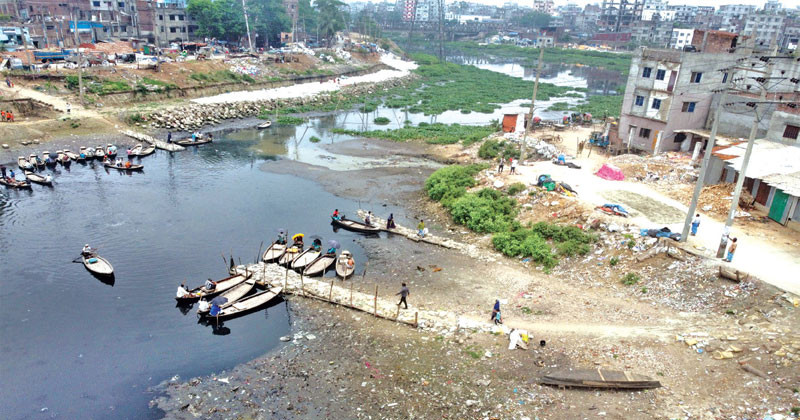
There is a well known Bengali proverb that says the judge’s cow exists in the ledger but not in the cowshed. It means something recorded on paper that has no existence in reality. The rivers of Bangladesh now face the same fate. Many rivers exist by name in official records, yet they no longer exist on the ground.
In this land of rivers, rivers are vanishing. The government’s list now counts 1,415 rivers across the country. Yet at least two thirds of these rivers cannot actually be found in reality. Some have been grabbed, some polluted, and some filled in and turned into canals, drains or farmland.
Even the rivers that still survive are struggling under grabbing, pollution and water shortages. More than a hundred rivers across the country now face an existential crisis. Because of the adverse effects of the Farakka barrage, more than 50 rivers in the northern and southwestern regions of Bangladesh nearly dry up in the dry season.
Deputy Environment Minister Mr. Sheikh Faridul Islam said that Farakka’s impact has caused about 54 rivers in the southwestern region to silt up. Despite years of meetings, plans and projects to protect rivers, their death cannot be stopped. World Rivers Day was observed yesterday amid this reality.
This year’s theme for World Rivers Day is “No forest, no river, no water, no life.” The day is observed every year to protect rivers and raise public awareness, but in practice, this goal is barely reflected. Bangladesh has observed the day since 2010, yet the visible effort put into observing the day far outweighs any effective action taken to rescue the rivers.
At a discussion event held for World Rivers Day, Water Resources Minister Mr. Mohammad Shahiduddin Chowdhury Annie called for the government, the public, researchers and environmentalists to work together to save rivers. He said that beyond stopping grabbing and pollution, the natural flow and biodiversity of rivers must also be protected.
He added that rivers must be seen not merely as channels for water flow, but as a vital part of the country’s environment, economy and people’s livelihoods. He said there is no alternative to conserving rivers and wetlands to face the impact of climate change, and that sustainable, climate resilient development plans must be built around rivers. He said the government is taking the necessary steps to keep rivers safe and alive for current and future generations.
The Bangladesh Water Development Board’s 2011 book on the country’s rivers officially listed 405 rivers. In 2023, the National River Conservation Commission published a list of 1,008 rivers. By 2025, under the interim government, that number rose to 1,415. Yet there is no reliable count of how many of these listed rivers actually flow, and how many are dead or nearly dead. Even after the new list was made, no visible effort has been seen to rescue the dying rivers.
The previous interim government took office and showed considerable activity in protecting the environment. It scrapped the old river list and created a new one, and the number of rivers on paper grew by several hundred. At that time, officials loudly announced plans to rescue at least 64 rivers across 64 districts, yet not a single river was actually rescued. As a result, the country’s rivers, like paper tigers, have remained paper rivers.
Government agencies also show major inconsistencies in their data on river length. A 2005 document from the Water Development Board lists the Buriganga’s length as 45 kilometers, but a 2011 record shows it as only 29 kilometers. In other words, 16 kilometers of the river have vanished even in official records. The Dhaka district administration lists the Shitalakshya’s length as 108 kilometers, while the river commission lists it as 109 kilometers. For the Dhaleshwari, the district administration’s figure is 292 kilometers, while the river commission’s figure is 330 kilometers. The Turag’s length also differs between the two agencies, at 62 and 65 kilometers.
River researcher Mr. Sheikh Rokon said that shortening a river’s length on paper effectively cements its grabbing. He said that roughly 16 kilometers of the Buriganga, from Washpur to Hazratpur, has simply been dropped from official records. Over the past two decades, eight projects worth at least 32.94 billion taka were carried out to save the Buriganga, yet no visible benefit has appeared.
The list of river grabbers has also seen mysterious changes. In 2019, the number of grabbers stood at 57,390. Following an eviction drive that removed 18,579 grabbers, the same year’s annual report showed the number of grabbers rising to 63,249. According to the river commission, that year’s eviction drive halted after clearing 32 percent of the grabbed land. After that, without any major eviction operation, the number of grabbers fell to 21,988 by December 2025. Even though the list has shrunk, grabbing and re-grabbing can still be seen on the ground along Dhaka’s Buriganga, Turag and Balu rivers.
This is not only the case for the Buriganga. The same picture repeats across the country. Parts of the once fast flowing Tepa river in Dinajpur have turned into sandbars now used for farming. In Habiganj, many stretches of the old Khoai river have been filled in and built over, and grabbing has returned even to areas that were once cleared. In Sreemangal, Moulvibazar, the Gopla river has shifted course after filling with sand and silt, and its former riverbed now holds fish farms, homes and farmland.
In Narayanganj, industrial waste has changed the color and smell of the water in the Meghna and Marikhali rivers, causing fish to float to the surface. The four districts of Mymensingh division list 179 rivers in their administrative records, including 94 in Netrokona, 59 in Mymensingh, 15 in Jamalpur and 11 in Sherpur. Yet a large portion of these rivers stay dry for nearly eight months of the year, and farming takes place on the riverbed during the dry season. These endangered rivers also lack a clear official list.
According to government figures, the Bangladesh Inland Water Transport Authority has removed 28,325 illegal structures since 2010 and reclaimed 1,244.22 acres of riverbank. Twenty seven ministries and departments, including the National River Conservation Commission, are involved in preventing river grabbing, pollution and flow obstruction. Even so, the 28 rivers that flow through cities suffer the most from grabbing and pollution.
Experts say that protecting rivers requires more than dredging or eviction drives alone. It requires an accurate official record of each river’s flow, boundary and existence. They say there is no benefit in adding more rivers to the list on paper. What matters is saving the rivers that actually exist.
The fierce impact of the Farakka barrage has put the entire environment of the southwestern region, including its rivers, under threat. In this context, the Padma Barrage project is expected to play a major and transformative role in reshaping the overall environment, river life, economy and agriculture of southwestern Bangladesh. It is expected to play the largest role in halting desertification in the region and ensuring water security.
The project’s main goals are to address the water shortage in the Padma river during the dry season, revive the river system, and improve overall water and environmental management in the southwestern region. According to project documents, the barrage being built at Pangsha in Rajbari will store about 2.9 billion cubic meters of water, which will greatly strengthen water management in the southwestern region.
Once completed, the project is expected to play a vital role in improving agriculture and irrigation in the southwestern region, controlling salinity, protecting the Sundarbans, resolving river navigability problems, supporting fish farming, protecting groundwater levels, achieving the Sustainable Development Goals, and countering the harmful effects of climate change.
Professor Dr. Ainun Nishat, an expert on water resources and climate change, said the country’s rivers are effectively orphaned. He said the government keeps making one promise after another to protect rivers, but in reality, river grabbing, pollution and shrinkage have not stopped. He noted that although the Supreme Court declared rivers to be living entities, that ruling has not been put into real practice. He said a living being has the right to survive in good health, and rivers deserve that same right. But in Bangladesh, after declaring rivers as living entities, the matter has effectively stopped right there.