Bangladesh Enters a New Chapter in Global Affairs
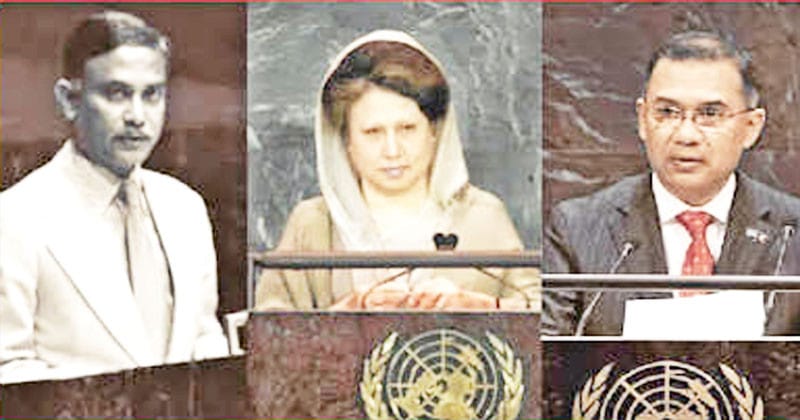
The newly formed BNP government led by Prime Minister Tarique Rahman, assuming power through a free and fair 13th Parliamentary election following the July Uprising, finds itself in a distinct position defined by unprecedented public expectations. Having navigated its initial 180-day milestone, the administration has placed social safety nets and marginal welfare programs at the forefront of its domestic policy framework. The rapid rollout of the ‘Family Card’ for low-income households within a month of taking office, alongside the introduction of the ‘Farmers Card’, has been received as an innovative approach to direct citizen welfare. Further plans covering universal healthcare through E-Health Cards, Sports Cards, and specialized IDs for freelancers remain under active development.
Addressing the 81st Session of the United Nations General Assembly (UNGA), PM Tarique Rahman outlined his administration’s broader strategic vision, key achievements, and future economic roadmap. During his address, he unveiled plans for an integrated ‘Universal Card’ designed to streamline all proposed welfare services under a single unified digital infrastructure. Furthermore, PM Tarique Rahman articulated a strategic framework and timeline aimed at transitioning Bangladesh’s economy toward a trillion-dollar horizon. His address signaled a clear departure from past practices, emphasizing a disciplined, pragmatic model of executive conduct and transparent economic planning.
This strategic vision stands in stark contrast to the speculative economic narratives that characterized the ousted regime led by Ms. Sheikh Hasina. The former administration left the national economy burdened with heavy foreign debt after executing capital-intensive mega-projects that were widely marred by allegations of financial irregularities, commission trade, and severe economic distress. Rejection of that grandeur, PM Tarique Rahman has adopted an unostentatious leadership style, conveying a new model of governance centered on restraint, economic realism, and fiscal accountability.
The 81st UNGA session also marked a historical diplomatic milestone as Bangladeshi Foreign Minister Dr. Khalilur Rahman presided over the session, securing the presidency after winning a competitive diplomatic election within the Asia-Pacific regional rotation. Dr. Khalilur Rahman won the position by securing 99 votes against 91 for Cyprus’s nominee, Andreas Kakouris, reflecting Bangladesh’s growing international standing and an assertive, independent foreign policy stance following the July Uprising.
The UN gathering featured key addresses by both Dr. Muhammad Yunus and PM Tarique Rahman, signaling a prominent international presence for the nation on the global stage. Concurrently, the appointment of Barrister Zaima Rahman as a Legal Officer in the Office of the President of the General Assembly highlighted a professional transition for a new generation of Bangladeshi political leadership. This professional progression contrasts sharply with the political scrutiny and legal challenges currently confronting family members associated with the previous regime regarding past governance and financial conduct.
Despite these foreign policy achievements, establishing robust internal security and social stability remains an ongoing domestic challenge two years after the July Uprising. Severe structural institutional weaknesses, inherited from past political interference and the systemic politicization of law enforcement agencies over the prior decade, left core public institutions fractured. This institutional breakdown was clearly underscored by the temporary collapse of public policing immediately following the August 5 transition, which required civil society and student volunteers to temporarily maintain public order.
Moving forward, long-term national stability depends heavily on transitioning from past impunity to systemic institutional justice and achieving comprehensive rule of law. For the current administration, preventing political patronage, financial extortion, and corruption within party ranks remains paramount to preserving its democratic mandate. Restoring full public trust ultimately requires unwavering accountability across government bodies and law enforcement agencies, ensuring that structural reforms successfully transform inherited institutional vulnerabilities into sustainable governance.