A Muddled Opening for the Asian Games
- Empty Galleries, A Shortage of Grandeur
Jahed Khokon, from Nagoya, Japan
All preparations had finished, and only the formal opening remained, the report begins. That opening took place yesterday. At 6 PM local time in Japan, the Aichi Nagoya Asian Games opened at Nagoya City Mizuho Park Athletic Stadium with a torch lighting, a display of participating nations’ flags, cultural performances, and the athletes’ march past.
The competition for Asian supremacy will run across various venues in Japan for the next 16 days, the report notes, with new sporting stories to be written alongside the medals. However, behind the grandeur of the opening ceremony, another picture stood out: empty galleries. Several thousand seats sat empty in a stadium built to hold 30,000 spectators, and many seats in the media tribune also appeared vacant.
The report states that recent Asian Games opening ceremonies have rarely shown this kind of scene, yet it appeared at the Aichi Nagoya Games. It notes that ticket demand and spectator turnout usually rank among an opening ceremony’s main attractions, but that enthusiasm was clearly lacking at Nagoya City Mizuho Park Athletic Stadium.
The Aichi Nagoya Asian Games had already generated various controversies and criticism before it began, the report says, and the opening ceremony could not escape that discussion either. It contrasts this with the opening ceremonies of the previous Hangzhou and Jakarta Asian Games, which it describes as quite grand, with host countries trying to impress the world through unique displays of their culture, history, and technology. Expectations for Japan, the report notes, had been even higher.
Japan ranks among the world’s most technologically advanced countries, the report states, so sports fans had waited to see innovative use of technology at the opening ceremony. It recalls that China’s laser shows and use of modern technology had impressed audiences at the Hangzhou Asian Games. By contrast, while Nagoya’s ceremony included music, cultural performances, and various formalities, the report says it lacked any notable technology driven spectacle, leaving the overall event feeling somewhat plain compared to expectations to many observers.
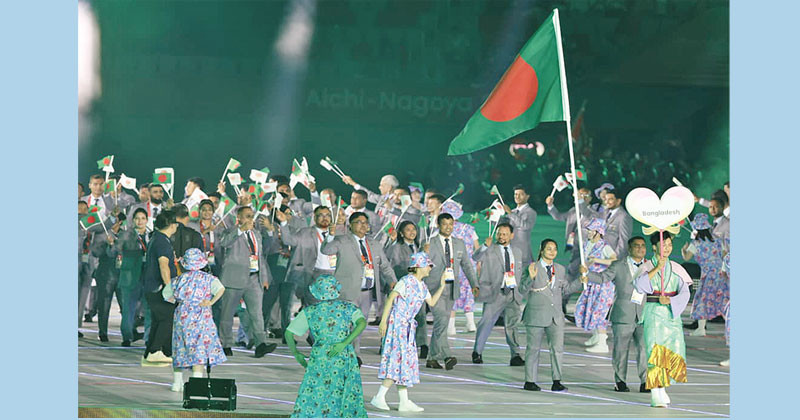
The roughly two hour opening ceremony ended a few minutes before 8 PM, the report notes, with the march past taking up nearly three quarters of an hour. The march past itself had some inconsistencies, the report states. Countries typically enter the march past in English alphabetical order, but this time that pattern broke down in places, and one country’s name was announced more than once. It also notes that athletes usually stand during the march past, but this time Japan had arranged seating for the participating athletes and officials.
Shooter Mr. Abdullah Hel Baki and karateka Ms. Humaira Akter Antara carried Bangladesh’s flag, the report states. It notes that athletes competing today, including those in women’s cricket, hockey, and badminton, were left out of the march past. Around 50 people represented Bangladesh in the march past in total, including coaches, officials, and staff of the Bangladesh Olympic Association.
After the march past, the report continues, the president of the Japan Olympic Committee and the president of the Olympic Council of Asia gave welcome remarks. The Olympic Council of Asia president called for uniting Asia’s sporting world, while the Japan Olympic Committee president expressed hope for a successful Nagoya Games, following the Tokyo Olympics and the Hangzhou and Jakarta Asian Games. International Olympic Committee President Ms. Coventry attended the event, the report notes, along with Japan’s Emperor, Empress, and Prime Minister.
After the formal declaration opening the Games, a Japanese high jump athlete recited the oath on behalf of all athletes, the report states. Then came one of the Games’ key moments, the torch lighting, carried out jointly by Japanese athletes who had won gold at the Olympics and Asian Games. The ceremony continued with music and cultural performances.
However, Nepali journalist Mr. Binod Pande, who has covered multiple Asian Games, did not find this year’s opening especially impressive either, the report says. It quotes him as saying this opening did not feel particularly special, noting that Qatar and Indonesia had staged far more colorful ceremonies, and that even the opening of their own South Asian Games had been more engaging.
Overall, the report concludes, the curtain rose on Asia’s largest sporting event through a grand ceremony, yet the opening still fell somewhat short of expectations. Attention now turns to competition on the field, where the athletes’ performances will determine the true character of the Aichi Nagoya Asian Games.