AB Party Demands Scrapping of Syndicate System for Sending Workers to Malaysia
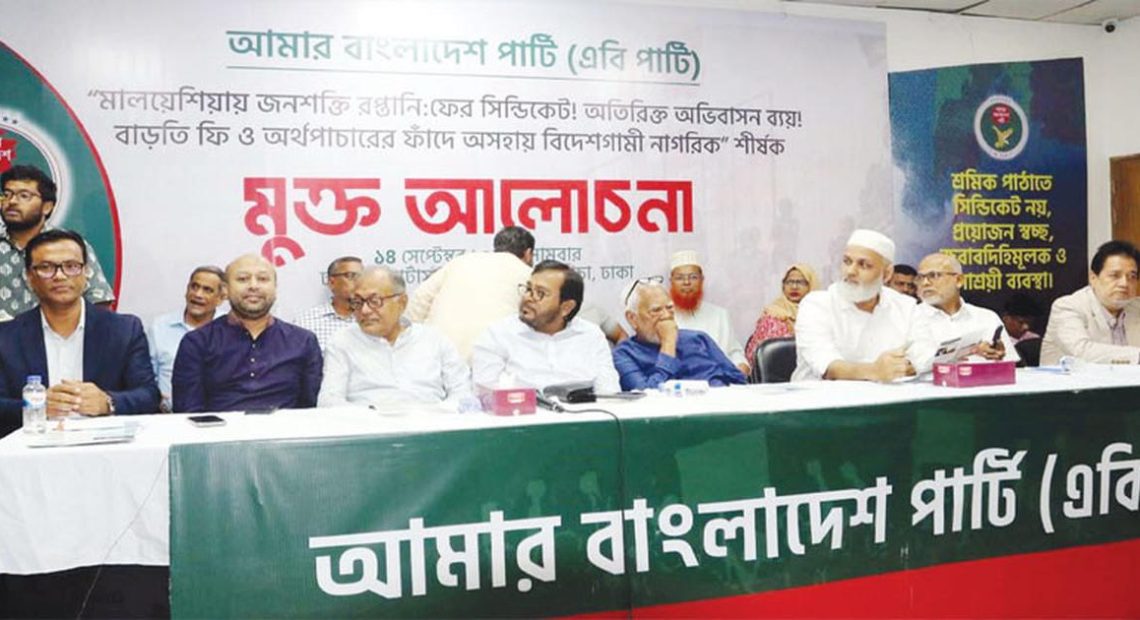
The Amar Bangladesh Party (AB Party) has demanded the cancellation of the syndicate system for sending Bangladeshi workers to Malaysia and called for allowing all licensed recruiting agencies to participate. The demand was made at a discussion meeting held at the Shafiqul Kabir Auditorium of Dhaka Reporters Unity on Monday.
At the discussion titled “Manpower Export to Malaysia: Syndicate, Prospects and Way Forward,” speakers said opportunities for manpower export must be ensured through transparent and open competition. At the same time, no money should be collected from workers beyond the migration costs fixed by the government. They alleged that despite changes in the members of the syndicate, structural irregularities in manpower export have not been eliminated.
In his address as chair, Mojibur Rahman Manju said the government conducts various examinations and procedures before issuing a licence to a recruiting agency. “If agencies do not get opportunities to work despite being licensed after such scrutiny, what is the justification for issuing licences?” he asked. All licensed agencies must be given opportunities to work through transparent and open competition, he said.
“No money can be collected beyond the migration costs fixed by the government,” Manju said. A syndicate-dependent system must be replaced with an open and competitive environment in the interests of workers. Many agencies have already started conducting interviews, he said, adding that Malaysia’s labour market is extremely important for Bangladesh. The governments of both countries and all concerned parties must play a responsible role in the interests of workers, he added.
Investment Corporation of Bangladesh (ICB) Chairman Professor Dr Abu Ahmed said competition would increase if opportunities for manpower export were opened up instead of being limited to 25 specific companies. This would also reduce the cost of workers going abroad, he said. A system must be established so that workers can travel abroad easily, through a transparent process and at a lower cost. He also called for removing “fraudsters” from the country.
AB Party Secretary General Barrister Asaduzzaman Fuad said expatriate workers endure unbearable hardships for meagre incomes. Yet, in many cases, even minimum humanity is not shown towards them by the relevant authorities. Expatriate workers are being treated as commodities rather than as human beings, he said.
“It is not enough to simply take pride in calling them remittance warriors. Their rights, security and dignity must be ensured,” Mr. Fuad said. Referring to reports of a meeting between Datu Amin and the prime minister, he demanded an explanation from the Prime Minister’s Office. “No game involving expatriates will be tolerated,” he said. He demanded the immediate cancellation of the syndicate of 25 companies and arrangements to send workers abroad through a low-cost, transparent and accountable process.
Pabna-1 constituency MP Barrister Najibur Rahman Momen said workers in the country sell their land to go abroad and send money home after engaging in inhumane labour. Bangladeshi workers are also working hard in Malaysia, he said.
He alleged that the old syndicate had once again been activated around the process of sending workers to Malaysia. “How were 17 companies included despite having no experience? An answer must be given,” he said. “If this is a government of the people, why should it bow to a syndicate? If Nepal and the Philippines can firmly stand their ground, why can’t Bangladesh?”
Former BAIRA Joint Secretary General Fakhrul Islam said Malaysia’s labour market is extremely important for Bangladesh. He described the continued existence of the syndicate formed during the Awami League period as deeply regrettable.
The interim government has failed to show visible progress regarding Malaysia’s labour market, he said. Although there were expectations that the syndicate would be dismantled, those expectations were not fulfilled. Rather, the current policy has created an opportunity for the syndicate to become stronger, he said.
He said that as the son of Shaheed President Ziaur Rahman, he expected the prime minister to directly intervene regarding the syndicate in Malaysia’s labour market and dismantle the syndicate of the past.
BNP Vice Chairman Dr Asaduzzaman Ripon said expatriate Bangladeshis played an important role in the August 5 movement. Besides participating in the movement, they contributed to the anti-fascist movement by stopping remittance transfers, he said.
Workers go abroad, earn money through hard work and send it back home, while the children of wealthy people take the country’s money abroad to study, Ripon said. “It is the children of the poor who earn foreign currency for the country.”
Calling for the proper use of workers’ hard-earned money, Ripon said recruiting agencies must give the highest priority to workers’ interests and safety. He expressed his determination to build a syndicate-free Bangladesh in line with the aspirations of August 5.
In his welcome speech, AB Party Vice Chairman Professor Dr Abdul Wahab Minar said people move from one country to another in search of livelihoods. Although Malaysia has created an opportunity to recruit workers from Bangladesh, there are concerns that the old syndicate may become active again.
He stressed the need to establish a transparent, accountable and humane migration system in the interests of workers.
The meeting was moderated by Barrister Abbas Islam Khan Noman, coordinator of the AB Party’s shadow government affairs. Party Chairman Mojibur Rahman Manju, along with leaders and activists of various levels of the AB Party, labour leaders and expatriate leaders, were present at the meeting.