
Technology, Talent and Partnership to Shape Bangladesh’s Future
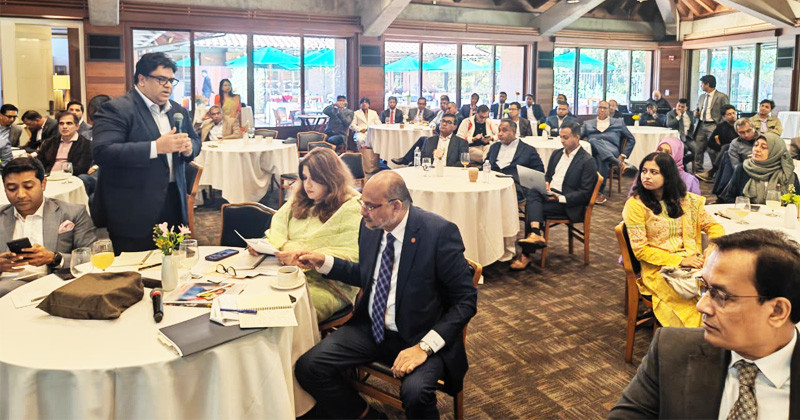
“Technology, talent and partnership—the future Bangladesh will be built on these three pillars.” Policymakers and senior government representatives from Bangladesh expressed this vision at the historic “Bangladesh-Silicon Valley Technology Dialogue” held at Cedar Hall of Stanford University in California.
The dialogue was organised by the Bangladesh Deputy High Commission in Los Angeles. Leading technology researchers, entrepreneurs, investors and successful Bangladeshi expatriates from Silicon Valley took part in the event. The dialogue was held under a special delegation sent by Prime Minister Tarique Rahman. The discussions focused on creating new opportunities to take Bangladesh’s technology sector to the global stage.
Policymakers and expatriates meet in Silicon Valley
Bangladesh Deputy High Commissioner in Los Angeles Kazi Mohammad Javed Iqbal welcomed the participants and moderated the event. Bangladesh Ambassador to the United States Tareq Md Ariful Islam also addressed the event as a special guest. He highlighted the importance of diplomatic and technological relations between the two countries.
The delegation included Prime Minister’s Adviser on Finance and Planning Rashed Al Mahmud Titumir, Foreign Affairs State Minister Shama Obaed Islam, Prime Minister’s Adviser for Posts, Telecommunications, Information Technology and Science and Technology Rehan Asif Asad, and State Minister for Primary and Mass Education Bobby Hajjaj. The participation of senior policymakers highlighted the government’s focus on technological transformation and engaging Bangladeshi scientists abroad.
New opportunities in AI and semiconductors
A major part of the dialogue focused on the use of advanced technologies such as artificial intelligence (AI) and semiconductors in Bangladesh’s economy and technology sector. Bangladeshi researchers working at leading global institutions delivered keynote presentations. Dr Syed Ishtiaq Ahmed, Associate Professor of Computer Science at the University of Toronto; Dr Sharifa Sultana, Assistant Professor at the University of Illinois Urbana-Champaign; Dr Mohammad Kamrul Islam, Distinguished Engineer at Uber; and Dr Mostafa Patwari, a researcher at NVIDIA, discussed practical applications of AI to address challenges in different sectors of Bangladesh.
Dr Mahbub Rashed of GlobalFoundries discussed the semiconductor industry and the development of its ecosystem. A panel discussion titled “Talent, Technology and Capital”, moderated by Dr Saif Islam, Professor and Chair of the Department of Electrical and Computer Engineering at the University of California, Davis, focused on research, skilled workforce development, industry links and access to venture capital and investment.
The panel included Special Assistant Rehan Asif Asad, Dr Shatil Haque of Credo Semiconductor, Dr Yusuf Haque, co-founder and Chief Technology Officer of Exo, Dr Omar Ishrak, former CEO of Medtronic and former chairman of Intel’s board of directors, Mohammad Enayetur Rahman, CEO of Ulkasemi, and Badrul Sarwar, CTO of CloudAIE.
Focus on links between research and industry
Rehan Asif Asad said the country’s technology sector cannot achieve its desired growth without effective links among education, research, startups and industry. Referring to the recently held BAER summit, he said the government’s main goal is to turn the technological talent of the younger generation into opportunities that can create innovation and skilled employment in the country. Foreign Affairs State Minister Shama Obaed Islam highlighted the important contributions of Bangladeshis living abroad. She said, “Science and technology diplomacy is now one of the key priorities of our foreign policy.”
She stressed technology transfer, developing the capacity of the local workforce and strengthening institutional ties between Bangladesh and US research institutions. She also outlined ways to use such technological cooperation to address key national needs, including agriculture and food security.
Combining digital skills with basic education
State Minister for Primary and Mass Education Bobby Hajjaj stressed the need to strengthen the foundation of the education system. He said it is not enough to focus only on advanced technology. Children must develop strong basic education and digital skills from the primary level to keep pace with the changing economy. He also stressed the proper use of technology in classrooms, practical training for teachers and access to quality educational materials for students in disadvantaged areas. He called for a culture of testing major national policies through pilot projects before implementing them on a large scale.
Commitment to revenue policy and people-focused technology
In his closing remarks, Prime Minister’s Adviser on Finance and Planning Rashed Al Mahmud Titumir outlined the government’s future plans. He said the government is evaluating appropriate revenue policies, investment plans and structural reforms to promote technology-based industrialisation and create skilled employment.
He called on expatriate researchers and investors to come forward with specific and practical projects that can create effective partnerships between both sides. He said the ultimate goal of all technological cooperation must be to improve people’s quality of life and reform public services.