Bangladesh Achieves Historic Success With Gold Medal at International Climate and Environmental Olympiad
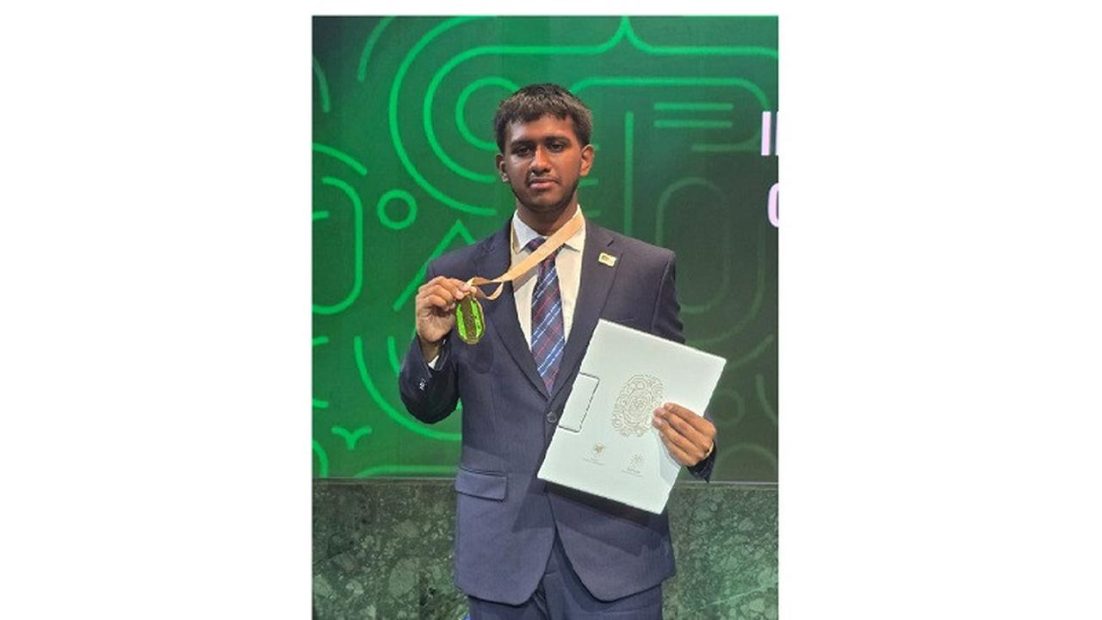
Bangladesh has achieved a major success at the International Olympiad on Climate Change and Environmental Issues (IOCE) 2026, held in Sirius, Russia. Bangladeshi students won one gold medal, two bronze medals and one honorary recognition in the individual category.
Abu Mahjurah Ayman, a ninth-grade student of Jalalabad Cantonment English School and College (JCESC) in Sylhet, won the gold medal and was named the overall champion of the competition after securing the highest score. Another ninth-grade student of JCESC, S M Anfal Habib, and Fabia Nurjina, a 12th-grade student of Viqarunnisa Noon School and College, won bronze medals. Ismah Arush, another ninth-grade student of Viqarunnisa Noon School and College, received an honorary recognition.
This year’s IOCE was held from September 20 to 29 in Russia’s Sirius Federal Territory. The Bangladeshi delegation returned home on Thursday. Students from different countries took part in the competition. The competition was not limited to a written test. It included field sample collection, research, laboratory analysis, individual problem-solving and team-based scientific work.
The competition had two main components: theoretical and practical. The theoretical round was held individually, while the practical round combined field research with laboratory analysis. The fieldwork took place in the mountainous natural environment of Rosa Khutor. Participants had to observe real ecosystems and collect data using research methods, rather than simply applying previously learned knowledge.
During the fieldwork, teams studied vegetation and biodiversity, recorded the abundance and distribution of species, analysed landforms and soil characteristics, and identified environmental impacts caused by human activities. They also collected soil and water samples for laboratory analysis.
After the fieldwork, the samples were analysed at laboratories in Sirius. Participants tested various indicators, including pH, mineralisation, nitrate, phosphate, iron and water hardness. They then compared the results with environmental standards to assess the ecological condition of the area.
The practical round therefore required participants to complete a full scientific process, from field observation and sample collection to laboratory analysis and ecological assessment. The theoretical round presented a different challenge. Each student had to independently work on a real-world environmental problem. Several problems were developed with support from scientific, educational, conservation and industry-related partner organisations.
Although the problems were linked to climate change, they also covered areas such as forest ecosystem conservation, resource use, biodiversity and environmental management. Knowing the correct information was not enough. Participants were also assessed on how accurately they identified problems, how realistic their proposed solutions were, how well their arguments were structured, and how much originality and innovation their solutions demonstrated.
Tasin Mohammad and Ahnuf Tahmid Uddin served as team leaders of the Bangladesh delegation. Ferdous Ahmed accompanied the team as an observer. Bangladesh’s journey to the IOCE began with the Bangladesh Olympiad on Climate Change and Environmental Issues (BOCE) 2026. The event was organised by the Sustainability and Life Sciences Network (SLSN) and Zero Competitions.
The BOCE 2026 selection process began with the preliminary round on July 17, in which more than 4,000 students from schools and colleges across the country took part. National regional and online regional rounds were held later. From these rounds, 300 students were selected to participate in the national round at Curzon Hall of the University of Dhaka on August 21.
The Bangladesh team for IOCE 2026 was then selected through training and a final team selection examination. The University of Dhaka was closely involved throughout the selection and preparation process. Teachers and students from the university’s Department of Geology and Department of Disaster Science and Climate Resilience provided support at different stages. Professor Dr Kazi Matin Uddin Ahmed of the Department of Geology, University of Dhaka, served as an academic adviser to BOCE.
The selected students were trained in ecology, biodiversity, environmental chemistry, climate science, Earth system science, geology and disaster management, preparing them for international field research, laboratory analysis and theoretical challenges. The journey that began in Bangladesh with more than 4,000 students ended on the international stage with an overall championship, one gold medal, two bronze medals and one honorary recognition.
The achievement goes beyond the medal tally. Through field research in real ecosystems, laboratory analysis and complex scientific problem-solving at the international level, the success of Bangladeshi students has highlighted the potential of the country’s young people in climate and environmental science.