

Buriganga set for revival under master plan
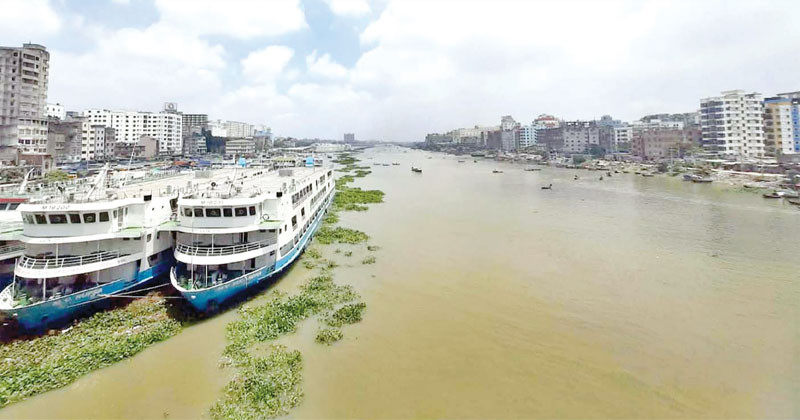
- Waste treatment to be brought under ETP system
- government has adopted the Clean Buriganga mega-project, including removal of 10-15 feet of plastic waste from the riverbed: Water Resources Minister
- locals demand permanent revival by freeing the river from pollution and encroachment
Musfiqur Rahman
The Buriganga, the river around which the beautiful city of Dhaka was founded, is now itself facing a crisis of existence. Left half-dead by pollution, encroachment, and neglect, this river is no longer just an environmental disaster but a living record of our collective indifference. Recently, however, the government has taken up a fresh master plan to save the Buriganga. Heavy machinery has been deployed to remove long-accumulated waste and evict illegal structures along its banks. Even so, concerned parties and locals harbour doubts about whether this initiative by the current government will quietly stall, like various token projects undertaken during the previous fascist government, or whether this struggling river will truly regain its lost glory.
The Buriganga, once known as the lifeline of Dhaka, was until recently seen as an all-but-dead prospect. But now this ancient main waterway and hub of trade and commerce seems to be hinting at a return of its lost vitality. Monsoon rains have increased the river’s flow, and the water’s appearance has become considerably more normal. In some spots, casting a net even yields fish. As a result, fishermen and ordinary people are being seen along the Buriganga’s banks after a long time. This recent change in the river’s condition has given rise to new hope. However, although the monsoon water has brought temporary relief, the Buriganga’s long-standing crisis has not been resolved. Industrial waste, sewage, plastic and solid waste, vessel oil, and various other forms of pollution, along with encroachment and siltation, have long obstructed the river’s natural flow and navigability. A recent assessment by the navy identified the Buriganga as being in an “extremely critical” state, naming Sadarghat, Hazaribagh, Kamrangirchar, Zinzira, and Shyampur as among the main pollution hotspots. Amid this, government activity around the river has increased, giving hope to those whose livelihoods depend on it.
In July this year, the Department of Environment announced that industries discharging polluted liquid waste into the Buriganga were being brought under online ETP (Effluent Treatment Plant) monitoring. Alongside this, efforts are underway to restore the river’s natural water flow, and regular dredging is being carried out to improve navigability, while legal action is being taken against polluters. According to the Department of Environment, between January 2025 and July 2026, a total of Tk 2.92 crore in compensation was imposed on 103 industrial establishments and projects along the Buriganga and its connecting canals for excessive liquid waste discharge, of which Tk 9,660,000 has been recovered. During the same period, the electricity connections of nine establishments without ETPs were disconnected. In August too, the government emphasised coordinated measures to stop pollution of the Buriganga and Turag. Environment Minister Mr. Abdul Awal Mintoo called on all concerned agencies to take coordinated, effective action. Earlier, the Prime Minister had also directed the adoption of a coordinated action plan to improve the water and environment of the rivers around Dhaka. Most recently, a central cell and three high-level sub-committees have been formed under the Prime Minister’s Office initiative to reduce pollution and restore navigability and natural water flow in the Buriganga and other rivers and canals around Dhaka. Priority has been given to controlling sources of industrial and household waste, curbing illegal drains and dumping into waterways, cleaning canals and drains, and removing waste accumulated on riverbeds.
On one front, the courts have also ordered the removal of plastic and other waste from the Buriganga’s banks. On 2 September, the High Court ordered the removal, within 15 days, of plastic and other waste from the riverbanks in Dhaka’s Islambagh, Lalbagh, and Kamrangirchar areas. On another front, multiple government sources connected to river affairs told Inqilab that another important stretch of the Buriganga, the original Buriganga channel, is also suffering from long-standing encroachment and waste. Obstructed water flow there has created problems such as foul odour, mosquito infestation, and waterlogging. The government has already taken steps to restore this stretch and turn it into an eco-friendly reservoir.
Rather than looking only to government and related initiatives, river experts stress the greater importance of raising public awareness, saying that although the Buriganga’s current condition under monsoon water offers a glimmer of hope, this cannot be called a permanent rebirth of the river. If, once the monsoon ends, industrial waste, sewage, and plastic again begin flowing into the river, and encroachment and siltation once more obstruct the flow, then even this temporary change could be lost. Those concerned argue that instead of merely regaining its lost vitality for a few monsoon months, the Buriganga needs to be restored to its familiar, normal form through planned initiatives, pollution control, eviction of encroachment, regular maintenance, and public awareness under special government oversight — a restoration that would then contribute to the national economy much as its lost vitality once did.
Mr. Sheikh Rokon, river researcher, writer, social worker, and founder and general secretary of the river-focused citizens’ platform “Riverine People,” said the Buriganga generally remains polluted for nearly eight months due to two factors and a lack of planning: waste discharged from industrial factories, and waste directly discharged and used by people living in Dhaka city; and, further, a plan involving the Buriganga-to-Dhaleshwari current channel has obstructed the normal flow of water and entry of water for nearly 16 kilometres, so that once the monsoon passes, the Buriganga loses its water current, creating such a polluted environment. He said the Buriganga remains in a normal state for only about four months, while for the remaining eight months it stays at an extreme level of pollution. Research shows that in normal water, oxygen levels stay at 5.00 milligrams or above, but although the Buriganga maintains that level for four months, over the remaining eight months it declines, even falling below 1.00 milligrams. Essentially, the Buriganga’s environment remains normal during the monsoon and autumn, but for the rest of the year, including winter, it stays polluted at an abnormal level. To overcome this, he said, the river’s depth from the Buriganga to the Dhaleshwari must be maintained to sustain the current, and plastic waste must be removed from the riverbed. He added that city corporations and other bodies whose lack of direct intervention is contributing to the Buriganga’s pollution need to become more conscious and ensure that any human waste entering the river directly is treated. He said the most worrying issue is that owners of factories discharging waste into the river’s water are fined only token amounts, which they pay without difficulty, after which they simply resume polluting. He noted, however, that the owners of the largest factories have direct political connections, making it far from easy to rein them in.
On this matter, Mr. Md. Mokhlesur Rahman, Additional Director General of the Water Development Board, said the government, including the minister of the Ministry of Water Resources, and all related government departments are extremely positive about doing everything possible to reduce public suffering on this issue. “We are trying to restore the Buriganga to its own form as quickly as possible. But this is not a simple or small matter that can be resolved just by wanting it to be,” he said, adding that around 10 to 15 feet of polythene or plastic-type waste has accumulated at the bottom of the river, and that clearing it would increase the Buriganga’s water-holding capacity. He said the master plan concerning the Buriganga is already in its final stages, and that once implemented, it will be possible to revive not just the Buriganga but all the rivers around the capital. Once finalised, the project will be ready for implementation following approval from the Prime Minister’s Office, several related offices, and finally ECNEC.
Water Resources Minister and BNP Joint Secretary General Mr. Shahid Uddin Chowdhury Anni told Daily Inqilab that the Prime Minister and all concerned are active on this issue. He said the main rivers around Dhaka include the Buriganga, Turag, Shitalakshya, Balu, and Dhaleshwari, and that among these, the Buriganga is currently in a completely abnormal state. Where the Buriganga and other rivers were once meant to serve as fish sanctuaries and key drivers of the economy, fish are now scarce, and at times the riverside is not even passable. He said about 10 to 15 feet of the riverbed remains filled with plastic-type waste, and that no effective initiative was taken regarding the Buriganga during the previous fascist government, causing the situation to worsen day by day. He said efforts are underway, with domestic, foreign, and World Bank funding, to build a “clean water circular way” around the rivers surrounding Dhaka, which, once implemented, would restore the Buriganga’s normal life and benefit everyone connected to the river and its surrounding population.
On waste generated across different parts of the capital ending up in the river, he said an initiative for a “Clean Water Master Plan” has already been undertaken, which, once implemented, would permanently resolve all these problems. He said the Buriganga and overall water management is not the responsibility of any single ministry or board; the Prime Minister is fully positive on the matter and has already formed a board coordinating local government, the Water Development Board, the Ministry of Shipping, and the city corporations of Dhaka and neighbouring areas, through which work has begun to implement the master plan in coordination with the city corporations of Dhaka, Narayanganj, Demra, and surrounding areas. He said a related policy is expected to be approved by ECNEC and implemented very soon.
He added that a joint plan has already been adopted for factories of various sizes around the Buriganga, under which large industrial establishments will be given the necessary technical support for waste management, while small and micro-scale factories will be brought under the ETP (Effluent Treatment Plant) system to treat their waste.
In this way, he said, with everyone’s cooperation, the government will be able to free the Buriganga and all the rivers around Dhaka from pollution in the future and restore them to their traditional form.