Civil Service Glass Ceiling: Discrimination and the Crisis in Public Service
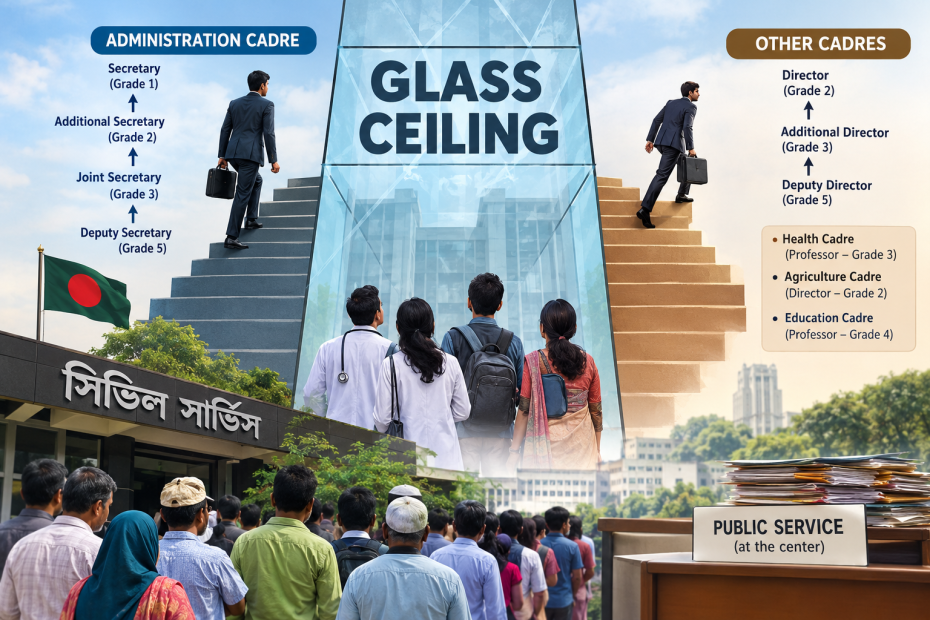
The civil service is the backbone of the administrative structure of an independent, democratic and modern state. In Bangladesh, talented young people enter 26 different cadres after passing the highly competitive Bangladesh Civil Service (BCS) examination. Some work as doctors to protect public health, others serve as engineers to build infrastructure, teachers to educate future generations, or officials responsible for law enforcement and field administration.
Differences in job responsibilities, working environments and initial duties are natural. The problem begins when officers who enter service at the same time through the same merit-based examination experience sharply different career paths within a few years. Why should promotion and access to senior policymaking positions remain restricted for some cadres while officers in one or two other cadres advance steadily and quickly? This gap is not merely a matter of personal frustration or conflict between cadres. Ultimately, ordinary citizens bear its consequences.
The Glass Ceiling in Civil Service
In sociology and human resource management, the term “glass ceiling” refers to invisible or structural barriers that prevent people from reaching senior positions. Research by Cotter and his colleagues in 2001 showed that not every delay in promotion amounts to a glass ceiling. It emerges when institutional barriers to advancement continue to grow and become permanent over time.
This problem is particularly severe in some professional and technical cadres of Bangladesh’s civil service, especially the BCS General Education Cadre. In the education cadre, the regular academic career ladder begins with the ninth-grade post of lecturer, followed by assistant professor in grade six and associate professor in grade five, with professor in grade four as the highest regular academic position. In contrast, the administration cadre has established routes to grades three, two and one.
Differences are also evident in other cadres. In the health cadre, the post of professor is in grade three. In the agriculture cadre, there is a defined career path from deputy director in grade five to additional director in grade three and director in grade two. When these limited career ladders are combined with years of promotion backlogs at lower levels, the glass ceiling becomes a harsh institutional reality.
In late 2025, for example, 1,870 education cadre lecturers were promoted to assistant professor. The following month, another 2,706 officers were promoted to various higher positions. Such large-scale promotions do not reflect a healthy, regular promotion process. Rather, they indicate the administrative pressure created by years of accumulated backlogs. Many officers remain stuck in their entry-level posts for more than a decade.
The prolonged wait and limited opportunities for advancement waste the most productive years of officers in professional cadres such as education and health. This is an irreparable loss for the state.
The Glass Escalator and Unequal Career Progression
The opposite situation exists in certain cadres, where career progression is smoother and faster. Christine Williams’s 1992 concept of the “glass escalator” helps explain this pattern. It describes invisible institutional advantages that allow certain groups to secure promotions, higher grades and senior administrative or policymaking positions more quickly than others.
Officers who joined the administration cadre through the 27th BCS in 2008 were promoted to deputy secretary, a grade-five position, by 2021. At the same time, some officers from the same batch in the education cadre were still working as lecturers. Newspapers reported that some had remained in the same position for nearly 13 years.
Promotion figures for deputy secretary posts, which serve as an entry point to higher positions such as joint secretary, additional secretary and secretary, reveal the scale of the disparity. In 2023, of the 240 officers promoted to deputy secretary, 178 came from the administration cadre, while only 62 came from the other 25 cadres combined. In August 2025, 198 of the 268 promoted officers were from the administration cadre. In August 2026, 190 of the 277 newly promoted deputy secretaries belonged to that cadre.
Moreover, when promotion backlogs or a shortage of vacant posts arise, the state sometimes uses special provisions, including supernumerary and retrospective promotions, to adjust the career timelines of officers in certain cadres. Similar flexibility is rarely seen in resolving backlogs in other professional and technical cadres.
This persistent inequality creates deep frustration among professional cadre officers. They see colleagues from the same batch, or even junior batches, moving into senior positions and gaining formal authority over them while they remain in the same posts for years.
The situation reflects what economists Albert Hirschman and Michael Rothschild described in their 1973 “tunnel effect” theory. When two lanes of traffic are blocked and one begins moving, drivers in the stationary lane initially feel hopeful that their lane will soon move too. But if the other lane continues advancing while theirs remains stuck, hope gradually turns into frustration, resentment and a sense of deprivation.
The same effect can be seen within the civil service. It weakens trust between cadres and undermines professional commitment and creativity. As a result, senior officers from professional cadres may find themselves competing with younger general-cadre officers for deputy secretary posts. Despite the risk of disrupting their normal professional careers, they may come to view securing such a post as the ultimate measure of career success.
Unequal Value of Career Time
The broader crisis can be understood through the concepts of “inequality in effective career time” and the “political economy of time.” Consider two officers from the administration and education cadres who each serve for 30 years. Their total years of service are equal. But does the state convert those 30 years into equal opportunities for professional development, responsibility, policymaking authority and institutional leadership? The answer is no.
An administration cadre officer may reach the centre of decision-making within the first decade of service, gaining experience and authority across different levels of government. An education or agriculture cadre officer may develop deep expertise in a specialised field but remain excluded from policymaking because of structural barriers.
Their calendar years of service are equal, but their effective career time is not. This is a structural failure that wastes talent and valuable years of experience. Research on public administration shows that deep expertise in a particular field does not automatically translate into policymaking authority. Institutional structures determine where and how that knowledge is applied, as discussed by Gailmard and Patty (2012) and Page (2010).
When the practical knowledge of specialist doctors, civil engineers, agricultural scientists and educationists remains outside senior administrative decision-making, expert knowledge becomes disconnected from policymaking. Health policies may be finalised by officials who have never treated patients in a hospital, while education policies may be shaped by people who have never taught in a classroom.
The conflict between “generalists” and “specialists” is therefore not simply a struggle over rank. It is a major obstacle to building a knowledge-based society.
How Citizens Pay the Price
The ultimate cost of these internal tensions and the inefficient use of time within the state falls on ordinary citizens. Repeated visits to government offices to obtain a document or signature, days of waiting for simple applications to be processed, and delays caused by poor coordination between departments are not isolated incidents. They are among the consequences of structural inequality and administrative inefficiency.
In public policy, these costs are often described as “administrative burden” or a “time tax.” Research suggests that bureaucratic complexity, lengthy procedures and delays impose direct and indirect costs on citizens, as discussed by Rose (2021) and Bhuiyan and Baniamin (2023).
For example, delays in correcting information on a birth registration certificate or passport can cause serious inconvenience and waste citizens’ time and money. Similarly, if the decisions of specialist doctors or agricultural scientists are held up by red tape and lengthy file processing, essential hospital beds may take longer to reach underserved areas, and new technologies may be delayed in reaching farmers.
In simple terms, the valuable time wasted inside the civil service returns to citizens as longer queues, delays and unnecessary hardship.
Structural Fairness, Not Blanket Equality
Resolving this multidimensional crisis does not mean imposing identical career structures on every cadre. The goal should be to establish structural fairness according to the nature and responsibilities of each profession.
The Public Administration Reform Commission’s recent recommendation to divide deputy secretary positions equally between the administration cadre and other cadres, using a 50:50 ratio and examination-based merit selection, is a positive step. However, changing quotas or ratios alone cannot provide a lasting solution.
First, the government should publicly disclose the average waiting time for promotion in each cadre, the ratio of vacant posts to approved positions, and clear promotion criteria. This would make the process more transparent and predictable.
Second, the career structures of education, health, agriculture and other professional and technical cadres should be reviewed objectively and redesigned where necessary. The artificial grade-four ceiling that limits advancement to the highest regular post in the education cadre must be removed.
Third, institutional and legal pathways should be created to ensure that specialised knowledge can directly contribute to national policymaking, alongside general administrative coordination.
A Career-Time Audit Is Essential
To build a modern welfare state, the government should introduce a “career-time audit” as part of public-sector human resource management. The state must assess not only how many years an officer has served but also how effectively their accumulated experience, talent and time have been used in policymaking and public service.
The success of the civil service should not be measured simply by how quickly officers rise to positions of power. Its real measure is how fairly and efficiently the state uses its human resources and valuable time to make public services more accessible, reliable and less time-consuming for citizens. Protecting citizens’ time requires the state to properly recognise and distribute the time and experience of its own public servants.
The author is an Associate Professor at Shaheed Buddhijibi Government College, Rajshahi.
Email: hhafij@yahoo.com