Clinging to Allah’s Rope for the Greater Good Is Ittihad Ma’al Ikhtilaf in Action, Says Hazrat Nesarabadi Huzur
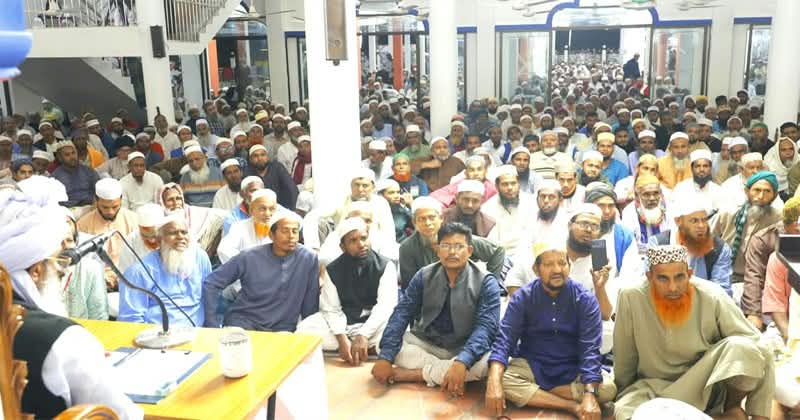
Despite unfavorable weather and challenging conditions, the traditional 78th Annual Isale Sawab Waz and Mahfil of Nesarabad began with enthusiasm last Thursday and is scheduled to conclude today, Saturday, after Fajr prayers with the Akheri Munajat. Musliheen activists, workers, and devout Muslims from metropolitan areas, districts, upazilas, unions, and wards across the country have gathered in Nesarabad. Because rain made the main Mahfil ground unsuitable, attendees have taken shelter inside the central Jame Masjid and various complex and madrasa buildings. Following Zuhr prayers and the inaugural address by Nesarabad’s Pir Saheb, Amirul Musliheen Hazrat Nesarabadi Huzur, prominent scholars arriving from across the nation have been delivering religious counsel.
In his inaugural speech, Amirul Musliheen Hazrat Nesarabadi Huzur emphasized that unity is obligatory in Islam and discord is prohibited, warning that a person who remains separated is fuel for Hell even while performing Salah and observing Sawm. He noted that although Islamic leaders organize around parties, ideologies, madhhabs, tariqas, darbars, and institutions to pursue unity, growing factions have intensified mutual strife and thickened clouds of division across the Ummah. According to him, these efforts falter because of flawed methodology rather than differing perspectives, parties, ideologies, or silsilas themselves. Citing Surah Hud (118), he remarked that trying to enforce unity while ignoring the reality of difference is like farming in a desert.
Pir Saheb Nesarabadi Huzur further stated that while differences of opinion, variations in thought, and distinct maslaks will naturally remain, believers must hold fast to the rope of Allah and keep their hearts close for the greater interest of Deen, referencing Surah Ali ‘Imran (103). He highlighted the principle of ‘Al-Ittihad Ma’al Ikhtilaf, unity alongside difference of opinion,’ explaining that mutual engagement and respect turn scholarly differences into a mercy, reflected in ‘Ikhtilaful Ulama-i Rahmatun.’ Through this approach, the lamp of difference illuminates the house of Islam rather than setting it ablaze.
He also stressed that united action does not require abandoning one’s own party, view, or ideology; instead, people should keep their distinct affiliations intact in their proper places while uniting on shared concerns for the broader interest of Deen. Upholding ‘Al-Ittihad Ma’al Ikhtilaf’ fosters a path where differences of opinion coexist with affection in the heart, allowing followers of different maslaks, parties, and darbars to walk shoulder to shoulder.
Centered on Nesarabad’s annual gathering, a distinct influence is felt across Jhalokathi, the southern region, and the entire country. Unlike gatherings focused solely on sermons, attendees here receive practical training in essential aspects of Deen-Islam to help them stay steadfast on Islamic ideals long after the event ends. Organizers anticipate several hundred thousand attendees if weather conditions improve, having already arranged comprehensive facilities for electricity, water, security, healthcare, sanitation, and law and order.