Satyajit Ray and Ishwar Chandra Vidyasagar: Their Historical Ties to Bangladesh
Does Defacing Rabindranath Tagore’s Graffiti Constitute Sedition?
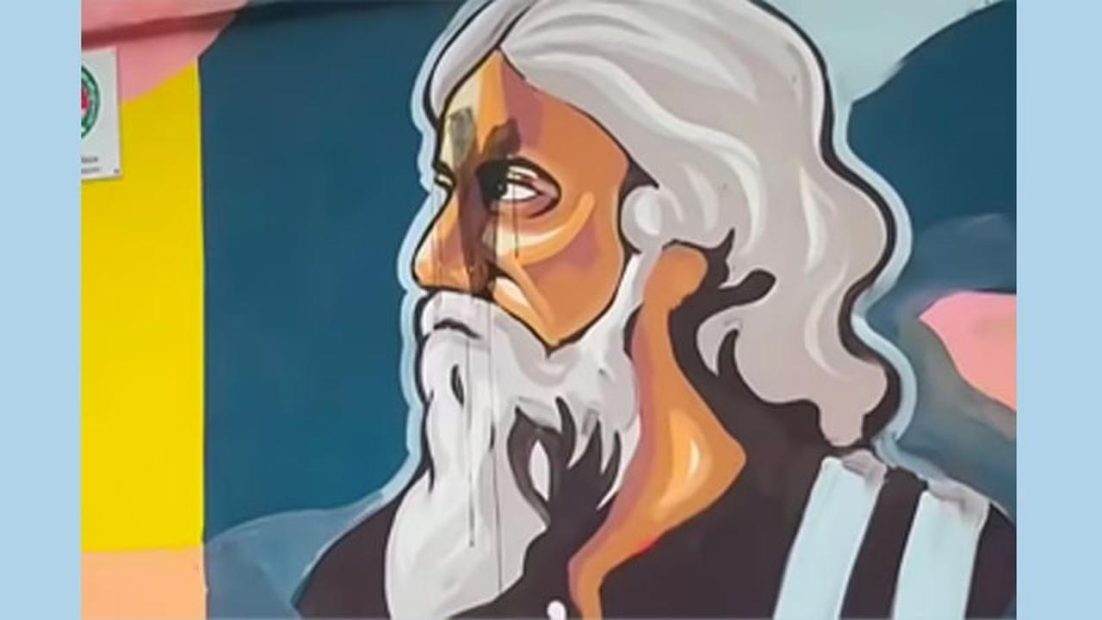
How can defacing a graffiti portrait of Rabindranath Tagore amount to sedition? Under which law? More surprisingly, the Constitution of Bangladesh does not contain a specific article defining sedition as a crime in the way it is often understood in this case. One relevant provision was Article 7A, which Sheikh Hasina introduced through the 15th Amendment to the Constitution. The provision was unnecessary and politically motivated.
Article 7A stated:
7A(1): If any person, by showing force or using force or by any other unconstitutional means—
(a) abrogates, repeals or suspends this Constitution or any of its articles, or attempts or conspires to do so; or
(b) undermines the confidence, belief or reliance of any citizen in this Constitution or any of its provisions, or attempts or conspires to do so,
such an act shall constitute sedition, and the person shall be guilty of sedition.
(2) If any person—
(a) assists or incites the commission of any act mentioned in clause (1); or
(b) approves, condones, supports or ratifies such an act,
that person shall also be guilty of the same offence.
(3) A person found guilty of an offence under this article shall be punished with the highest penalty prescribed by existing law for other offences.
Sheikh Hasina introduced this provision for political purposes. After the July uprising, the High Court declared Article 7A, along with several other provisions of the 15th Amendment, illegal. The Appellate Division of the Supreme Court subsequently upheld the High Court’s verdict.
However, Bangladesh’s Penal Code still contains a provision on sedition. This is Section 124A of the Penal Code, 1860. The official legal database also identifies the offence under the heading “Sedition”.
The main provisions of Section 124A concern the following:
• Nature of the offence: Using spoken or written words, signs or visible representations to bring or attempt to bring hatred, contempt or disaffection towards the government established by law.
• Punishment: Depending on the applicable provision, the punishment may include life imprisonment or imprisonment for up to three years, with or without a fine.
• Important exception: Lawful criticism of government policies or administrative actions, with a view to securing change through legal means, does not constitute an offence under this section if it does not create the hatred, contempt or disaffection described in the law.
Apart from this provision, there is no other section of Bangladesh’s criminal law specifically under which a person can be charged with sedition, the author argues. According to reports on the incident, police have charged four people with sedition under this provision. Defacing Mr. Tagore’s portrait with ink might constitute another criminal offence. But can such an act be considered an attempt to create hatred, contempt or disaffection towards the government established by law?
I discussed the matter with several knowledgeable and experienced individuals. They were astonished to hear that defacing a portrait had led to a sedition charge. According to a report by The Daily Star, the case also includes charges under Sections 120B, 153A and 295A of the Penal Code. Section 120B deals with criminal conspiracy; Section 153A concerns the promotion of enmity between different groups; and Section 295A deals with deliberate and malicious acts intended to outrage religious feelings.
Defacing Mr. Tagore’s portrait may constitute an offence. But does the act fall within the scope of any of these three provisions? The 166-year-old sedition law is outdated, the author argues. Several countries and jurisdictions, including England and Wales, Scotland, Northern Ireland, India, New Zealand, Ghana, Singapore, Kenya, Jamaica, Sierra Leone and the Maldives, have abolished sedition laws or repealed the relevant provision.
India repealed Section 124A and introduced a new law, the Bharatiya Nyaya Sanhita, on July 1, 2024. The author argues that the relevant provisions of the new law are more narrowly focused on acts threatening secession and the territorial integrity of the country.
The Lahore High Court in Pakistan’s Punjab province has also struck down the sedition law, although the author says it is unclear whether the law has been abolished in the other three provinces. Thus, while many countries have abolished sedition laws and India has replaced its former provision with a more narrowly defined offence, the defacement of a portrait of Rabindranath Tagore on a road in the capital has been treated as one of the gravest crimes against the state.
What an extraordinary and unparalleled example of devotion to Mr. Tagore! In fact, the excessive devotion of some admirers has made Mr. Tagore a subject of controversy. His songs of love, poetry and nature are remarkable. But does every issue have to be viewed through the lens of admiration for Mr. Tagore?
Indian communists have also portrayed Mr. Tagore as a landlord. According to the author, excessive glorification of Mr. Tagore has now prompted questions about his strong attachment to Hindu traditions. Inqilab has not joined the criticism of Mr. Tagore, the author says. However, Bangladesh’s National Poet, Kazi Nazrul Islam, wrote numerous Shyama Sangeet and devotional songs dedicated to Hindu goddesses. Did Mr. Tagore, by contrast, write even one Islamic song? Beyond Islamic songs, did he write a song, short story or novel about Muslims?
Bangladesh was not founded solely on the basis of language. Otherwise, Bangladesh might have merged with West Bengal in India, or West Bengal might have become part of Bangladesh. Yet the two Bengals remained separate. The author argues that religion was the dividing line, a reality that Jawaharlal Nehru, Lord Mountbatten and Sir Cyril Radcliffe could not ignore.
Before discussing the issue further, it is necessary to examine the incident that led to the sedition case. On October 5, Dhaka South City Corporation painted graffiti portraits of several prominent figures on a wall beside the footpath near the Shilpakala Academy, as part of an initiative to improve the capital’s appearance.
Initial media reports differed on the number of portraits painted. One report said that the first 10 figures were Rabindranath Tagore, Kazi Nazrul Islam, artist Zainul Abedin, Lalon Shah, Satyajit Ray, SM Sultan, Zahir Raihan, Shah Abdul Karim, Humayun Faridi and Ishwar Chandra Vidyasagar. Reports also said that a portrait of a person named Sanjib Chowdhury had initially been included but was removed following criticism.
The publication and broadcast of the list triggered strong reactions from different sections of society. Many questioned the criteria used to select the figures, particularly the inclusion of at least two individuals whose connection with Bangladesh was disputed by critics.
Why was Satyajit Ray’s portrait included? What contribution did he make to the creation of Bangladesh or to the struggle for the rights of its people? How much of Bangladeshi culture could be found in his work, the author asks.
Mr. Ray died on April 23, 1992, 21 years after Bangladesh became independent. The basis of his inclusion in a project intended to represent Bangladesh. If international recognition as a filmmaker was the criterion, figures such as American director Steven Spielberg, Swedish filmmaker Ingmar Bergman and Japanese director Akira Kurosawa could also have been considered.
Why was Ishwar Chandra Vidyasagar included? He was born on September 26, 1820, and died on July 29, 1891, around 80 years before Bangladesh became independent. He opposed the practice of sati and campaigned for Hindu widow remarriage. How his life and work relate to Bangladesh’s independence or cultural identity.
A portrait of the late Abul Mansur Ahmed would have been more appropriate. His book Purba Bangla may be one of the few works that clearly outlines the cultural identity of Bangladesh. Ahmed showed that although West Bengal lies on one side of the border and Bangladesh on the other, their cultures are not identical. Even though both regions speak Bengali, there are differences between the Bengali spoken and the cultural traditions followed on the two sides.
Following public criticism, the portrait of Sanjib Chowdhury was removed, and graffiti portraits of Begum Rokeya Sakhawat Hossain, rural poet Jasimuddin and West Bengal poet Jibanananda Das were added. The inclusion of actor Humayun Faridi also puzzled many people. If an actor had to be represented at the national level, the author argues, actor Raj Razzak should have been the first choice. He was widely known by the title “Nayak Raj Razzak”.
City corporations would be better off avoiding interference in cultural matters, the author argues. By intervening in the question of Bangladeshi cultural identity, Dhaka South City Corporation has introduced an inappropriate element into the debate.
The administrator of the corporation had previously served as the convener of the BNP’s Dhaka South city unit. Although the BNP is a 46-year-old political party, the author believes it has a serious lack of awareness of Bangladeshi cultural identity. He questions whether its leaders have fully understood the essence of the Bangladeshi nationalism championed by Shaheed Ziaur Rahman.
If the BNP cannot provide Bangladeshis with a clear sense of their national identity and cultural heritage, the party’s future will remain uncertain, and the nation’s future will also be clouded by uncertainty.
Email: journalist15@gmail.com