Drinking water crisis in the southern region and its sustainable solutions
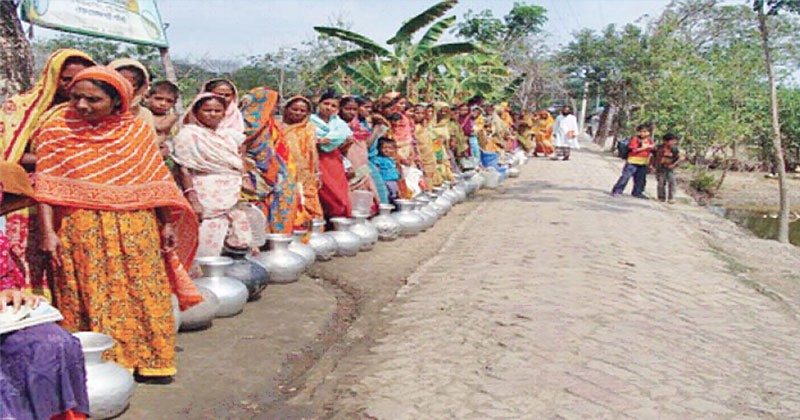
The southern region of Bangladesh is a land full of danger. It is surrounded by natural beauty, rivers, canals, wetlands and wide stretches of water. Its people face one hardship after another every day. Every season, whether summer, monsoon or winter, looks a little different here from the rest of the country.
Cyclones, tidal surges, river erosion, waterlogging and salinity often disrupt normal life in the region. Among all these problems, the crisis of safe drinking water has now become one of the biggest sufferings of people in the coastal areas.
Various UNICEF studies and reports say about 20 million people in the coastal areas of Bangladesh live at risk from salinity in water. So safe water for a huge number of people is a major public health and humanitarian challenge. The effect of this crisis is clear in the daily lives of people in coastal districts such as Khulna, Satkhira, Bagerhat, Patuakhali, Barguna and Pirojpur.
The situation gets worse in the dry season, when the flow of fresh water drops in rivers and other water bodies. Sea water enters rivers and underground water layers and changes the natural quality of the water. As a result, even deep tube well water is not fit to drink in many areas. Using water from ordinary wells or shallow tube wells is an even harder question.
In a region surrounded by rivers and water bodies, people must walk a long way every day to fetch one pitcher of drinking water. In some places, deep tube well water is pumped and sold by the litre. In other places, water reaches homes through pipelines, but people must pay bills by meter for the water they use.
For low income day labourers, farmers and working people, it is often hard to spend extra money on drinking water. Water is needed not only for drinking but also for cooking, bathing, washing clothes and other daily tasks. Yet people in the coastal region struggle every day to meet these basic needs. Women and children carry the duty of collecting water, and this takes time away from education, work and other important tasks.
Natural salinity is not the only cause of this crisis. Climate change, sea level rise, cyclones and tidal surges, less fresh water flow from upstream and unplanned use of underground water also make things worse. Rain water brings some relief in the monsoon, but that relief is gone in the dry season. So safe drinking water for people in the south is no longer only a local problem. It is an important issue of national development, public health and climate adaptation.
In this situation, there is no alternative to using modern water treatment technology along with the traditional ways of collecting and storing water. Desalination technologies used across the world to turn salty water into safe drinking water can open a new door of hope for our coastal region. Countries facing water shortages, including Saudi Arabia, the United Arab Emirates, Israel and China, already turn sea water or salty underground water into usable water with such technology.
Reverse osmosis, or RO, is the most widely used and effective desalination method today. It uses a special semipermeable membrane. First, the salty water goes through several steps of basic treatment. This removes sand, mud, floating particles, organic matter and other pollutants from the water.
Then high pressure pushes the water through the special membrane. The membrane lets water molecules pass but holds back most dissolved salts and other ions. This gives salt free water on one side and separates concentrated salty water, or brine, on the other. In the next step, needed minerals are added back, the pH is adjusted and the water is disinfected to make it fit to drink.
The biggest benefit of RO is that it produces a large amount of water using relatively little energy. Modern large sea water plants usually need about 3 to 6 kilowatt hours of electricity for every cubic metre of water. For water with lower salinity, such as underground water, the energy needed can be even less. But the actual energy use depends on the salinity level, membrane type, water pressure and plant design.
Another benefit is that this technology can work at every scale. It can serve small family units as well as large community or municipal water supply systems.
Author: Researcher and columnist. Email: ajoymondal325@yahoo.com