FDI Stagnates as New Investment Declines

Hasan Sohel
Net foreign direct investment (FDI) in the country looks slightly higher, but there is no speed in capital investment from new foreign investors. Most of what is shown is reinvested profit of existing foreign companies. The latest Bangladesh Bank data says net FDI rose by 12.78 percent in the April to June quarter of 2026. But new net equity investment fell.
This means reinvested profits of existing foreign companies played a big part in raising FDI, while capital from new investors is still weak. Yet the government’s efforts to bring foreign investment over the last eight months are clearly visible. From Prime Minister Mr. Tarique Rahman to responsible people in the finance, industry, commerce and foreign ministries, many have held repeated meetings with investors and business delegations from various countries.
Talks have been held with investors from China, the United States, Saudi Arabia, the Netherlands, Malaysia, South Korea, Qatar, the UAE, Japan and Singapore. Some showed interest in ports and industrial zones, and some in energy, technology, artificial intelligence, agro processing and manufacturing. Announcements of possible investment worth millions of dollars, MoUs and projects have also come up. But a question has been raised: against all these meetings, investor interest, talks and the statements by ministers about FDI flow, how much new foreign capital is actually coming to Bangladesh?
Meanwhile, State Minister for Foreign Affairs Mr. Humayun Kabir said the day before yesterday that Bangladesh no longer wants to run on foreign aid but wants to stand on its own feet. He said the era of dependence on foreign aid is over. He said Bangladesh wants to build investment based partnerships with different countries, standing on its own capacity.
The State Minister’s remark is presented as a ray of hope for the country, but the reality is different. In particular, dependence on foreign aid and budget support has risen sharply to cover the budget deficit and carry out the country’s economic priorities. To ease pressure on domestic sources and bank loans and to control inflation, the government has set a target of using a total of 13.27 billion US dollars (about Tk 162,000 crore) in foreign loans and grants to carry out the budget for the 2026 and 2027 fiscal year.
Meanwhile, in the first three months of the current fiscal year, the implementation rate of the Annual Development Programme (ADP) fell to the lowest level in history. From July to September, ministries and divisions could spend only 3.89 percent of the annual development budget. Economists fear this slow pace of development projects may hurt public investment, economic growth and employment. Existing roads in many places are in bad shape because they are not repaired for lack of money.
When public spending rises on projects such as roads, bridges, power infrastructure, schools and hospitals, demand grows for construction materials, transport, labor and many services. This affects business and the rural economy. It also raises the chance for the government to collect more revenue from these activities. So if project implementation drags on, the flow of money in the economy and the pace of job creation may slow.
However, in the last eight months, Finance Minister Mr. Amir Khasru Mahmud Chowdhury has taken no groundbreaking or urgent step to revive the fragile economy. He needed to take some quick steps to lift the economy, steps that would make it easy to raise employment quickly and move the economy forward. Because of the lack of needed steps or poor coordination, the economic situation is heading towards a terrible crisis day by day. There is no good news in the economy, from the drought of investment, stagnant import and export trade, rising unemployment, working people losing jobs, falling incomes and rising prices. Every economic indicator is going down.
Prof. Ms. Sayma Haque Bidisha of the Department of Economics at the University of Dhaka said that slow implementation of development projects in sectors like education and health hurts human resource development. She said public investment also plays a role in keeping jobs, economic growth and business activity moving. In her view, along with regular monitoring by IMED, monitoring and evaluation of public spending must be strengthened. If a project does not show expected progress even after three months, the cause must be found quickly and action taken.
Although Mr. Humayun Kabir says the country wants to stand on its own feet without foreign aid, the government has already moved to seek 1 billion US dollars (100 crore dollars) in budget support from South Korea. This is to handle the energy crisis caused by the long running unrest in the Middle East and the pressure on foreign exchange reserves. The Finance Division of the Finance Ministry has prepared a proposal to seek this loan support for the current 2026 and 2027 fiscal year. The proposal names rising budget deficit, price instability, pressure on foreign currency and exchange rate uncertainty as key risks.
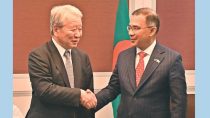
Earlier, Bangladesh asked China for energy support. During the ongoing visit to Japan, the day before yesterday, Prime Minister Mr. Tarique Rahman asked Japan to keep helping carry out Bangladesh’s development priorities, ensure energy security and improve people’s living standards. He made this call at a courtesy meeting with Japan International Cooperation Agency (JICA) President Mr. Tanaka Akihiko.
He said Japan’s support continues to play an important role in the country’s infrastructure development, socio economic progress and development goals. He said it is important to deepen the long friendly ties of the two countries and keep working with Japan for development and better living standards. The Bangladesh government has also applied to the IMF for a new loan of 4.5 billion US dollars (450 crore dollars).
Analysts say that to raise foreign investment, the country needs political and policy stability and secure energy supply. Long term planning is needed. Researchers say the biggest challenge for the country now is to increase the flow of foreign investment and ensure proper use of foreign loans.
Bangladesh Bank spokesperson Mr. Arif Hossain Khan gave the reason FDI is not coming as expected. He said foreign investors want to see what policies the new government takes to encourage investment. This means they want to watch the policies of the new government, so their decisions have been delayed. He said that because of this delay, foreign investment fell in the June quarter compared with the next quarter.
Dr. Nazneen Ahmed, Executive Director of the Centre for Policy Dialogue (CPD), said no major long term investor friendly change has been made to bring FDI in the last four decades. She said the complex and long process of both starting and closing a business makes investors lose interest in Bangladesh. So even when they see potential, they move away.
According to sources, government spending keeps rising although revenue collection is not growing. This is also raising the government’s dependence on loans. Most of the government’s revenue income now goes to repay loans and interest. To revive the fragile economy created by the corruption, plunder and money laundering of the fascist Hasina, huge money is needed. Just to fix the crisis in the banking sector, at least 40 billion dollars are needed.
Policymakers say donor funding is essential to overcome the overall economic and banking crisis. Economists also stress internal structural reform along with donor loans. When a huge amount of money is needed to fix the broken economy, the struggling banking sector is becoming a big obstacle. Bangladesh Bank data says total defaulted loans in this sector are more than Tk 6 lakh crore. Now about Tk 33 out of every Tk 100 of loans is defaulted, and the whole sector is struggling to cope.
A recently published IMF report says the country’s gross domestic product (GDP) will fall further to 3.2 percent. The World Bank and the Asian Development Bank have made the same forecast. Reports of different agencies in the country also speak of an extreme economic crisis. There is outcry among businesspeople.
The Prime Minister’s Adviser on Finance and Planning Dr. Rashed Al Mahmud Titumir says that international bodies, including the World Bank, the International Monetary Fund (IMF) and the US Treasury Department, have promised support to protect Bangladesh’s economic stability. He said assurance on this support will come within two to three months. He said the economy Bangladesh has now, and its fragile state, was inherited. He said that even by a very conservative estimate, 40 billion dollars will be needed to recover from the chaos in the banking system.
How capable is the government of getting out of this situation? Is it really possible to carry out the reform advice given by international bodies? Experts say bringing in foreign loans and giving temporary liquidity alone will not solve the problem. They say sustainable reform and accountability are needed.
The Foreign Investors’ Chamber of Commerce and Industry (FICCI) recently said that to keep up economic growth, finance huge infrastructure needs and survive in global competition after graduation from the LDC list, FDI must grow nearly seven times to 15 billion dollars by 2030. FICCI said there are nine structural problems behind the low FDI flow in Bangladesh, which have slowly weakened investor confidence. The biggest obstacle among them is policy uncertainty.
According to government estimates, the investment approval process should take 76 days. In reality, many investors wait six months to one year to get final approval. Lack of institutional coordination is also a big challenge. Foreign investors now have to deal with 23 government agencies and about 150 separate services, which raises both time and cost.
Infrastructure limits are also affecting investment. The report mentions power shortage, scarcity of land for industry, and slow transfer of land ownership in special economic zones. Logistics is also weak. The report says clearing goods at Chattogram port takes eight to 10 days on average, while in Vietnam the same work is done in just three to four days. This raises costs for exporters and reduces competitiveness.
FICCI also pointed out several weaknesses in the financial sector. These include 32.26 percent defaulted loans, a lack of enough capital in the banking sector, a complex tax system, a heavy effective tax burden despite a relatively low legal tax rate, a shortage of skilled workers, and Bangladesh’s weak position in global competitiveness and logistics indexes.
Mr. Toufiq Ahmed Chowdhury, former Director General of the Bangladesh Institute of Bank Management (BIBM), said FDI will rise and fall. He said it goes up once, then comes down, then goes up again, and there is nothing to fear. But he said it is a matter of long term policy. He said the ongoing Middle East war is taking a new turn and the Houthis have started attacking Saudi Arabia. He said it seems the Middle East war will go on longer, which is a warning sign for us in the coming days.