Footpaths Must Be Made Safe for Pedestrians
My residential quarters are next to my office, so I rarely go outside the area unless necessary. The crowds, traffic congestion and excessive noise make going out unpleasant. However, whenever I do, I face an old but increasingly serious problem in Dhaka: pedestrians have no space to walk.
Although many roads have footpaths, large sections are occupied by hawkers, shop merchandise, tea stalls and temporary structures. Pedestrians are forced onto the main roads, where traffic congestion and the growing dominance of battery-powered autorickshaws make walking dangerous. Some autorickshaws even drive onto footpaths.
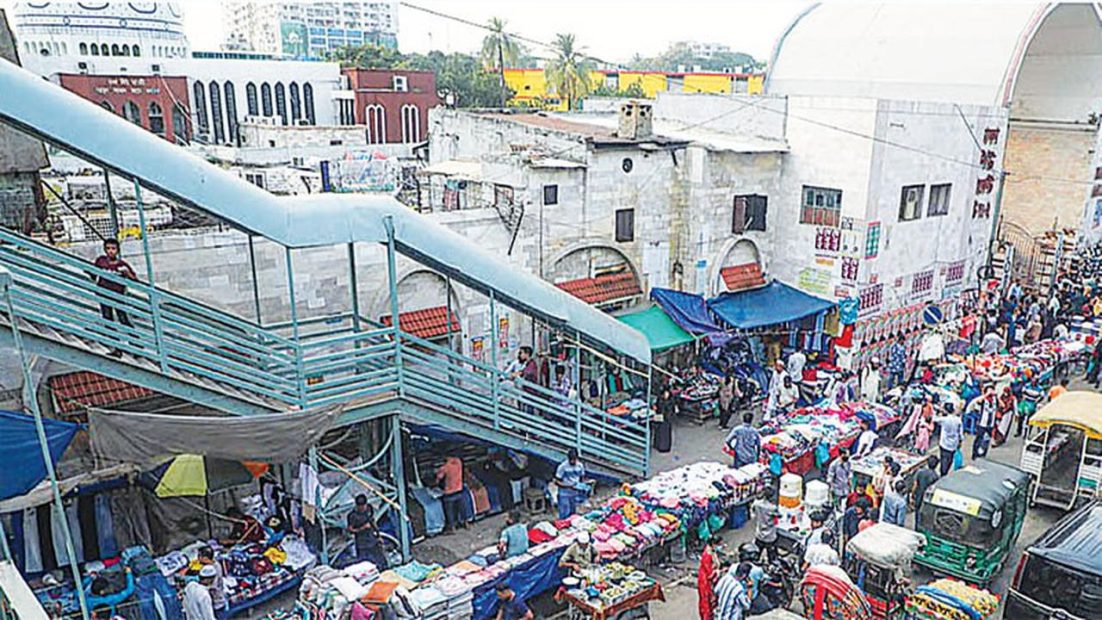
Recently, I walked from my home to New Market along New Elephant Road. The journey should have taken no more than 10 minutes, but it took nearly 30 minutes because hawkers occupied most of the footpath, forcing me to move slowly through the crowds.
After struggling through the crowd, I reached the overbridge near Gate No. 3 of New Market. However, hawkers had occupied both sides of the bridge, leaving only a narrow passage. They had even taken over the stairs, while beggars occupied the remaining space. An overbridge built for pedestrians had effectively become a marketplace.
Many people avoid using foot overbridges in Dhaka. Some are occupied by homeless families, beggars and drug users, while others are dirty and unsafe. People fear using them even during the day, as some have become gathering places for muggers and drug users.
Looking down from the overbridge, I saw hawkers occupying a large section of the road between the Nilkhet and Science Lab intersections. Crowds of customers had narrowed the road, slowing traffic and forcing pedestrians, hawkers and vehicles to compete for space.
Similar scenes are common across Dhaka. Footpaths built for pedestrians have become informal markets, leaving pedestrians like unwelcome guests.
Near my home, an air-conditioner shop on Hatirpool Road provides another example. Every evening, four or five people place chairs on the footpath to enjoy tea, snacks and conversation. They occupy the space from afternoon until late at night, leaving pedestrians unable to pass. Their behaviour suggests that they consider themselves influential, making others reluctant to object for fear of facing their hostility.
Tea stalls and other businesses frequently occupy entire footpaths and parts of roads. People have become so accustomed to these scenes that few speak out.
Hawking is a social and economic reality, and many people depend on it for their livelihoods. Simply evicting hawkers will not solve the problem. However, hawkers often have to pay substantial upfront sums and monthly rent to occupy footpaths. Those who collect this money from public land are illegally profiting while depriving pedestrians of their rights. Such irregularities have become commonplace, while the authorities remain silent.
People’s need to earn a living must be balanced against the right of millions to move freely. Bangladesh has laws regulating the use of roads and public spaces. The Dhaka Metropolitan Police Ordinance, 1976, provides for action against obstructions on footpaths and public places. The Road Transport Act, 2018, also prohibits placing goods or setting up shops on roads, footpaths, overpasses and underpasses in ways that obstruct pedestrians or vehicles.
The main problem is not the absence of laws but their enforcement. Footpaths are cleared through eviction drives, only for hawkers to return days later. Meanwhile, shop merchandise, restaurant furniture, construction materials and parked vehicles also occupy public spaces. The law must apply equally to everyone, including influential business owners. Selective enforcement undermines public confidence in the law.
Recent eviction drives in Mirpur and other parts of Dhaka have brought some relief, but the question remains whether the footpaths will soon be occupied again.
Footpaths are public property, not the possessions of individuals, shops, organisations or political parties. Everyone, regardless of wealth or occupation, has the right to use them. For children, older people, persons with disabilities and women, blocked footpaths are not merely inconvenient; they pose serious safety risks. Footpath occupation is therefore an issue of urban planning, public safety, transport management, social justice, livelihoods and law enforcement.
The problem also contributes directly to traffic congestion. When pedestrians are forced onto roads and customers gather around roadside stalls, the space available for vehicles shrinks. This increases the risk of accidents and makes it harder for ambulances, fire service vehicles and other emergency services to move through busy streets.
Eviction drives must be conducted regularly, but they should not be temporary publicity exercises. Authorities need a permanent management plan specifying where hawkers may operate, how much space must remain clear for pedestrians and where alternative vending facilities can be established.
Technology could help through digital maps, regular photographs and videos of footpaths, and records of repeated encroachment. An effective digital complaint platform should allow citizens to submit photographs and identify locations where footpaths are blocked.
Designated hawker markets, fixed vending locations and hours, unobstructed pedestrian corridors and strictly enforced boundaries could help balance livelihoods with public access.
A city exists for its people, and not everyone travels by vehicle. People walk, too. Ensuring their right to walk safely is not a luxury but a fundamental requirement of a liveable city.
The writer is a researcher and columnist.