
Long march won’t solve gas and power crisis:PM
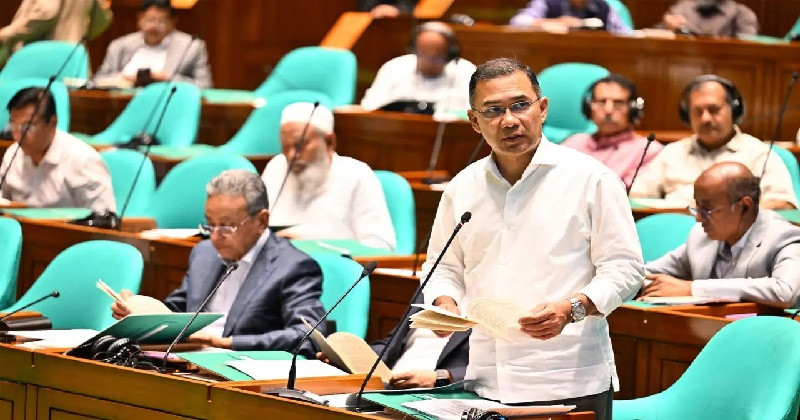
In his closing remarks at the third session of parliament, Prime Minister and House Leader Mr. Tarique Rahman appealed to the public for patience over the gas and power crisis, which he attributed to the fragile economy left behind by the previous “fascist” government, the recent conflict in the Middle East, and an accidental malfunction at one of the country’s two LNG terminals.
He sharply criticized the opposition’s long-march program at this critical time, saying it was inappropriate to stoke public frustration rather than stand with the government in resolving the crisis. He argued that if long marches could fix gas or electricity problems, the ruling party would have organized one first. He also described the opposition as an important part of governance and reaffirmed his intent to make parliament the central forum for all national debate, while announcing major plans to expand solar power generation as a long-term fix for the energy crisis. He pointed to what he called BNP’s historic record of resolving national crises and expressed confidence in overcoming the present situation quickly.
Mr. Rahman spoke at the closing of the third session of the 13th parliament on Thursday (September 10), presided over by Speaker Mr. Hafiz Uddin Ahmed.
He opened by paying tribute to the martyrs of the 1971 Liberation War and of the mass uprising two years earlier, calling the session’s conclusion historic. He said that while the session was short, it saw substantive discussion between both sides, and reiterated his hope of making parliament the central venue for national dialogue, without claiming every debate had been fully meaningful.
Praising the sincerity of all MPs, the PM said there was no doubt that both sides had genuinely tried to serve the country and the people. He said the government has worked tirelessly since taking office to fulfil the aspirations of those who sacrificed their lives or were injured in the struggle for democracy up through the 2024 movement, and to ensure public safety.
Recalling the mandate behind the government’s formation, he noted that voters backed BNP’s election manifesto in the February 12 election, entrusting it with running the country. Believing that the opposition is part of the democratic process, he expressed his intent to work with them for public welfare. He said that since taking office on February 17, the government has been implementing its promises step by step. He said that at the time of taking charge, power, energy, industry, education, and banking were all burdened by corruption left by the previous “fascist” regime — a fact known to the opposition, media, and public alike — and said the government was taking concrete action on these inherited problems rather than using them as excuses.
Explaining the roots of the recent gas and power crisis in detail, he said it hadn’t emerged suddenly: for over a decade, the previous government made no real effort to extract domestic gas, even as neighboring countries extracted gas from the Bay of Bengal, allegedly to benefit a particular country by keeping Bangladesh from drilling its own wells. This left the country fully dependent on Middle Eastern energy imports. Only 10–12 days after the current government took office, war broke out in the Middle East, disrupting oil and gas imports. This was compounded when one of the country’s two LNG terminals (FSRU) was disabled by an accident caused by an electrical shock, deepening the crisis.
He questioned the opposition’s sense of responsibility during this energy crisis, strongly criticizing their large vehicle convoy for the long march, saying it was wrong to exploit public suffering or stir unnecessary agitation. He repeated that if a long march of vehicles could solve the gas or power problem, the government would have organized one itself first.
Recalling how, during the 2022 Russia-Ukraine war, the then-government changed office hours, shortened bank hours, and declared extra school holidays, he said that government’s “quick rental” power plants had left the state bankrupt and heavily indebted without providing a lasting solution. He warned that turning the current situation — shaped by the continuing effects of the Ukraine war, the Middle East conflict, and technical disaster — into a pretext for provocation would devalue the sacrifice of the roughly 1,400 martyrs and 30,000 injured in the recent movement, and would only benefit the ousted “fascist” faction.
On the way forward, he said the government has already taken multiple steps to manage the crisis and that it would ease over time, with a broader plan to reduce import dependence by expanding solar power generation and turning the country into a self-reliant producer nation.
Citing past achievements, he said BNP has always led the country out of crisis whenever it has held power. Under Mr. Ziaur Rahman’s leadership in the late 1970s, he said, Bangladesh shed its “bottomless basket” label to become a food-surplus, food-exporting nation, and Mr. Rahman also laid the foundation for remittance inflows and overseas employment through large-scale labor exports to Middle Eastern markets.
Referring to the government formed after the 1990 anti-autocracy movement, he thanked Jamaat-e-Islami for its support in that era’s election, and said Ms. Khaleda Zia brought about a revolution in women’s participation in education that helped lift roughly 20 million people out of poverty. He expressed confidence that, drawing on that past experience and capability, the current government would likewise navigate all domestic and international political and economic challenges and deliver the nation a prosperous, peaceful future.