Pledge to Avoid the Mega-Project Trap Must Be Honoured
Rintu Anwar
We react strongly to small irregularities and corruption that happen before our eyes. But we stay calm about huge state looting. The reason may be that beyond a certain point, big numbers look like a bunch of zeros to ordinary people. They cannot grasp the real size of such figures.
The fallen Hasina government ruled for about 15 and a half years. The Centre for Policy Dialogue (CPD) and the state’s own research found that about Tk 28 lakh crore was laundered out of the country in that time. This shocking fact created little heat in public life or at tea stalls. Yet small corruption cases often cause an uproar.
A common person may never have seen even Tk 10 lakh at one time. To that person, there is no real difference between Tk 1,000 crore and Tk 28 lakh crore. Both just mean “a lot of money.” Rulers and the bureaucrats who support them have used this limit of the human mind for ages.
Economists often say the best, oldest and safest tool for state level looting is building physical infrastructure. Leaders choose mega projects of concrete buildings and paved roads instead of investing in education, public health, research, jobs or poverty reduction. We have no reason to think only a wish for development drives this. Behind it hides a perfect and risk free plan to take thousands of crores of taka.
The biggest victims of this plan are the common people. They must repay the burden of these loans with their hard earned money.
In a democratic system, governments change and new leaders come. But does the culture of mega looting, hidden deep in the way the state runs, ever change? This question has now come before us in a very relevant way. Before the last election, in late 2025, the top leaders of the ruling BNP gave a strong message again and again.
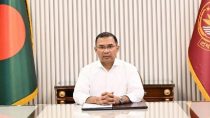
Prime Minister Mr. Tarique Rahman said clearly in December last year, “One of BNP’s main goals is that we will not go for any mega projects. Mega project means mega corruption. The state’s money must be spent on people’s education and health.” Earlier, Finance Minister Mr. Amir Khasru Mahmud Chowdhury said that if they came to power, they would focus on skills, jobs and self employment instead of concrete mega projects. These promises gave people hope of a caring state that works for its people.
But just three months after forming the government, the new administration has started walking the opposite way. It approves one mega project after another. It also raises the cost of unrealistic projects taken by the past government and keeps them running. This is a clear warning sign.
For example, the Executive Committee of the National Economic Council (ECNEC) quickly approved the first phase of the Padma Barrage project at a cost of Tk 34,497 crore. Surprisingly, no updated study on the technical side of this project has been done. The government took up such a big project after a decade, based on a feasibility study made in 2013.
In the past decade, the river’s course, depth and the whole ecosystem have changed greatly. Experts have already voiced concern over how wise it is to build this barrage while ignoring all that.
The government recently approved three metro rail projects with a combined cost of about Tk 2.5 lakh crore. Among them, the 17.20 kilometre MRT Line 5 Southern Route from Gabtoli to Dasherkandi is estimated to cost Tk 45,503 crore. Meanwhile, the government has revised the costs of two projects taken by the past government, and has almost doubled them. These are MRT Line 1, from the airport to Kamalapur and Purbachal, and the MRT Line 5 Northern Route, from Hemayetpur to Vatara.
After revision, MRT Line 1 will cost more than Tk 1,14,394 crore, and the Northern Route will cost about Tk 90 thousand crore. At first, these two projects were estimated at about Tk 52 thousand crore and Tk 41 thousand crore.
The worst joke is the MRT Line 1 route, covering the airport, Kamalapur and Purbachal. On this route, we have already spent thousands of crores in the name of easing traffic jams. The first phase of the Dhaka Elevated Expressway, built to connect Kamalapur directly with the airport, is complete at a cost of Tk 9 thousand crore. Work on the rest is still going on. For the airport to Purbachal road, the 300 feet expressway was built at a cost of Tk 14 thousand crore.
So there is no logical reason for traffic jams on this route. Yet the government is now building a metro rail on the same route at a cost of more than Tk 1.2 lakh crore. It is even breaking a part of the Tk 14 thousand crore 300 feet expressway to set metro rail pillars. This is a self destructive act. Whether any other country in the world could waste so much on parallel mega projects on one route needs research.
Many people may think that an unemployed young man or an ordinary housewife does not pay income tax to the government, so the cost of mega projects does not affect them. This is a big mistake. Common people pay the price of every state mega project in full. When you buy a bar of soap, you pay VAT.
To cover the large gap in development spending, the government raises electricity and gas prices again and again. This hits your household costs directly. When fuel prices go up, transport costs rise, and the prices of all daily necessities shoot up. The value of the money you saved in the bank for years falls because of inflation. In this way, with one stroke of a pen, your pocket and your wardrobe are looted without your knowing, in the name of mega projects.
Our media often says that JICA, ADB or the World Bank “will give” thousands of crores of taka to a project. The news is told as if foreign agencies are giving grants or help out of love for us. In truth, these are all loans with hard terms. Ten or fifteen years from now, the people of the country must repay every paisa with interest.
Not only that, these foreign agencies cleverly add a condition while lending. International firms from local or low cost sources cannot join the tender. So the government must give the work to contractors from the donor country at high prices. This raises the project cost artificially by several times.
Another dangerous side of bureaucratic tricks in mega project costs is the “hidden cost.” Suppose you build a house. The total cost includes bricks, sand and cement, and also cutting trees, preparing land, building a connecting road, and laying electric and water lines. If someone asks, you will tell them the full cost.
But in our projects, the cost of the main structure is shown up front, and the related costs are cleverly hidden. For example, we know the Padma Bridge cost Tk 30 thousand crore. But about a dozen separate projects were taken for river training, land acquisition, rehabilitation of affected people, connecting roads, easing environmental damage and building a museum. Their costs are not shown in the main cost. In total, the real cost of that bridge may have gone beyond Tk 50 thousand crore.
The culture of extending project time and raising costs has become part of our nature. A project due to end in 2034 will surely not finish before 2042. After 60 percent of the work is done, bureaucrats will raise the project budget by several thousand crores more, citing a design error or some other weak excuse.
Against this wrong idea of development, leading economists and engineers keep warning what our real priorities should be for city transport and the overall economy. Dr. Shamsul Haque, a professor of Civil Engineering at BUET and a transport expert, says metro rail is no magic wand for Dhaka’s traffic jams. He says it is foolish to go straight to mega projects without doing urgent but low cost work. This includes bus route rationalisation, introducing a franchise system and modernising traffic signals. Development built on top without a strong base will never last.
Dr. Zahid Hossain, former lead economist of the World Bank, has raised the issue of the opportunity cost of mega projects. Current policymakers need to understand it deeply. Instead of building a Tk 1.2 lakh crore metro rail or a Tk 83 thousand crore “cordon line” railway, we could repair lakhs of kilometres of broken village roads with that money. The benefit would reach marginal people at their doorstep right away.
The pace this brings to the rural economy would ensure far more national growth than a flyover. In this time of deep financial crisis, revenue collection has a huge gap and the debt burden is growing heavier compared to GDP. Stepping into the mega project trap again would be suicidal for the economy.
The government must understand that Dhaka now ranks near the bottom of the world in livability. In this crowded city of polluted air and polluted rivers, there is no reason to build a new metro rail and draw in two crore more people. If we want real development, we must decentralise Dhaka. The administrative headquarters, High Court benches, big hospitals and universities should spread to other divisional and district cities.
Mega projects of rod and concrete alone, without creating jobs, modernising education and ending unemployment, can never be the path to a nation’s lasting freedom.
Those in power must remember that people are far more aware than before. One of the main reasons for the fall of the past government was public anger at limitless corruption and mega looting. If the present government also breaks its promise, falls into the same bureaucratic trap, and burdens the nation with loans in the name of mega projects because of foreign donors’ temptation, it will be a great misfortune for the people.