Muslim Men in India Face Lower Risk of Premature Death Than Upper-Caste Hindus
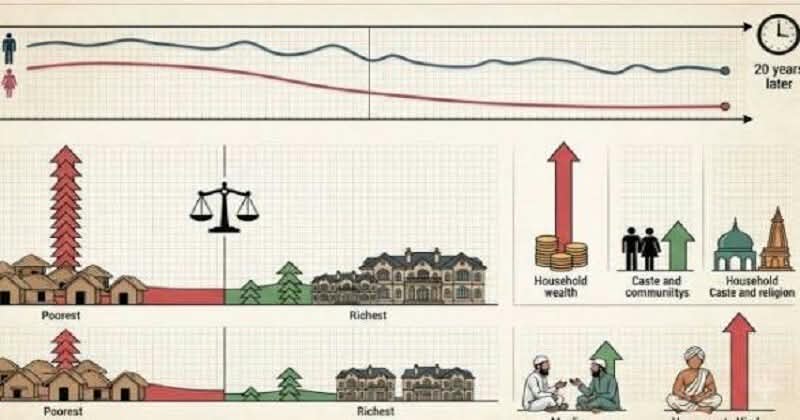
A landmark demographic study has revealed that household wealth, rather than caste or religion, is the primary determinant of working-age survival in India. Conducted by Moradhvaj Dhakad of the Max Planck Institute for Demographic Research and Nandita Saikia of the International Institute for Population Sciences (IIPS), the research analyzed data from three rounds of India’s National Family Health Survey (NFHS) spanning 1998 to 2021. Published in the journal Demographic Research, the study found that men aged 15 to 59 from India’s wealthiest 20 percent of households face a 62 percent lower risk of premature death than those in the poorest 20 percent. Similarly, women from affluent families experience a 42 percent lower mortality risk compared to their poorer counterparts, highlighting deep economic divides in public health.
Detailed figures from the 2019-21 survey underscore the severity of these wealth-based disparities across the country. Among every 1,000 working-age men, the probability of death stood at 280 in the poorest households, compared to just 158 in wealthy ones. For women, the risk dropped from 157 per 1,000 in low-income families to 87 in affluent households. Researchers confirmed that these stark gaps persisted even after controlling for caste, religion, rural-urban residence, and state-level variations. While higher mortality rates among Scheduled Caste (SC) and Scheduled Tribe (ST) men were largely driven by poverty and geography, SC women still faced a 19 percent higher mortality risk than upper-caste Hindu women regardless of their economic or geographic standing.
Conversely, the study uncovered a consistent survival advantage among Muslim men across all survey rounds over the past two decades. Even after accounting for wealth, residence, and state differences, Muslim men exhibited a 21 percent lower risk of adult mortality than upper-caste Hindu men in the 2019–21 data. Researchers attributed this trend to lower alcohol consumption among Muslim adults and higher rates of urbanization, which grant them better access to healthcare facilities. However, this survival advantage did not extend to Muslim women, whose mortality risk showed no statistically significant difference compared to upper-caste Hindu women once economic and geographic factors were adjusted.
Over the two-decade period, overall female adult mortality declined far more rapidly than male mortality. The probability of death for women aged 15 to 59 fell by roughly 40 percent, dropping from 208 per 1,000 in 1998–99 to 125 in 2019–21. In contrast, male mortality decreased by only 17 percent, from 268 to 221 per 1,000 over the same period. Notably, male mortality actually rose from 209 to 221 per 1,000 between 2015–16 and 2019–21, an uptick researchers linked primarily to greater occupational hazards and higher male fatalities during the COVID-19 pandemic.
In conclusion, the authors emphasized that broad economic uplift must accompany targeted social welfare programs to save lives. ‘Enhancing economic stability and alleviating poverty can substantially reduce adult mortality across all social groups,’ the report stated. ‘While targeted interventions for specific social groups remain essential, they must be integrated with broader economic and health policies to achieve maximum impact.’ Ultimately, the research demonstrates that addressing systemic poverty and expanding equitable healthcare access are critical to narrowing India’s survival gaps and protecting its working-age population from preventable, premature deaths.