
Mysteriously closed Shyampur Sugar Mill leaves unemployed staff struggling to survive
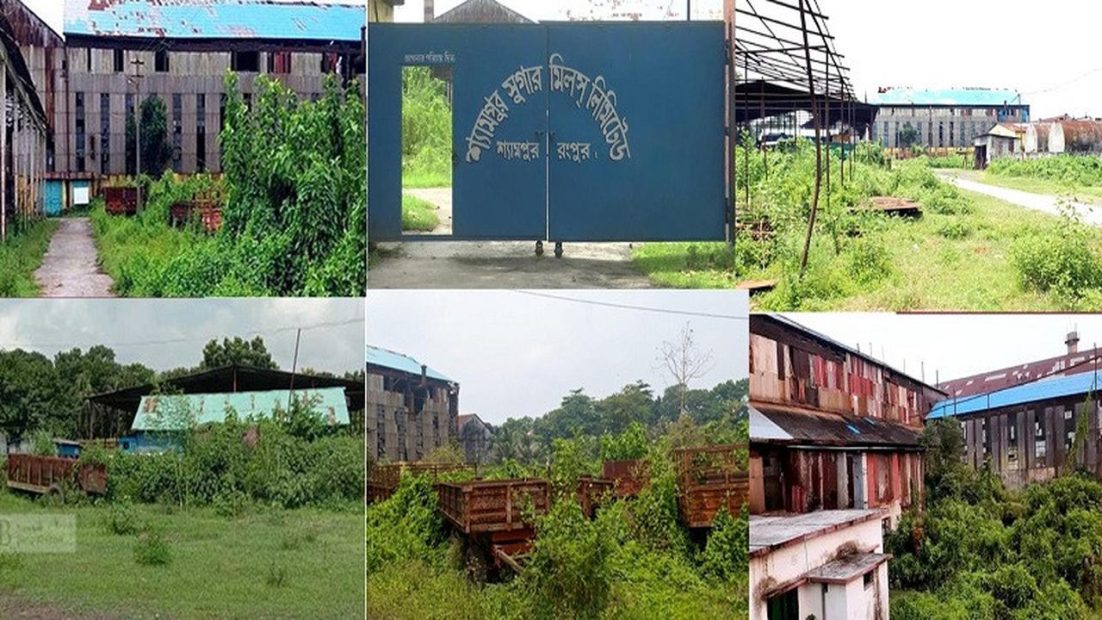
The debt of Shyampur Sugar Mill, the only state-owned heavy industrial facility in the Rangpur region, has been increasing steadily as production has remained suspended for years for unexplained reasons. The mill has been closed for five years, leaving the premises without the activity once seen among workers, farmers and visitors. Once a bustling area, the mill compound now turns deserted after evening. Valuable machinery and vehicles are being damaged by exposure to rain and sunlight after years of neglect. Tractors are also rusting and falling apart after being left unused.
A proposal for alternative production and employment to prevent losses and maintain jobs for workers and employees has remained stuck in bureaucratic red tape and has yet to be implemented. The matter has raised questions, with some believing that a group is attempting to transfer the mill to private ownership.
If the mill is reopened, it would create jobs for several hundred unemployed people while also benefiting thousands of farmers and farming families in remote areas of eight upazilas of Rangpur district through sugarcane cultivation. Beyond farmers and those directly involved in agriculture, many others would also gain opportunities to earn a livelihood.
According to information gathered, Shyampur Sugar Mill was built in 1964 on around 145 acres of land in the Shyampur area of Badarganj Upazila, Rangpur. Established as the only heavy industrial facility in the Rangpur region, the mill officially began crushing sugarcane in 1967. It has a daily sugarcane crushing capacity of 1,016 metric tonnes, with an annual production capacity of 10,161 tonnes. The mill operates for three months during the annual sugarcane-crushing season.
After its establishment, the mill operated profitably for many years. However, due to irregularities and corruption by some officials and employees, inefficiency, mismanagement and other factors, it began incurring continuous losses from 2000. Including bank loans, interest on loans, unpaid salaries and workers’ provident fund liabilities, the losses eventually rose to around Tk 600 crore.
Against this backdrop, an investigation committee formed with representatives from the ministries of industries, commerce, finance and agriculture recommended suspending the mill’s crushing operations. Subsequently, the Bangladesh Sugar and Food Industries Corporation suspended the mill’s operations during the 2020–21 crushing season.
Concerned quarters have questioned whether the ultimate fate of the mill will be similar to that of the Adamjee Jute Mill.
According to relevant sources, 493 permanent and temporary officers and employees were working at the mill when it was operational. Since its closure, many have retired while some employees have been transferred to other mills. Many are still living in hardship with their families without receiving outstanding salaries or finding alternative employment.
A visit to the mill found that the facility, which was closed citing losses, has now effectively turned into grazing land. With operations suspended, the machinery and vehicles lie idle and unattended. There is no activity among workers, employees or visitors on the premises. Workers are cultivating corn, potatoes, paddy and various vegetables on vacant land inside the mill compound.
Cows, goats and sheep roam around the premises. As the mill has remained closed for a long time, machinery worth crores of taka is rusting and deteriorating. Numerous tractors used to transport sugarcane, left outdoors, are also rusting and falling apart. Rainwater enters through damaged roofs, causing valuable machinery and equipment to corrode. Vegetation has grown throughout the factory premises. Criminals have removed parts from machinery and tractors used for transportation.
Locals said that since the mill’s closure, its valuable assets have not only deteriorated but have also been taken away, with the process allegedly continuing. They said there appears to be no one to oversee the assets, allowing people to remove equipment as they please. The mill compound becomes deserted after evening and has also reportedly become a gathering place for drug users.
Meanwhile, conflicting statements have emerged from the mill management and workers, employees and sugarcane growers regarding the reasons for the losses. While the management claims that declining sugarcane production in the area and a lack of modern machinery have contributed to the growing losses, workers, employees and sugarcane growers reject the claim.
They say the mill suffered losses due to corruption by former officials, an inefficient workforce, mismanagement and other factors. They believe the mill could become profitable if it is reopened with proper planning, modern machinery, repairs to old equipment and the recruitment of skilled personnel.
They also proposed creating employment and putting unused assets to productive use by constructing a potato cold storage facility on the mill’s own land, establishing agro-based industries, and setting up factories to produce PP bags and sugar packets. A proposal to this effect was submitted some time ago but has yet to be implemented.
Several workers told this newspaper that many are struggling to support their families because their salaries and allowances have stopped. Unable to find alternative sources of income, many have turned to farming or driving auto-rickshaws for a living. Workers and employees are spending their days amid severe financial hardship and uncertainty.
Mr. Mostafizur Rahman, a bank official, said the area had been economically vibrant when the sugar mill was operational. Transactions worth crores of taka took place every day in and around the mill compound. Now, however, the area is quiet and deserted. Local people who were once economically active are now struggling with poverty. Sugarcane growers are unemployed, while transport workers and farmers have also been affected. He said the local economy would regain momentum and people’s livelihoods would improve if the mill were reopened with proper planning.
Retired senior mill official Mr. Shahidul Islam said Shyampur Sugar Mill was one of the major heavy industrial establishments in the northern region and was once connected to several thousand families. However, its closure has created severe hardship among workers, employees and sugarcane growers.
He said several proposals had already been sent to the relevant authorities to make the mill production-oriented and create employment, including the construction of a potato cold storage facility on the mill’s own land, establishment of agro-based industries, and factories for producing PP bags and sugar packets. However, none of the proposals has yet been implemented.
Asked about the matter, Dr Abdul Majid, Director General of the Bogura Rural Development Academy, told Inqilab that modernising Shyampur Sugar Mill is now a pressing need. He said the sooner a decision is made, the more beneficial it will be.