North Cleared, South Reoccupied in Dhaka City Corporations’ Eviction Drives
Footpaths in the capital are not private property; they are meant for pedestrians. Yet, for decades, most footpaths along Dhaka’s roads have remained occupied by someone or other. Some are taken over by temporary shops, others by piles of goods or extensions of permanent shops. As a result, pedestrians often cannot use the footpaths, while illegal occupation contributes to regular traffic congestion.
To ensure smooth movement for pedestrians, Dhaka North and Dhaka South city corporations have been conducting eviction drives at different times. The campaigns have sparked debate, but residents have welcomed the renewed efforts after a long period. Temporary shops and illegal structures are being removed, restoring walking space in some areas. However, in other places, vendors have returned after eviction and set up their shops again.
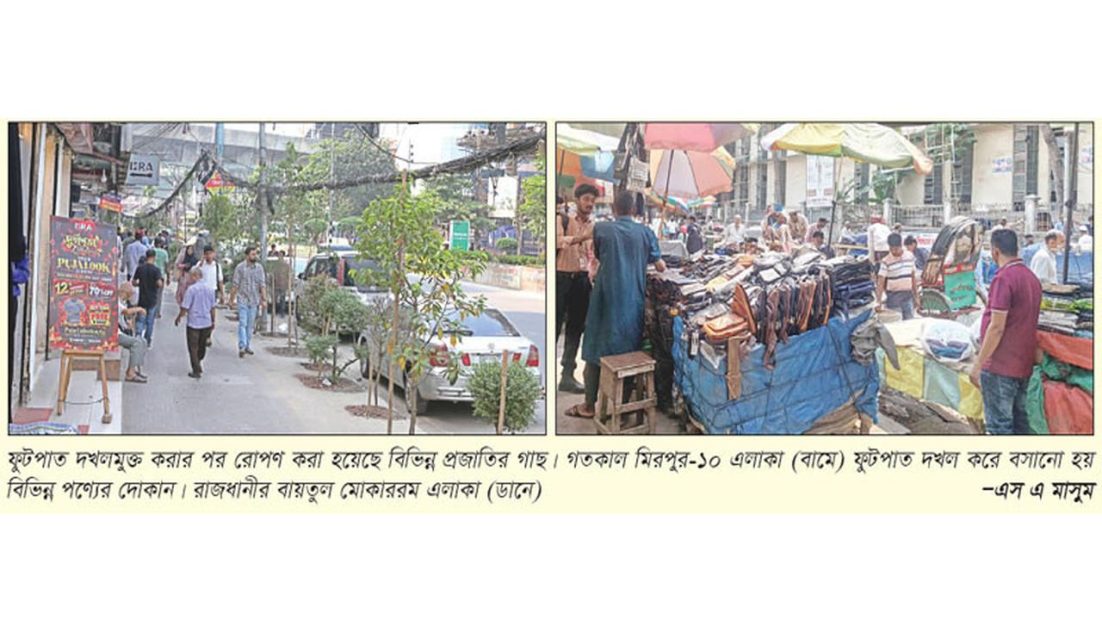
A visit to the affected areas shows a clear difference: areas cleared by Dhaka North City Corporation (DNCC) are now cleaner and more accessible to pedestrians, while many footpaths under Dhaka South City Corporation (DSCC) have once again fallen into the hands of illegal occupiers.
Urban experts say there are allegations of large financial transactions linked to footpath occupation. They stress that the two city corporations need coordinated initiatives and effective plans to reduce public suffering and ensure that footpaths serve their intended purpose. Eviction drives alone cannot provide a lasting solution. In the past, shops have returned to cleared areas, preventing the campaigns from achieving their intended results.
Identifying networks involved in extortion and preventing the reoccupation of footpaths are therefore essential. DNCC and DSCC need to coordinate with local police stations, traffic authorities, Dhaka Metropolitan Police and other relevant agencies to develop a joint action plan. Anyone found involved in extortion should face legal action, regardless of their identity or position.
Footpaths in Mirpur Become Accessible
The roads and footpaths beneath the metro rail line in Mirpur-10, Kazipara and Shewrapara were once controlled by illegal occupiers. Numerous temporary shops had been set up along the footpaths, selling clothes, fruits, tea, snacks and other goods. These shops made it difficult for pedestrians to walk normally, forcing many to use the main roads. This increased traffic congestion and raised the risk of accidents.
Eviction drives by DNCC have brought changes to these areas. Trees of different varieties have also been planted along the cleared footpaths and roadsides, creating a more pleasant environment. Pedestrians can now move around with greater ease.
During a visit to Mirpur-10, Kazipara and Shewrapara on Saturday, this correspondent found that shops occupied far less of the footpaths than before. Areas once covered with shop goods, tables, benches and piles of merchandise have largely been reopened for pedestrians. People no longer have to step onto the main road as frequently to continue their journeys.
Working people, students, women, children and elderly residents use the roads in Mirpur-10 every day. Similar improvements were visible in Kazipara and Shewrapara, where trees have been planted along sections of the roads beneath the metro rail line. The greenery has made the busy urban environment more pleasant. Local residents believe that regular cleaning and maintenance of the roads and footpaths would make these areas even more attractive and liveable.
On September 30, tensions and clashes broke out during an eviction drive in Mirpur-10. City corporation vehicles were damaged, and a fire also broke out. Law enforcement agencies had to intervene to bring the situation under control. Despite the clashes, DNCC announced that the campaign would continue.
DNCC Administrator Md Shafiqul Islam Khan said eviction drives would continue to ensure that pedestrians could move freely. He warned that strict action would be taken against anyone who occupied the cleared areas again. He added that local residents had stood against illegal hawkers in Mirpur-10 and welcomed the city corporation’s campaign. Operations against illegal street vendors would continue.
Arifur Rahman, a businessman in Mirpur-10, told Inqilab that pedestrians suffer the most when footpaths are occupied. “When the footpaths were occupied, we pedestrians faced the greatest difficulties. The area in front of our shops was also taken over, forcing us to walk with difficulty. Sometimes, goods displayed by shops and crowds of customers made it impossible to use the footpaths. As a result, we had to walk on the roads. The problem was worse during office closing hours, when educational institutions opened or closed, and during other busy periods,” he said.
He added that the DNCC campaign had reduced these difficulties considerably. However, he stressed that regular monitoring was necessary alongside eviction drives to prevent the footpaths from being occupied again.
Footpaths in South Dhaka Occupied Again
Footpath management has remained a longstanding problem in areas under DSCC, including Old Dhaka, Motijheel, Paltan, Gulistan, Segunbagicha and surrounding commercial zones. These areas see heavy pedestrian traffic every day because of shops, markets, offices, banks, public transport and various service institutions.
Footpaths are particularly important in these busy areas, but many are occupied by shops and merchandise. Shop employees also use sections of the footpaths, further reducing the space available to pedestrians. DSCC has also conducted eviction drives, including operations to clear roads and footpaths from Paltan through Gulistan Zero Point to North South Road. The authorities have said hawkers would not be allowed to operate outside designated areas.
Although the footpaths remain clear for some time after an eviction drive, shops gradually return. Within a few weeks, some areas risk reverting to their previous condition. DSCC Administrator and freedom fighter Md Abdus Salam said legal cases would be filed and goods seized if illegal shops occupied roads and footpaths in the capital.
He said illegal hawkers and roadside shops were largely responsible for traffic congestion, indiscriminate waste disposal and obstruction of pedestrian movement. He stressed that the city corporation would not tolerate the occupation of roads and footpaths, adding that goods would be seized and legal action taken against vendors operating outside designated areas.
He also said another eviction drive would be conducted in the New Market area the following week to clear roads and footpaths. “Under no circumstances will hawkers be allowed to set up shops on the roads,” he said.
Experts Call for Coordinated Action
Professor Dr Adil Muhammad Khan, executive director of the Institute for Planning and Development (IPD) and an urban planner, told Inqilab that Dhaka North and Dhaka South have separate administrative boundaries, but residents’ daily movements do not follow those boundaries.
Many people live in the northern part of the city and work in the south, while others travel between the two city corporation areas. As a result, even if footpaths are improved in one area, problems elsewhere reduce the overall benefits for city residents.
He said the two city corporations could exchange experiences and adopt similar plans to improve footpath management. Keeping footpaths free from illegal occupation would allow pedestrians to travel safely and could also help improve traffic discipline, he said. Safe and unobstructed footpaths are essential to an effective urban transport system.
He added that, alongside eviction drives, the authorities must ensure regular maintenance, safe road-crossing facilities and infrastructure accessible to people with disabilities. Long-term solutions cannot be achieved through eviction drives alone, he said. The authorities must also take action against extortion networks and influential individuals involved in the illegal occupation of footpaths.