Now Is the Time to Strengthen Bangladesh-Myanmar Relations
Bangladesh and Myanmar are geographical neighbours, yet much of the potential in their bilateral relationship remains unexplored. Their long land and maritime borders, the Bay of Bengal, historical ties and strategic location at the crossroads of South and Southeast Asia offer significant opportunities for cooperation. However, the Rohingya crisis, border instability, internal conflict in Myanmar, drug and human trafficking, and a lack of mutual trust have repeatedly hindered this potential.
The question is whether Bangladesh and Myanmar can build a pragmatic, peaceful and forward-looking relationship despite these complex realities. I believe they can. However, this requires consistent diplomacy, practical initiatives and well-planned efforts to increase people-to-people contact instead of relying on emotion-driven statements.
Lessons from History for the Future
The geographical proximity between the people of Bangladesh and Myanmar dates back centuries. During the colonial period, the territory of present-day Bangladesh and Burma were connected in various ways through the broader administrative and economic system of British India.
In 1937, Burma became a separate administrative entity from British India. During the Second World War, Burma and the eastern regions of British India, particularly Chittagong and its surrounding areas, became important theatres of war.
History reminds us that the lives, trade, security and communication of people living on both sides of the border are interconnected. The lessons of the past should not remain merely a matter of historical remembrance. They should serve as a foundation for peace, mutual respect and cooperation.
Bangladesh and Myanmar share a land border of approximately 271 kilometres. Their maritime boundary in the Bay of Bengal was also settled in 2012 through a ruling by the International Tribunal for the Law of the Sea. This means that not only are the two countries geographically connected, but there are also clear opportunities for cooperation in the blue economy, fisheries, maritime communication and environmental protection.
The Rohingya Crisis: The Biggest Test for Bilateral Relations
The Rohingya crisis is the biggest obstacle to Bangladesh-Myanmar relations. Following violence in Myanmar’s Rakhine State in 2017, more than 700,000 Rohingya were forced to seek shelter in Bangladesh. Including those who arrived earlier, around 1.2 million Rohingya are currently sheltering in the country. This prolonged crisis has placed enormous pressure on Bangladesh’s economy, environment, local communities, law and order, and humanitarian management.
Bangladesh has fulfilled its humanitarian responsibilities, but it cannot achieve a lasting solution on its own. The repatriation of Rohingya must be voluntary, safe, dignified and sustainable. This requires effective security guarantees, assurance of citizenship and legal identity, fundamental rights, livelihood opportunities, and an environment in which returnees will not face persecution or displacement again.
The constructive involvement of Myanmar’s authorities, relevant parties, the United Nations, China, ASEAN and other international stakeholders is essential. Bangladesh must maintain its principled position while continuing diplomatic engagement.
Development Is Impossible Without Security and Stability
Myanmar’s internal conflict could directly affect Bangladesh’s border security, the lives of local people and regional stability. Effective communication is essential to address gunfire along the border, the entry of displaced people, drug and arms smuggling, human trafficking and other cross-border crimes.
To this end, regular communication, hotlines, information-sharing and joint emergency response protocols among the border guard forces, police, military and naval authorities of the two countries need to be strengthened. When circumstances permit, practical cooperation can also be expanded in training, professional exchanges, disaster management and humanitarian assistance.
The purpose of these initiatives is not to interfere in the internal affairs of either country. Rather, they are intended to ensure border security, reduce misunderstandings and prevent suffering among ordinary people.
Economic Connectivity: Time to Turn Potential into Reality
Bangladesh’s manufacturing, trade and service sectors, combined with Myanmar’s geographical position, could give a new dimension to bilateral economic relations. There are opportunities for cooperation in agriculture, fisheries, food processing, small and medium-sized enterprises, tourism, border trade and the blue economy. However, realising this potential requires careful consideration of security, political realities, transport systems, banking, trade policies and legal frameworks.
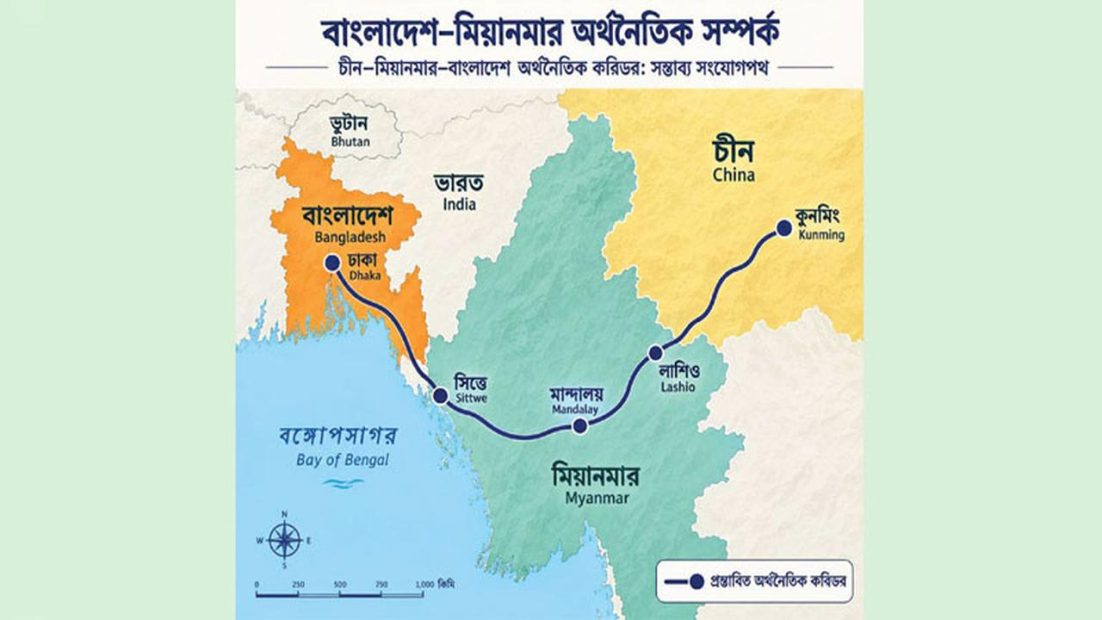
There have also been discussions about a possible economic corridor linking China, Myanmar and Bangladesh. As a potential proposal, its economic benefits, security risks, financial feasibility and compatibility with Bangladesh’s national interests must be carefully assessed.
Any regional corridor must safeguard Bangladesh’s sovereignty, commercial interests, environment, local communities and financial sustainability. At the same time, such a corridor must not be used as a condition for or an alternative to Rohingya repatriation. Instead, if developed on a realistic basis, regional connectivity could help expand trade and people-to-people contact.
Bangladesh and Myanmar need to facilitate trade, arrange visits by business delegations, organise trade fairs, exchange market information and establish transparent mechanisms for legal border trade. If the security situation permits, joint initiatives could also be considered in tourism, cultural heritage and the economic development of coastal areas.
People-to-People Contact Is the Foundation of Trust
Relations between countries are strengthened not only through official meetings and agreements but also through personal connections, mutual understanding and cooperation. Universities, research institutions, think tanks and professionals from both countries could engage in regular dialogue. Research and policy exchanges on regional security, the economy, climate change, displacement, public health and the development of border areas could produce practical results.
When circumstances permit, initiatives could be taken for student exchanges, scholarships, visits by teachers and researchers, language learning, literary translation and cultural events. The more people in the two countries learn about each other’s history, culture, language and social realities, the greater the opportunity to reduce misconceptions and distance.
The Embassy of Myanmar in Dhaka and the Embassy of Bangladesh in Yangon have important roles to play in promoting public engagement. Through cultural events, educational activities, information-based communication and the dissemination of information about lawful travel and trade, the embassies can help increase mutual understanding.
In the future, if the security situation and necessary permissions allow, a friendly maritime fishing competition involving coastal fishers from both countries, or an exchange programme on fisheries, could also be considered. This is not an existing programme but a possible proposal to build mutual trust, promote safe fishing practices and raise awareness of marine conservation. Before organising such an event, the maritime boundary, navigational safety, weather conditions, environmental concerns and approval from the relevant authorities must be taken into account.
Regional Diplomacy and Practical Cooperation
Both Bangladesh and Myanmar could benefit from broader regional cooperation frameworks. BIMSTEC offers opportunities to explore cooperation in trade, connectivity, energy, disaster management and maritime affairs. Constructive diplomacy is also important in Bangladesh’s engagement with ASEAN and in regional initiatives concerning Myanmar.
China maintains relations with both countries and has opportunities to contribute to regional stability and economic cooperation. However, any mediation or cooperative initiative must respect the consent of the parties concerned, Bangladesh’s interests and international principles.
Bangladesh should pursue principled firmness alongside pragmatism. It must work to resolve the Rohingya crisis, ensure border security and address the effects of Myanmar’s internal conflict. At the same time, it should keep channels of communication open wherever mutual interests exist.
Now Is the Time to Take Action
The future of Bangladesh-Myanmar relations will depend on the ability of both countries to address existing problems while making use of available opportunities.
First, sustained international diplomacy must be strengthened to ensure the safe and sustainable repatriation of the Rohingya. Second, effective mechanisms must be established for border security, preventing drug and human trafficking, and maintaining emergency communication. Third, when the security situation permits, economic, educational, cultural and research-based exchanges should be expanded gradually. Fourth, transparency, national interests and realistic assessments must guide any regional connectivity project.
Neighbours cannot be changed, but progress in relations with them is possible through sound policies, wisdom and initiative. Bangladesh must remain committed to its humanitarian principles and national interests while working for peace, stability and mutual benefit. Maintaining constructive relations with Bangladesh would also serve Myanmar’s long-term regional interests.
If Bangladesh-Myanmar relations are viewed only through the lens of crisis, the door to potential cooperation will narrow. But talking about opportunities while ignoring practical challenges will not produce sustainable results either. What is needed is a balance between the two: firmness in principles, patience in diplomacy and pragmatism in cooperation.
If this balance can be achieved, the people of both countries, the Bay of Bengal region and the wider areas of South and Southeast Asia could move towards a more peaceful and prosperous future.
The author is a Chinese language specialist, researcher and writer on Bangladesh-China relations, adjunct professor at the Institute of Professional Language, Bangladesh Maritime University, and general secretary of We Speak Chinese Club Bangladesh Limited.