Organised Attempts to Destabilise the Garment Industry: Who Is Behind the Chaos in the Name of Workers?
Hasan Sohel
The garment sector faces a global slowdown and many problems at home. Everyone except government employees now struggles to live. Every day, small and big businesses and large factories shut down, and unemployment rises. Even so, the government is sincere about the workers’ demands. Following the set schedule, it formed a new minimum wage board yesterday. Still, workers block roads in the name of a movement and do whatever they like.
The Bangladesh Knitwear Manufacturers and Exporters Association (BKMEA) welcomed the decision to form the wage board. BKMEA President Mr. Mohammad Hatem sent a statement on Sunday with this news. BKMEA said it also understands the pressure that our worker brothers and sisters feel because of the rising cost of living. But it said the challenges are real too: the global slowdown, the fuel crisis, rising production costs and falling export orders. So it said that securing workers’ fair dues and keeping factories running are equally important to the owners.
Ministry sources say the government took the firm decision to announce the wage board after several meetings and talks with owners and worker representatives. Minister Mr. Ariful Haque Chowdhury alleges that one circle keeps the movement going. He says this circle brings workers onto the streets by design to create unrest against the government and public suffering. He says the process of forming the board is final, and the government has been sincere about the matter from the start.
The government formed the new wage board because it understands that workers struggle to run their homes as living costs rise. Yet for a long time, some people have tried to create worker unrest. On the day before the wage board meeting and on the day of the meeting too, people tried to cloud the situation with worker unrest in the capital and several other places. Although the government and owners are sincere, people now ask about the workers’ restlessness and their aggressive behaviour toward police and law enforcement. Most of the people in the movement are outsiders.
Several intelligence agencies of the government hold information that the fascist Ms. Sheikh Hasina, who fled to India, has announced she will return to the country this coming December. After hearing that announcement, one group is trying to use workers to destabilise the country. The group has started a plot against the country. In 2006 too, people let workers loose in this way against the BNP government. So claims of political provocation tied to December have come up.
People allege that several former Members of Parliament from Dhaka and fallen leaders try to use the worker unrest to create instability in the industrial areas. People also allege that the wife of a state minister of the government is inciting the workers’ movement. Locals say Nipa Garments shut down for an indefinite time on purpose, without any reason, in the middle of the workers’ movement. Management also declared five more garment factories closed in Uttara. Factory closure announcements come from somewhere every day. This raises fears that the workers’ movement may spread even more.
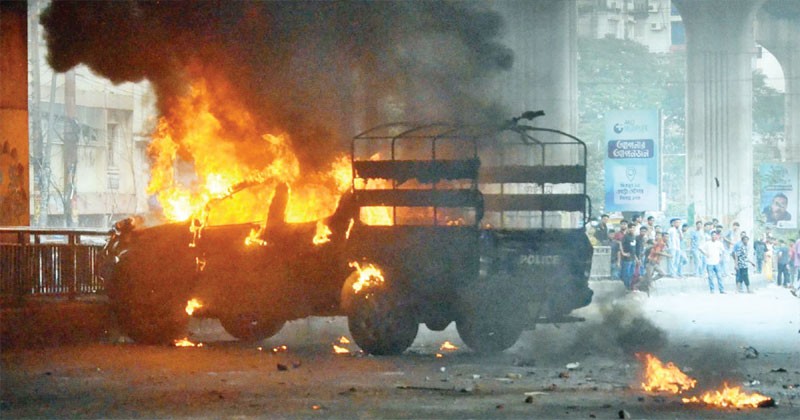
As on earlier days, workers behaved aggressively toward police yesterday in Mirpur and other places in the capital in the name of the movement. People set fire to a police vehicle in Mirpur 11. According to BGMEA, in the DMP area, 51,625 workers of 68 out of 320 factories left their work in the name of labour unrest. In the Gazipur and Mymensingh area, workers did not work in 225 of 836 factories, and the number of workers was 525,360. In the Savar, Ashulia and Zirani area, 125,270 workers of 25 out of 441 factories left work.
Earlier, people attacked seven police members and vandalised vehicles in the Uttara and airport areas. On the day of the wage board announcement, police broke up workers who had blocked the road in Mirpur since morning and made traffic normal again. DMP Joint Commissioner Mr. Mohidul Islam said some anti government or anti state circle has joined the protesting workers and is trying to worsen law and order. He said the government formed the wage board to set the workers’ wages, and now the board will work on it. He said police tried to explain this to the workers, but they still did not leave the road. Police felt that an anti government or anti state circle joined the protesters to worsen law and order.
Meanwhile, garment owners have warned that if unrest and violence continue after the wage board is formed, they may have to close factories under Section 13(1) of the Bangladesh Labour Act. BGMEA President Mr. Mahmud Hasan Khan said this yesterday after an emergency meeting with members at the BGMEA complex in the capital about the ongoing labour unrest. He called on worker unions and federations to play a responsible role in controlling the movement. He also asked the government to apply the law fairly against any side, workers or owners, that takes the law into its own hands.
Mr. Mahmud Hasan Khan said BGMEA members are worried because the movement for higher wages disrupts factory production. He said it has become hard to run factories regularly. He said, “We open the factory in the morning, but we have to close it again after one hour. We want a lasting solution to this problem.” About 235 members joined the meeting yesterday. He said they represent about 600 to 700 factories. He said the meeting made no final decision.
He said they asked the various labour federations, including organisations that represent garment workers, to make sure their members act responsibly. He said anyone, worker or factory owner, who joins violence or takes the law into their own hands will face the law. He said they asked the government, especially the Home Minister, to send a firm message on this. He also proposed that the members of the new wage board come before the press together and ask workers and everyone in the industry to stay patient until the board finishes its work.
Mr. Mahmud Hasan Khan said the wage board must get the chance to work freely in setting the new minimum wage, in the interest of workers, industry and the national economy. Industry sources say about 529 garment factories are closed in Mirpur, Ashulia, Gazipur and other industrial areas because of the ongoing labour unrest and violence.
Analysts say the continuing worker unrest and the closure of one factory after another have put the whole economy in deep worry. After the Covid pandemic, the Russia Ukraine war, the Middle East crisis and world inflation cut global demand and orders for garments. At home, the power and gas crisis and high bank interest rates raised production costs many times over. In the current crisis, both owners and workers face very real problems. Workers find it hard to run their homes as living costs rise.
Owners find it impossible to pay wages, because many factories have shut down as orders fell and production costs rose in the global slowdown. Several owners who did not want their names published said it is hard to run a factory even at today’s wages, so raising pay again is impossible for them. They say it is beyond their power to keep factories alive even with the many benefits from the government. They say there are no orders because of the global slowdown and worker unrest. The few orders they have are hard to deliver on time. So many buyers do not want to place new orders during the unrest.
According to the factory owners, workers should keep the factories alive in this crisis. Instead, they spoil the work environment through the movement and try to create unrest by closing factories. Yesterday too, garment workers blocked the road without reason in Uttara and attacked police. Police suspect outsiders are inciting this movement. The owners allege that a self seeking circle still wants to cloud the situation by saying various things to the workers and provoking them, even after the government took the step to form the wage board.
So observers advise the government to stay alert about the garment workers’ movement. They say that, by custom in the country, winter is the season for movements, and opposition political parties and various groups join movements in this season. They also say the banned Awami League and its allies are making many kinds of plots to destabilise the political situation, based on the announcement that the fascist Sheikh Hasina will return in December. They say signs of this have already appeared. They say outsiders in the name of the banned Chhatra League, Jubo League and Awami League’s sister bodies lead the movement.
For the last 15 years, the fascist Hasina government committed huge irregularities, corruption and looting, committed loan fraud and sent thousands of crores of taka abroad. The people now carry the burden. The World Bank, the International Monetary Fund (IMF), the US Treasury Department and other multilateral development agencies and international partners say Bangladesh inherited its present fragile economy. The forecasts that donor agencies have given about the economy hold nothing but bad news.
A recent IMF report says the country’s Gross Domestic Product (GDP) will fall further to 3.2 percent. The World Bank and the Asian Development Bank gave the same forecast. Reports from various agencies in the country also speak of an extreme economic crisis. Businesspeople are crying out. Even in this crisis, factory owners demand that the people responsible for the planned unrest in the garment sector and the factory closures be identified and punished.
Labour Secretary Mr. Abdur Rahman Tarafdar said the government is talking about the workers’ demands and is also alert so that no outside self seeking circle can create disorder around the movement.