PM Tarique Rahman calls for grants, not loans, for climate-vulnerable countries
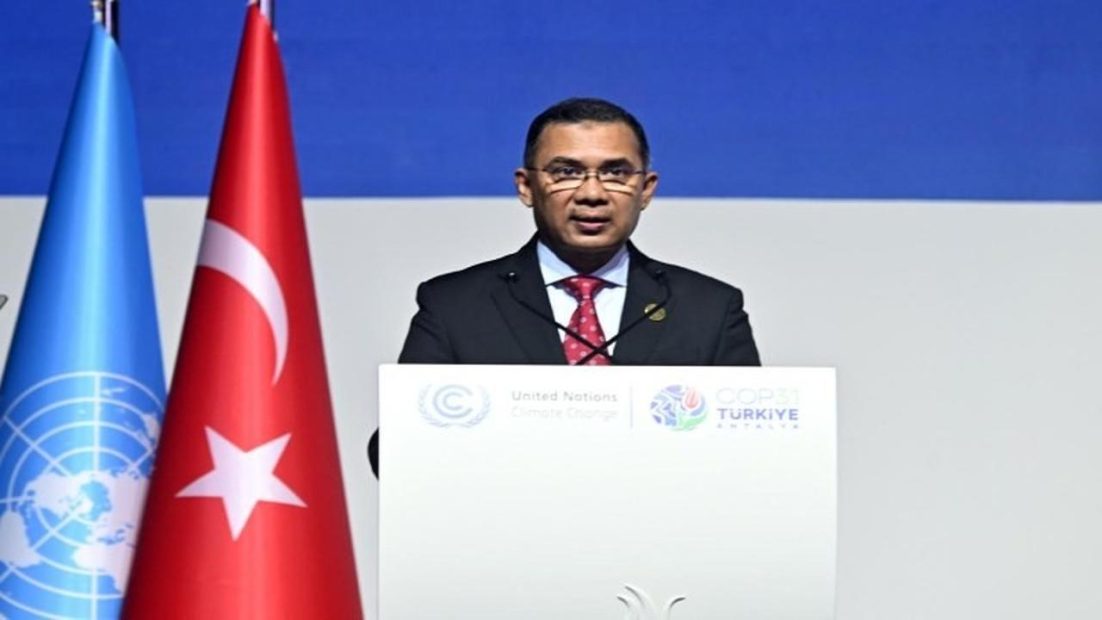
Prime Minister Tarique Rahman has called for adequate grants and fair financing for climate-vulnerable countries instead of increasing their debt burden to address the impacts of climate change.
He made the call while delivering an address at the high-level segment of the United Nations Climate Change Conference (COP31) in Antalya, Türkiye, on Thursday.
Presenting Bangladesh’s position on tackling global warming and the climate crisis, the Prime Minister proposed five urgent measures to world leaders.
Five-point proposal
In line with the principle of “common but differentiated responsibilities and respective capabilities”, the Prime Minister called for five urgent measures:
- Allocate at least 50 per cent of international climate finance to adaptation based on each country’s priorities, while also supporting efforts to reduce emissions.
- Introduce urgent debt relief facilities for climate-vulnerable countries, including climate-resilient debt clauses and debt-for-climate swaps.
- Ensure equitable access to environmentally friendly climate technologies and provide necessary support for transferring these technologies to developing countries.
- Accelerate the transition to renewable energy through affordable financing, skills development and a just energy transition.
- Adopt the Belém-Antalya Action Mechanism at COP31 to ensure a just energy transition, based on fair financing and equitable trade.
Climate finance and debt burden
At the beginning of his speech, the Prime Minister thanked Türkiye for hosting COP31 and Australia for leading the negotiation process.
He noted that although Bangladesh is on the frontline of climate change, its contribution to global greenhouse gas emissions is less than 0.5 per cent.
Describing the existing global climate finance system as inadequate, he said climate-related losses and damages were placing a significant burden on the country’s economy, while mounting debt repayments were making the situation more difficult.
Therefore, climate-vulnerable countries need reliable financial assistance, modern technology and grants, he said.
Bangladesh’s domestic initiatives and targets
Referring to the philosophy of “Bangladesh First”, the Prime Minister said the government was committed to building a $1 trillion climate-resilient and sustainable economy.
Highlighting various initiatives taken towards this goal, he said:
Renewable energy
In line with the Paris Agreement and its target of achieving net-zero emissions, the government has set a target of meeting 20 per cent of the country’s electricity demand from renewable sources by 2030. Initiatives have also been taken to generate 4,000 megawatts of solar power and produce energy from waste through special tax incentives.
Green industries and transport
A national framework is being developed to promote green industries, including around 300 LEED-certified garment factories, electric vehicles, jute-based products and carbon trading.
Tree plantation and river dredging
The government plans to plant 250 million trees over the next five years. It is also implementing the Padma and Teesta Barrage Master Plan and undertaking the excavation of 20,000 kilometres of rivers and canals.
In addition, mangrove afforestation is underway on reclaimed coastal land.
In the concluding part of his speech, the Prime Minister emphasised keeping the rise in global temperatures within 1.5 degrees Celsius, ensuring the participation of women and young people in climate action, and creating decent green jobs.
He expressed hope that COP31 would deliver meaningful and balanced outcomes for climate-vulnerable countries.