PM Vows to Secure Bangladesh’s Due Share of Teesta and Padma Waters at Any Cost
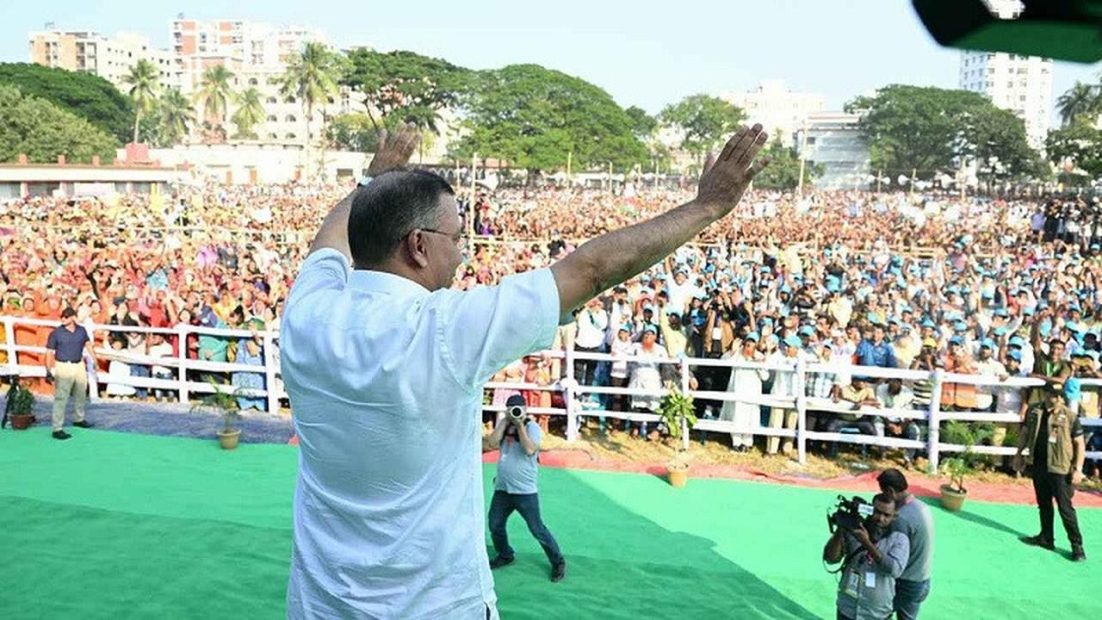
Prime Minister Tarique Rahman has said barrages will be built on the Teesta and Padma rivers to address water shortages and secure Bangladesh’s fair share of water. He said a Padma barrage would benefit people in 14 districts and urged people to continue supporting the BNP.
He made the remarks while addressing a rally at the historic Madrasa Ground in Rajshahi on Tuesday afternoon.
“This is our country, and we must build it ourselves. No one will come from abroad to build our country,” he said, calling for unity to prevent anyone from obstructing development. He cited the party’s slogan: “We will work, we will build the country, a Bangladesh for all.”
The rally was chaired by BNP Acting Secretary General Ruhul Kabir Rizvi. Land Minister Mizanur Rahman Minu, local lawmakers and leaders and activists of the BNP and its affiliated organisations attended.
Tarique Rahman said the BNP believed that saving agriculture meant saving the country. The party had outlined its plans for farmers at election rallies eight months ago. In line with its election pledge, loans of up to Tk 10,000 owed by 1.3 million farmers were waived within seven days of the February 12 election, he said.
He said the BNP had started distributing farmer cards, targeting four million small, medium, marginal and large farmers. The party would try to provide fertilisers and pesticides for at least one crop to ease farmers’ hardship.
The cards would offer 10 benefits, including access to insurance and bank loans, as well as information on whether it would rain the following day, he said.
Describing northern Bangladesh as the country’s granary, Tarique Rahman said farmers in the region suffered from water shortages. He recalled that the Barind project was launched during the tenure of Shaheed Ziaur Rahman.
The BNP had pledged to excavate 20,000 kilometres of canals if elected. Work on 8,000 kilometres had been completed, he said, adding that the initiative would improve water availability and irrigation and help replenish groundwater.
On healthcare, the prime minister said local leaders had proposed increasing the number of hospital beds in Rajshahi from 1,300 to 2,500. The BNP had also decided to increase bed capacity at upazila hospitals within five years.
He said Shaheed Ziaur Rahman had introduced 30-bed hospitals and Khaleda Zia expanded their capacity to 50 beds in 1991. The BNP planned to upgrade 50-bed hospitals to 150 beds so that rural women would not have to travel long distances for treatment. Separate beds would also be arranged for kidney patients, he said.
Tarique Rahman said the prices of dialysis medicines had been reduced and taxes on equipment used in cardiac treatment had been cut. The government was also working to reopen around 46 closed factories by December to create jobs, he said.
He accused some political groups of trying to spread confusion while the BNP worked to strengthen national security, reopen factories and create employment. The government was encouraging foreign investment to generate jobs, but some parties were creating disorder on the streets and obstructing its work, he said.
He warned that the public would suffer if these initiatives were not implemented and questioned whether those opposing them could be considered friends of the people.
Tarique Rahman said canal excavation was a public welfare programme and that a plan had been taken to plant 250 million trees over five years. He alleged that these initiatives were facing opposition.
He said Khaleda Zia had introduced free education for girls up to higher secondary level. The BNP had decided to provide free education for girls up to the honours level, with scholarships for those achieving good results. He stressed that girls also needed to become self-reliant.
The BNP chairman recalled the party’s election pledge to introduce family cards to provide financial assistance to households. The support could help families meet expenses and generate additional income, making the country more self-reliant, he said.
Referring indirectly to Jamaat-e-Islami, he said a political party did not want these initiatives and that people no longer believed its claims. He urged the public to remain alert, saying the BNP upheld the spirit of both 1971 and 2024. He said the party had stood beside the families of martyrs, arranged employment and taken initiatives to provide treatment to the injured.
He alleged that although a political party spoke about the spirit of the 2024 movement, it had sent no representative to pay tribute at a related event. He accused the party of betraying the movement by saying one thing and doing another.
He said people wanted stability and employment, reiterating the BNP’s slogan: “We will work, we will build the country, Bangladesh first.”
He also alleged that some people had tried to sell tickets by making false claims and urged the public to remain vigilant against attempts to create disorder.
At the rally, the prime minister inaugurated the distribution of Tk 12.2375 crore in agricultural incentives among 38,970 sugarcane farmers. After pressing a button to launch the programme, he recited “Bismillahir Rahmanir Rahim”. When the money reached the farmers’ mobile phones, he said “Alhamdulillah”, prompting thousands of rally participants to respond in unison. Activists also chanted slogans welcoming Tarique Rahman.