Shahjalal Airport Passengers Receive Baggage Within 15–20 Minutes as Modernisation Eases Hassles
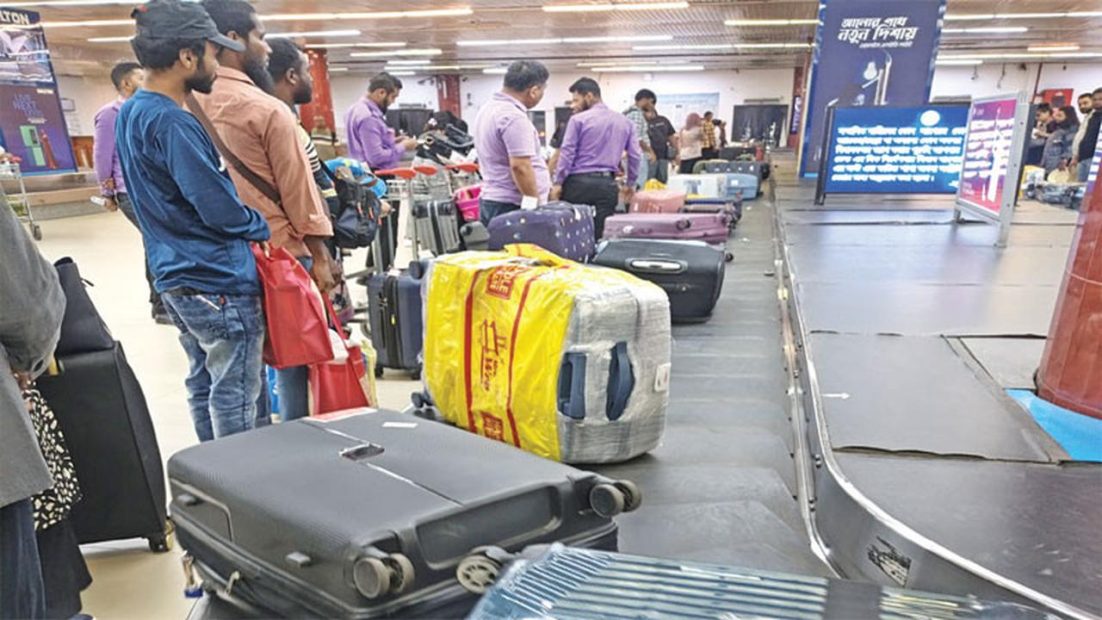
After a long flight, expatriate Bangladeshis and other passengers arrive home feeling tired but happy to be back on familiar ground. However, waiting for luggage for a long time often becomes one of the most frustrating parts of the journey. For migrant workers, elderly passengers, women, children and people with health problems, the wait adds to their physical and mental exhaustion.
Recent changes in baggage management at Hazrat Shahjalal International Airport in Dhaka have reportedly reduced waiting times, with passengers now receiving their luggage within 15 to 20 minutes. Many travellers see this as a positive change after years of delays and inconvenience.
However, faster baggage delivery alone cannot bring an international airport up to global standards. Passengers also expect cleanliness, security, responsible staff behaviour, clear information, easy movement and efficient overall management.
Baggage Theft and Security Concerns
The Airport Armed Police Battalion (APBn) has arrested a man named Jasim over the theft of luggage belonging to three passengers at Hazrat Shahjalal International Airport. Police arrested him in Kachua, Chandpur, and recovered all three stolen bags.
Police Superintendent (Operations) Mohammad Nazir Ahmed Khan of Airport Armed Police Battalion-13 disclosed the information on Wednesday. Meanwhile, the Civil Aviation Authority of Bangladesh (CAAB) has introduced live baggage monitoring to improve passenger services and ensure transparency in baggage handling. The system allows passengers to watch the baggage-handling process directly.
Passengers and people familiar with airport operations say an international airport’s reputation depends on more than modern buildings, advanced terminals and attractive architecture. It also depends on the comfort, security and respect passengers receive at every stage, from entering the airport to boarding their flights or collecting their luggage after returning home.
In this regard, Hazrat Shahjalal International Airport still has considerable room for improvement. Government policy decisions and effective action by the airport authorities are essential to making the airport more modern, clean and efficient. Better funding, adequate staffing, technology, maintenance and operational skills could significantly improve service quality.
A clear action plan, implementation deadlines and regular progress reviews are also needed. Security must remain a top priority at any international airport. Passenger safety, baggage protection, access control, detection of suspicious activities and emergency response are all essential parts of airport security. Meeting passengers’ expectations requires effective surveillance, trained staff and coordination among the agencies responsible for security.
People familiar with airport operations say major international airports around the world place strong emphasis on technology, planning and staff efficiency.
Disorder and Congestion at the Airport
A visit to Hazrat Shahjalal International Airport revealed several problems. Vehicles and members of the public were seen entering through the main gate without searches. Visitors were also seen crossing the security barriers in the departure area.
Although the airport has designated car-parking facilities, CNG-powered auto-rickshaws and other vehicles were occupying the departure road. Outside vehicles were reportedly being allowed to park in exchange for money.
Despite the airport being designated a beggar-free area, beggars were seen moving around. Vendors were also selling fruit, lemons, spicy puffed rice and cigarettes. The departure area of Terminal 2 was overcrowded, with large groups of people gathering to see off departing passengers. Similar congestion was visible on the ground floor around Terminals 1 and 2.
Live Baggage Monitoring Introduced
CAAB said it had installed 32 CCTV cameras and 18 65-inch monitors across eight baggage-belt areas at Hazrat Shahjalal International Airport to improve transparency and security in baggage handling. The system allows passengers to watch the different stages of baggage handling, from unloading bags from aircraft and transporting and sorting them to delivering them to the baggage belts.
The initiative aims to improve passenger services, strengthen baggage security and ensure greater transparency and accountability. The monitors provide a clearer view of baggage movement and are expected to improve efficiency and accountability at every stage of the process.
CAAB said it would continue expanding technology-based, passenger-friendly services so that expatriate Bangladeshis and other domestic and international travellers could collect their luggage safely and without unnecessary difficulty. The authority expects the initiative to play an important role in improving passenger services and strengthening transparency at the country’s main international airport.
Passengers Welcome Faster Baggage Delivery but Raise Concerns
Uzzal Hossain, an expatriate Bangladeshi living in Italy, told Inqilab that the airport is the country’s main international gateway. Every day, it serves Bangladeshi and foreign passengers, expatriate workers, tourists, businesspeople, diplomats and people from many other professions.
He said airport service quality was closely linked to Bangladesh’s international image, economic potential, tourism industry and global connectivity. However, he said poor management often weakened the sense of happiness and relief passengers felt after arriving home.
“Now getting luggage within a short time is a good initiative,” he said. However, he complained that passengers were sometimes stopped again while leaving with their luggage and questioned about what was inside and how much they were carrying. He described the repeated questioning as embarrassing and frustrating.
Transport experts say air travel is often considered a fast and comfortable means of transport, but long journeys can be physically exhausting. After spending hours sitting on a plane, many passengers experience fatigue, sleep deprivation and physical discomfort. Having to stand in long queues after landing adds to their difficulties.
Many migrant workers returning from the Middle East, Europe, North America and other parts of Asia come home on leave after long periods of work. They often carry several bags containing personal belongings, essential items and gifts for their families.
Elderly passengers, families travelling with young children and people with limited mobility also need easy access to baggage collection services. Faster baggage delivery can provide considerable relief, but it is not enough on its own. Adequate seating, clear signs, helpful staff and accessible facilities for passengers with disabilities are equally important.
Effective coordination among airport authorities, airlines, ground-handling service providers and security agencies is essential. When one organisation’s work is disrupted by poor coordination with another, passengers ultimately suffer.
Experts Call for Better Overall Services
Dr Hadiuzzaman, a transport and communication expert and professor in the Department of Civil Engineering at Bangladesh University of Engineering and Technology (BUET), told Inqilab that faster baggage delivery was beneficial, but passengers remained dissatisfied with other airport services.
He said Hazrat Shahjalal International Airport should provide a cleaner, safer, more orderly and more passenger-friendly environment. According to him, international airport standards depend on several factors, including cleanliness, ease of movement inside terminals, adequate seating, toilet facilities, effective information centres, security, efficient immigration procedures, baggage delivery, complaint handling and professional staff behaviour.
Improving services at every stage builds passenger confidence. Progress in one area alone cannot ensure overall satisfaction. He added that maintaining a clean and orderly environment was a key feature of well-managed international airports. At Hazrat Shahjalal International Airport, passenger movement in arrival areas, customs procedures and exit routes should be organised to prevent unnecessary congestion. Similarly, entry, check-in, security screening and boarding procedures in departure areas need to be managed efficiently.
Aminul Islam, an expatriate Bangladeshi living in Singapore, told Inqilab that Bangladeshis returning home after long periods abroad expected better services at the airport. “Compared with airports in other countries, our airport seems unclean and dirty,” he said.
He also expressed concern about baggage security, saying expatriates often save money for years to buy essential items for their loved ones, only to find that those belongings go missing at their own country’s airport. He described such losses as deeply distressing.
Passengers should receive safe, comfortable and respectful service at every stage, from entering the airport to leaving for their destinations. Meeting these expectations is not only the responsibility of airport authorities but also important for protecting Bangladesh’s international reputation.
Aviation Expert Stresses Enforcement of Security Rules
Aviation expert ATM Nazrul Islam said preparing security policies was not enough; their proper implementation on the ground was the real test. He stressed the need for stronger CAAB oversight, regular maintenance of scanners and a clear separation of responsibilities between the regulatory body and the airport operating authority.
He said the International Civil Aviation Organization’s (ICAO) audits placed greater importance on the practical implementation of security protocols than on rules that existed only on paper. Irregularities by airport staff could pose serious security risks.
Minister Says Passenger Services Have Improved
Civil Aviation and Tourism Minister M. Rashiduzzaman Millat said passenger services at the airport had improved through the current government’s efforts. Passengers were now receiving their luggage within 15 to 20 minutes, and he expressed satisfaction with the quality of service.
However, he stressed the importance of maintaining these improvements. He said the Prime Minister’s plans were being implemented gradually across different areas. According to the minister, plans to introduce live baggage monitoring had been drawn up about two months earlier and had now been implemented. Passengers had expressed relief at being able to monitor baggage handling directly. He said initiatives to improve passenger services, ensure transparency in baggage management and reduce inconvenience at the airport would continue.