The Demand for Safe Roads Must Be Fulfilled
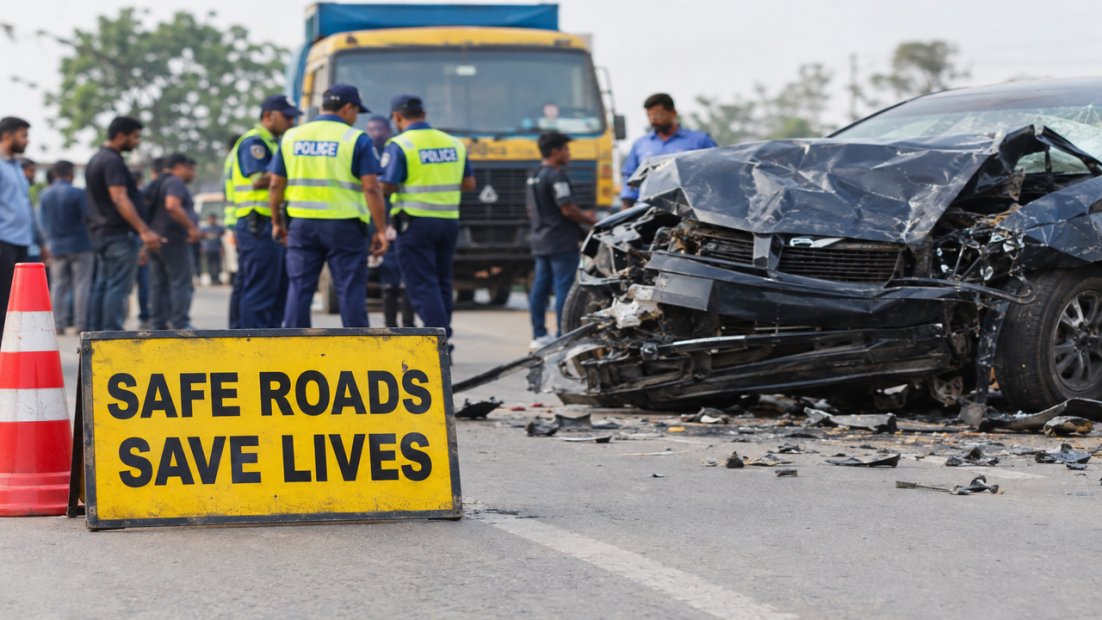
Laws are being amended, penalties are being introduced, and various warnings are being issued. Yet, the number of road deaths is not declining. Instead, it continues to rise. Some transport drivers have become increasingly reckless. Their irresponsible behaviour, excessive speed, unfit vehicles and pedestrians’ lack of awareness are claiming lives and destroying property every day. Despite repeated fatal road accidents, there is little evidence of effective measures to prevent them. These premature deaths are also shattering the dreams of hundreds of families.
Experts say that despite the daily loss of lives and property in road accidents, drivers are rarely given exemplary punishment. The failure to punish offenders, along with their ability to secure bail or be acquitted through loopholes in the law, encourages drivers to become even more reckless. Many people obtain driving licences despite lacking the skills required to operate vehicles. Some also drive heavy vehicles with licences issued for light vehicles.
The traffic police and the Bangladesh Road Transport Authority (BRTA) are responsible for monitoring speed limits, overtaking, vehicle documents and other irregularities involving drivers. However, it is difficult to say that they are fulfilling these responsibilities properly. Even when accidents occur, those responsible often escape punishment through various means. As a result, reckless driving continues.
News reports of frequent road accidents reveal many aspects of this problem. However, some important issues have received comparatively little attention. These include the root causes of such tragic incidents, who should actually be held responsible, and how these accidents should be properly investigated and analysed. Whose unethical practices and gross negligence create the conditions for such accidents? Ultimately, who should be held specifically accountable? These questions deserve serious consideration.
There is a saying in marketing: “If a seller can procure a good product to sell, it can be considered half sold.” Similarly, having a skilled driver behind the wheel provides a greater assurance of reaching a destination safely. The question, therefore, is who assesses drivers’ skills. Who authorises inexperienced drivers to operate vehicles on public roads and puts the lives of others at risk by handing them the steering wheel?
Every country has an authority responsible for issuing driving licences. Such an authority also operates in Bangladesh. Its responsibility is to ensure that an applicant has the necessary skills and meets all the relevant requirements before issuing a licence. However, the situation in Bangladesh often appears to be that anyone who can somehow handle a steering wheel is considered qualified to drive. In some cases, the authorities do not even adequately establish whether an applicant can actually drive.
There have also been widespread concerns about fake driving licences. This raises another question: how can people continue driving with forged licences despite the regular presence of so many law enforcement personnel on the roads? Are the authorities unaware that many driving licences are fake? Who issues these licences, and who is responsible for verification and investigation?
It is clear that trying to reduce road accidents without addressing these fundamental failures is futile. At one point, a law was introduced stipulating that a driver responsible for a road accident resulting in death would face a proper trial and could receive the death penalty. However, the government eventually backed down in the face of protests by transport workers. Later, life imprisonment was introduced as a punishment, but this also failed to produce the expected results.
It is now time to examine whether the authorities responsible for issuing driving licences have properly assessed applicants’ skills and qualifications before certifying them as drivers. This matter requires a thorough investigation because driver incompetence is often one of the main causes of accidents. If the authorities exercise due caution, road accidents should naturally decline.
Accidents can happen whenever vehicles are on the road. However, given the rising number of accidents in Bangladesh, the consequences will become even more severe unless the underlying causes are addressed. Another important issue is the roadworthiness of vehicles. Defects in vehicle components and engines can also cause accidents.
A system is in place to inspect vehicles at regular intervals and issue fitness certificates. However, irregularities are common in this area as well. Those responsible for inspecting vehicles often appear more interested in how much money they receive under the table than in checking the actual condition of the vehicles.
There are also instances of negligence and irregularities among those responsible for traffic control. Our demand to the authorities is that, alongside introducing appropriate punishments for drivers, exemplary penalties must also be imposed on those responsible for allowing unskilled and inexperienced drivers onto the roads, as well as those tasked with ensuring that vehicles are roadworthy.
The death penalty for drivers has been repeatedly discussed. However, little attention has been paid to punishing those who enable unqualified drivers to operate vehicles. The time has come to hold not only drivers responsible for accidents accountable, but also officials whose negligence and irregularities contribute to them.
This does not mean that drivers should escape punishment. After an accident, an investigation must establish whether a driver deserves punishment by examining the driver’s role in the incident. As for those who confidently drive with fake licences, Bangladesh has policies and laws governing vehicle movement and traffic management, but these do not appear to be properly enforced. Traffic officials and employees responsible for collecting information, investigating cases and identifying fake, forged or counterfeit licences may also be failing to perform their duties properly because of dishonesty.
The final point is that effective solutions must target the source of the problem. To prevent these failures from taking root, honest and dedicated personnel must be recruited. Their performance must be properly evaluated, and appropriate structural incentives must be ensured within their employment system. Only through such measures can the demand for safe roads be fulfilled.
The writer is a journalist and columnist.