Turkish Influence in the Middle East Draws Growing Attention from Israeli Media
Turkey’s growing influence in the Middle East, driven by its close ties with Qatar and expanding naval cooperation with Egypt, has attracted significant attention from Israeli media. Analysts are examining the potential impact of these developments on regional security and the balance of power.
Israeli media outlets have highlighted Turkey’s expanding diplomatic and military influence across the Middle East. Ankara’s deep strategic partnership with Doha and growing naval cooperation with Cairo are being viewed as developments that could reshape regional security dynamics.
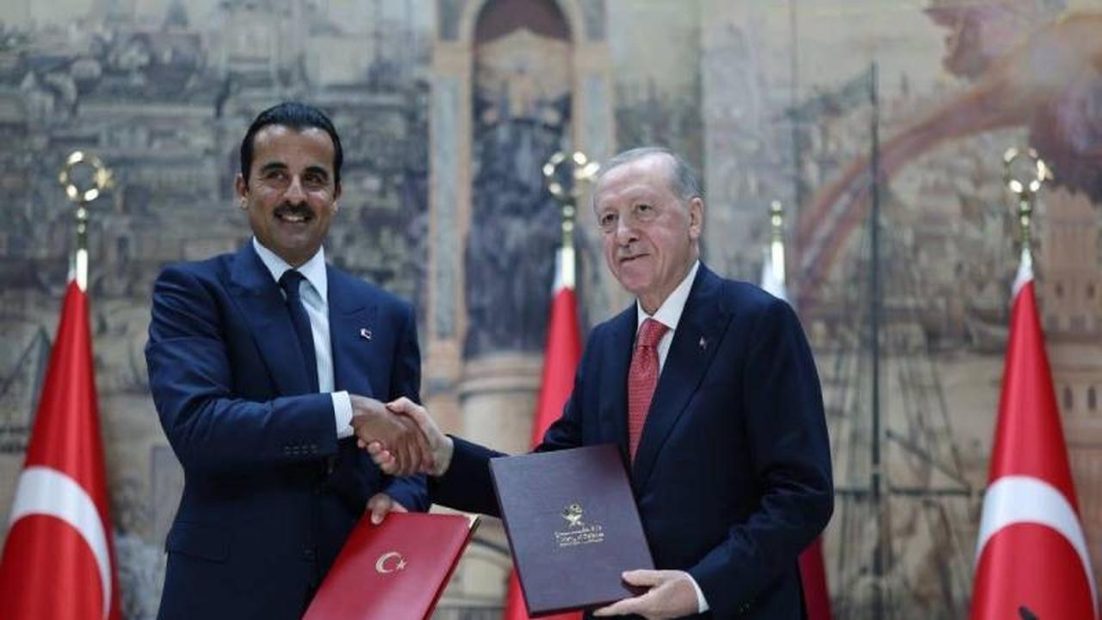
Following the signing of agreements between Turkey and Qatar at Istanbul’s Dolmabahçe Palace, Israeli newspaper Haaretz analysed Turkey’s expanding relations with Gulf countries. The newspaper described the partnership as part of Ankara’s broader efforts to strengthen its regional role.
Five agreements covering defence, trade, education and diplomacy were signed during the 12th meeting of the Turkey-Qatar Supreme Strategic Committee in Istanbul last week. Among them was a mutual defence agreement aimed at strengthening security cooperation against external threats.
Before overseeing the signing ceremony, Turkish President Recep Tayyip Erdogan and Qatar’s Emir Sheikh Tamim bin Hamad Al Thani held a private meeting and delegation-level talks at the president’s Dolmabahçe office.
According to Haaretz, uncertainty over the future of US security commitments in the Middle East has encouraged regional countries to diversify their defence partnerships, creating new opportunities for Turkey. The report noted that Gulf countries are no longer limiting themselves to conventional arms purchases.
Instead, they are seeking partnerships that strengthen deterrence capabilities, maritime security and their influence over regional developments. Haaretz argued that Turkey offers a combination of military capabilities, defence industry cooperation and diplomatic engagement that differs from Israel’s approach.
Muhammad Mazhar Shaheen, a faculty member at the College of Education and Arts at Lusail University in Qatar, told Daily Sabah, “The Turkey-Qatar relationship should be viewed as a strategic partnership that is much deeper than traditional bilateral diplomatic relations.”
Mr. Shaheen stressed that the two countries share similar positions on several regional issues, including Gaza, Syria, Libya, Sudan, Somalia and Yemen. Referring to the presence of Turkish land, naval and air forces in Qatar, he said defence cooperation between Ankara and Doha went beyond formal agreements and reflected an active strategic partnership.
The mutual defence agreement aims to strengthen collective defence capabilities through close military coordination between Ankara and Doha and to promote regional security and stability. A joint statement issued by the Turkish Foreign Ministry after the meeting said the agreement reflected both countries’ commitment to protecting their sovereignty and territorial integrity.
Both sides agreed to expand cooperation through joint military exercises, defence industry partnerships and exchanges of military personnel for training. The statement also highlighted the Badr Memorandum of Understanding, signed by Turkey, Qatar, Pakistan and Indonesia as a framework for joint defence production, technological development and stronger supply chains.
Mr. Shaheen further noted that Turkey’s growing defence industry had made it an important strategic partner for Gulf countries. Its role is expanding in areas ranging from unmanned aerial vehicles (drones) and air defence systems to military training, intelligence sharing and security cooperation.
He identified three key factors driving Turkey’s expanding partnerships with the Gulf region: security diplomacy, economic integration and cultural diplomacy. On security diplomacy, he said Turkey had demonstrated an ability to understand the security needs of Gulf countries and provide practical solutions. Regarding economic integration, he highlighted opportunities for cooperation in trade, investment, energy, transportation and technology.
He also stressed the importance of cultural diplomacy, saying that Turkish language education, university partnerships, cultural exchanges and shared historical ties were strengthening relations between societies in the two regions.
Turkey-Egypt Relations Also Under Israeli Scrutiny
In a separate report, Mako, a news website affiliated with Israel’s Channel 12, examined growing military cooperation between Turkey and Egypt, particularly the possibility of jointly building warships and expanding naval coordination in the eastern Mediterranean.
The report expressed concern over the potential strategic implications for Israel as Ankara and Cairo strengthen their defence relations. During the Friendship Sea 2026 naval exercise in Alexandria, Turkish Naval Forces Commander Admiral Ercüment Tatlıoğlu said the two countries were considering joint shipbuilding projects. Ankara wants to expand maritime defence cooperation with Egypt along the lines of its MILGEM warship programme with Pakistan.
The proposed cooperation could include joint production, training, operational planning and closer coordination between the two navies. Held off the coast of Alexandria from November 4 to 9, the Friendship Sea 2026 exercise marked a major step towards restoring military cooperation between Turkey and Egypt after a 13-year suspension of joint naval exercises.
Turkey deployed several naval platforms, including its largest warship, TCG Anadolu, as well as unmanned systems such as the Bayraktar TB3 drone. The exercise covered air defence, anti-submarine warfare, maritime security operations and specialised naval training.
The expanding cooperation reflects broader efforts by Ankara and Cairo to strengthen diplomatic and military relations after years of tension. For Israel, these developments have renewed questions about the implications of Turkey’s expanding defence partnerships in the eastern Mediterranean.
Professor Shaheen criticised Israeli policies in recent years, describing them as ‘expansionist and aggressive’. He argued that these policies threatened not only Palestine but also the wider Middle East, including Syria and Lebanon. He said efforts to achieve military superiority, violations of neighbouring countries’ sovereignty and repeated actions that trigger security crises would not bring lasting stability to the region.
In contrast, Mr. Shaheen said Turkey, under President Recep Tayyip Erdogan, was pursuing a multidimensional regional policy combining diplomacy, defence capabilities, economic partnerships and cultural ties. He noted that Ankara’s regional influence was steadily growing through its strategic partnership with Qatar, expanding security cooperation with Saudi Arabia and Pakistan, initiatives under the Organisation of Turkic States and a wider diplomatic presence in Africa.
Concluding his remarks, Mr. Shaheen stressed, “Turkey’s rise has not come from ambitions to occupy other countries, expand its own territory or establish dominance over regional states. Rather, its position has emerged because it is becoming a strong regional power capable of protecting the sovereignty, security and political independence of countries in the region.”