386 Teenage Gangs Active Nationwide, Emerging as a ‘Pipeline’ to Crime
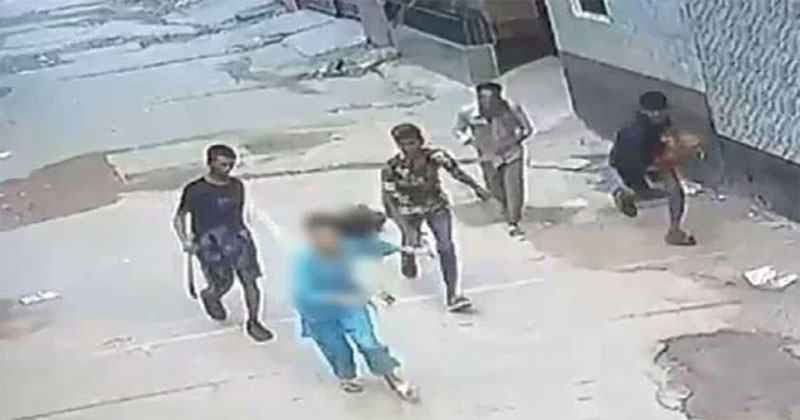
- 386 Teenage Gangs Active in the Country, 159 Operating in Dhaka Alone
- Gang Members Highest in Mohammadpur, Adabar, Bashila, Mirpur, and Pallabi: SRB
- Gang Members Linked to 40 Percent of All Crime in the Country: Police
Hasan uz Zaman
Teenage gangs have become a name of terror. They now pose a serious social problem across the country. They threaten not just individuals and families but society and the state as a whole.
During the 2014 election without real candidates or voters, the ruling party placed young slum children near polling centers as guards during opposition blockades. These children created fear in front of police and helped block BNP and Jamaat activists from protesting. After the election, these same teenagers turned to crime and police began calling them a teenage gang.
This kind of gang first appeared in Dhaka but has now spread across the country. Teenage gangs have become a serious problem in every neighborhood, in Dhaka and beyond. Rival groups fight fiercely to control their local areas.
Gang members openly carry homemade weapons and take part in attacks, beatings, theft, mugging, extortion, robbery, murder, land grabbing, threats, harassment, and drug dealing. Some also work as hired criminals for murder and other crimes. Their activities have created fear in neighborhoods across the country.
Dr. Mr. Touhidul Haque, associate professor at Dhaka University’s Institute of Social Welfare and Research, spoke about the political links behind gang growth. He said politics in Bangladesh needs criminals, and criminals need political power in return. Both sides exchange this support as needed.
He said when power changes hands, control over criminal groups also changes hands. Political connections have given these gangs a lasting structure. He said the people who build and protect these gangs for political use must also be identified and brought under the law.
The 13 year old son of a Comilla University teacher, school student Ishayat Shahriar Apratim, was recently killed by his own friends. Apratim, a seventh grade student, was murdered in a way that shocked the nation’s conscience. This case is now discussed across the country.
After Apratim’s murder, the cruelty of teenage gangs came under fresh scrutiny. Strangely, those accused of killing him stayed in regular contact with his grieving family afterward. Some even posted on Facebook asking about the missing boy, pretending not to know what happened.
Among the accused friends, Tuhin, Fahad, Kamrul, and Siyam, only Tuhin is 19 years old. The rest are between 15 and 17. Investigators and psychologists were shocked by how normally the accused behaved even after killing a friend.
Investigators say the main accused, Tuhin, was trying to build his own gang. He reportedly wanted to recruit Apratim into it. He would gather other teenagers under the pretense of making TikTok videos.
Police data shows that teenage offenders are linked to 40 percent of all crime in the country now. Law enforcement agencies struggle to control this trend. After Apratim’s murder, police in Comilla launched an operation against teenage gangs there.
Around 600 suspects were detained. Most were released after signing bonds. Surprisingly, some teenagers reportedly escaped from inside the police station itself while chanting slogans, though local and district police denied any such incident of attack or vandalism.
In the capital itself, law enforcement recently found teenagers involved in vandalizing a health center in Mirpur and in a plot grabbing incident in Mohammadpur. These cases drew wide attention.
On average, 20 murders occur every month in Dhaka. Police found that teenage offenders were behind most of these killings. After each high profile case, police arrest a significant number of young offenders.
However, once released on bail, these offenders often become more dangerous than before. Fueled by a desire for revenge after their arrest, they return to crime. This cycle has made it difficult to control gang culture, and both the number of gangs and their membership keep growing.
Crime experts say teenagers fall into crime due to the lure of quick money, the spread of gang culture on social media, and weak law enforcement. These combined factors continue to push young people toward criminal activity.
Assistant Inspector General (Media) at Police Headquarters, Mr. A. H. M. Shahadat Hossain, told Inqilab that police are still verifying updated figures on the total number of gangs, their members, and arrests nationwide.
Police Headquarters data shows the country had 127 teenage gangs before the July 2024 uprising. After the uprising, a few days of police inactivity and weak law enforcement under the interim government allowed the number to rise to 237.
Some organizations now estimate the number at over 300. At least 50,000 active gang members across the country take part in various crimes. Their criminal activity keeps rising in Dhaka and other divisional cities.
Police say they are focusing on both enforcement and prevention to control juvenile crime. They are taking legal action against gang members based on specific information. They also stress the need to involve families, schools, and local representatives to guide teenagers toward positive activities.
Dhaka has the highest number of teenage gangs among all cities. The capital has 159 gangs involving 1,812 members. Chattogram ranks second with 98 gangs.
Sylhet has 15 gangs, Rajshahi and Gazipur have 13 each, and Khulna has 7 active gangs. Other cities and districts together have 81 more gangs. Many teenagers start with hanging out, using drugs, or small thefts and fights.
Once they form groups, a drive to dominate their area develops among them. This leads them to acquire homemade weapons and drugs.
Wing Commander Mr. A Z M Intekhab Chowdhury, Director of Law and Media at the Special Response Battalion, told Inqilab that around 386 teenage gangs are currently active nationwide. Of these, 159 operate in Dhaka city and 227 operate in other cities and districts.
So far, 2,052 people have been brought under the law. Of these, 144 were sent to correction centers. Gang activity remains especially high in a few areas of the capital, particularly Mohammadpur, Adabar, Bashila, Mirpur, and Pallabi.
Gang activity also continues in Uttara and Jatrabari and other parts of the capital. A recent list from Dhaka Metropolitan Police shows 32 gangs in the Mirpur division and 26 in the Tejgaon division. By police station, Pallabi has 14 gangs and Mohammadpur has 16.
Mohammadpur and Adabar have the highest number of teenage gangs in Dhaka. Last April, in Rayerbazar in Mohammadpur, members of a rival group publicly hacked to death Mr. Imon, leader of the Alex Imon group.
The killing was extremely brutal. Attackers cut off his hands, legs, and separated parts of his body. Police say the deceased Mr. Imon had 18 cases against him, including double murder. Members of the rival Arman Shahrukh gang carried out the killing.
The brutality of teenage gangs continues to shock the public. Law enforcement has conducted operations in these areas but has not been able to fully control the problem. Police say offenders often return to crime soon after being released on bail.
Walls in Mohammadpur, Adabar, and Hazaribagh still carry painted names of various teenage groups. In Adabar and Mohammadpur, groups include Lo Thela, Level High, Patali Group, Dailla Group, Alex Group, Gangchil Group, Farhad Group, Nabi Group, Lengra Nuru, and King Shawon Group.
In Dhanmondi and nearby areas, groups include Brotherhood and Tousif Group. In Tejgaon and Mogbazar, there is the Mainuddin Gang. In Bangshal and Old Dhaka, there is the Jumman Gang.
In Mugda and Khilgaon, groups include Chan Jadu, David King Fall Party, Volume Two, and Bhandari. In Uttara and Mirpur, groups include Gangchil, Max Polu, Battu Bahini, Potato, Kobji Kata Group, and Lal Bahini. In the Khilgaon police station area, notable groups include 999 Group, KG 19, 001 TikTok Group, 007 TikTok Group, Alif Group, and Tareq Group.
Mohammadpur police station’s Officer in Charge, Mr. Mohammad Abdul Halim, told Inqilab that police recently arrested Mr. Joy, second in command of the Mahi group in Mohammadpur. He said he personally interrogated Joy at length.
According to Joy, he was once a dangerous criminal but tried to reform himself after his arrest. He began avoiding his old criminal associates in an effort to change. Soon after, he began receiving constant threats.
The officer said many like Joy want to leave crime but cannot escape it. They are often forced to keep following the orders of their gang leaders. He said new housing companies have emerged in the area.
To protect or grab land, these housing companies fund and arm teenage criminals with money and weapons.
He added that the Rayerbazar area is known as a drug hub, and the Geneva Camp area also has a long history of illegal drug trade. Drug lords provide shelter and protection to criminals to keep their illegal businesses running.
He said police conduct daily operations in the area, arresting more than 20 people on average. He said arresting small time offenders alone will not solve the problem. The root causes must be addressed, and a coordinated effort from all sides is needed.
Adabar police station’s Officer in Charge, Mr. Jahidul Islam Jahangir, said his area once had more than 150 teenage offenders. After the DMP Commissioner announced a zero tolerance policy on gangs, continuous operations by law enforcement led to the arrest of over a hundred criminals.
He said those still active have left the area and are hiding in Keraniganj and nearby areas. Operations continue to track them down.
Experts say law enforcement and punishment alone cannot stop the spread of teenage gangs. They call for a four pronged approach. First, they say, family bonds and cultural engagement must be strengthened.
A long term solution requires economic support for marginalized families, social justice, and an end to political patronage of gangs. Experts also call for counseling, education, technical training, family monitoring, and rehabilitation programs suited to each teenager’s age and situation.
They say combining law enforcement with social and humanitarian efforts is the only way to bring these young people back from crime.
Deputy Attorney General Mr. A. K. M. Rezaul Feroz Rintu told Inqilab that parental neglect is the main cause behind juvenile crime. He said weak monitoring by families allows teenagers to fall into bad company.
He said mild punishment has led teenagers to lose respect for the law. He called for legal reform to increase penalties based on the severity of crimes. He also pointed to easy access to drugs as a major factor.
He said the state should introduce a legal ban on smartphone use for anyone under 18. He added that drug addiction, poverty, poor living conditions, family problems, despair, declining social values, lack of education, and lack of religious guidance are the main causes behind the rise of teenage gangs.
Ms. Rakhi Gangooly, senior psychologist at Dhaka Ahsania Mission’s health sector, told Inqilab that teenage gangs are no longer just a law and order issue. She said they are deeply connected to family life, education, mental health, the social environment, and the safety of future generations.
She said weak family relationships, peer pressure, identity struggles, exposure to violence, drug use, disconnection from school, and a lack of positive opportunities can push a teenager slowly toward criminal groups. If a teenager cannot build a positive identity at home, school, or in society, he may search for that identity elsewhere.
She said preventing this requires a coordinated effort involving families, schools, communities, mental health services, and law enforcement working together.