Despite 4 lakh tonnes of unsold salt, imports allowed
A huge amount of salt made in the country is lying unsold, and salt farmers in Cox’s Bazar and Chattogram are losing money. At this very time, the government has allowed the import of 150,000 metric tons of raw salt, and this has raised new worry among farmers. Farmers fear that if imported salt enters the market, the price and demand for local salt may fall further. Many farmers may then quit salt farming in the next season, as they cannot even cover their costs.
The worry is highest among salt farmers in Kutubdia, Maheshkhali, Pekua, Chakaria, Cox’s Bazar Sadar, Teknaf and Banshkhali. They say officials must first look at the stock in the market, local output, demand, market price and cost of production before they allow new imports. They also demand that the government find a way to sell the unsold local salt and make sure farmers get a fair price.
Farmers say last season’s bad weather and heavy rain cut the output below the target. The market also did not give the price they hoped for. So output fell while the cost of production rose. On top of this came the weight of a huge stock of unsold salt.
According to the BSCIC Cox’s Bazar office, farmers grew salt on a total of 67,757 acres of land in nine upazilas of Cox’s Bazar and in Banshkhali of Chattogram last season. The target was 2.675 million tons. But natural disasters and bad weather cut the output to about 1.935 million tons. So the output fell short of the target by about 700,000 tons.
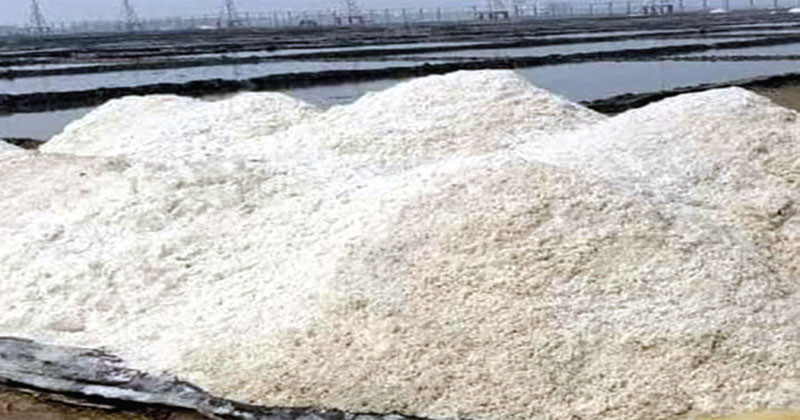
Even so, those concerned say about 400,000 tons of salt is still unsold in the fields and in different storage places. Farmers are unsure how this huge stock will sell before the new season starts. Mr. Idris Mia, an inspector at the BSCIC Cox’s Bazar office, says about 400,000 tons of salt is unsold in the fields. He says heavy rain forced farmers to leave the fields about 15 days earlier than planned last season. This cut the output, and farmers also lost money as they did not get a fair price.
Harunur Rashid, a farmer from West Borobheola in the Matamuhuri area of Cox’s Bazar, grew salt on about 60 acres of land last season. He is the acting chairman of the East Borobheola Union Council in Chakaria upazila. He says the salt cost him about Tk 7 million to make, but he earned only Tk 4 million from sales. So he lost about Tk 3 million. He says he sold each 80 kg sack of salt for Tk 450 to Tk 700 last season. He also paid about Tk 150 per sack to move it. He says the market price was lower than the cost of production, so farmers suffered a big loss. He says he never faced such a big loss in salt farming before.
Nazrul Islam, a farmer from Rampur in the same area, still has about 50 tons of salt unsold. Mizanur Rahman Chowdhury, a farmer from Bahaltoli mouza in Khutakhali union, also has about 50 tons of salt from the last three seasons lying on his land. He grew salt on about 100 acres. Nurun Nabi, a farmer from Badarkhali union in Matamuhuri upazila, put his own money and a bank loan into salt farming on about 300 acres. He has not yet paid back the full loan because of the loss. He says he lost about Tk 8 million in salt farming.
Permission to import 150,000 tons of salt: The Bangladesh Salt Mill Owners Association lobbied for imports. After that, BSCIC advised the Ministry of Commerce to allow salt imports this year. Last week, the government then allowed traders to import 150,000 tons of raw salt.
Under the approval, 244 salt mills can import 543 tons each, which makes a total of 132,500 tons. Seven firms that make salt by the vacuum method can import 2,500 tons each, which makes a total of 17,500 tons of raw salt. In all, the approved import comes to 150,000 tons.
Farmers ask why the government allowed new imports on the basis of an imagined shortage. They point out that a huge amount of field made salt is unsold in many areas, and farmers are losing money as they cannot cover costs. Mr. Mizanur Rahman Chowdhury, known as Khokon Mia, is Vice President of the Cox’s Bazar District BNP and former chairman of Dulahazara union in Chakaria. He says officials allowed the import without looking at the real situation in the fields. He says this can hurt salt farmers and the huge number of people who depend on the sector. He fears that many farmers will not start salt farming from next month.
Shoaibul Islam Sabuj, a farmer from Matamuhuri, and Nazrul Islam, a farmer from Rampur, say something else. They say Home Minister Mr. Salahuddin Ahmed, the local MP, promised a fair price for salt at an opening event in Matamuhuri upazila earlier this year. But farmers still cannot sell the salt they made. They ask why the government allowed imports for fear of a salt shortage instead of finding a way to sell the salt made in the country. They call this a self defeating step.
Mr. Jamil Ibrahim Chowdhury is the President of Matamuhuri Upazila BNP and a former chairman. He says many farmers could not even cover their costs last year. Even so, they are getting ready to grow salt next season to keep their family trade alive. But the news of the import has created new worry among farmers.
A key farm based industry of the country: Salt is not just a daily need. It is also directly tied to the country’s industry and food system. From day labourers in remote areas to people at every level, everyone uses salt in their daily meals. Many factories and industries also use a huge amount of salt.
Millions of people in the coastal areas of Cox’s Bazar and Chattogram earn their living, directly or indirectly, from salt farming, transport, marketing, storage and trade. Those concerned say the lives and livelihoods of at least 1.5 million people depend on this sector. So unrest in the salt market can hurt not only farmers but also the workers, traders, transport workers and others tied to it.
Farmers fear that if imported salt enters the market while a large stock of unsold local salt remains, it can add more pressure on prices. This may lower the interest in investing in farming next season. Salt farmers demand that officials study the real stock, output, market demand, current price and cost of production together before they allow imports. They also demand that the government sell the unsold local salt fast and make sure of a fair price that matches the cost of production. They say that if farmers lose heart about growing salt in the fields, it can hurt this key farm based industry in the future.