China’s Support to Open Golden Gateway to Bangladesh’s Prosperity
Shafiul Alam
The China Myanmar Bangladesh Economic Corridor (CMBEC) has drawn new interest, talk, analysis and research among the world’s economic and geostrategic groups. It may soon rise as an influential bloc in South Asia. Experts say the key to Bangladesh’s “Look East” policy and strategy lies in making this corridor real. They say it will open a golden gate of “eastward” growth. It will also help all three neighbours, and Bangladesh most of all, reach their economic goals.
The three countries agree on the corridor in principle. Only a formal announcement and a three country mega project to carry it out are left, and it is only a matter of time. China is the rising economic and military superpower of the world today. China’s master plan, money and technical help will bring a big change to the modern and joined up corridor link among the three countries.
The corridor route will enter and leave Bangladesh through greater Chattogram and Cox’s Bazar. Then it will pass through neighbouring Rakhine (once Arakan) and other parts of Myanmar. At last it will join Kunming City in Yunnan province in the south west of China. But experts have not finished the final study of the route and layout of the corridor. It is still at the stage of talks, review and research. By size and border, the longest stretch of the three country route will run through Myanmar.
The possible distance by highway and rail between countries may be 1,200 km to 1,850 km. A detour by a different sea route will add more distance. The road and coastal sea route from the Kyaukphyu deep sea port in Myanmar to Chattogram Port and Matarbari Deep Sea Port may add up to about 400 km. China will bear the full cost of building the infrastructure in the Myanmar part of the corridor. Myanmar depends on China in most areas, such as the economy, defence partnership, use of natural resources, infrastructure and technology. The two have been friendly neighbours for a long time. The Myanmar infrastructure for highway, rail and sea port links will be paid for as part of the same mega project with China.
Experts say China is ready to give full help to find a lasting solution to the Rohingya problem, which is in the shared interest of the three countries. It is also ready to help end the unrest inside Rakhine. China will give all the needed help to find a lasting answer to the problem of Muslim Rohingya refugees driven from Rakhine into Bangladesh. It will help them return home fast and help restore their lives, property and civil rights in Rakhine. It will also help end the clashes between the rebel armed group “Arakan Army” and the administration and local people, and the public safety crisis.
Once Rakhine returns to normal, the path to build the corridor will become smooth. China is the main development partner and a tested friend of Myanmar. China is also the main trade and development partner of Bangladesh. With China as a mediator, the Rohingya problem and the unrest in Rakhine can ease. Bangladesh and Myanmar will also back this move.
There is more. China is ready to give full help, including money, to Bangladesh to build the infrastructure for the historic proposal and vision of Chinese President Mr. Xi Jinping to set up the CMBEC. China has given bright examples of help to Bangladesh in the recent past. They include the Chattogram to Dohazari to Cox’s Bazar railway mega project, the Karnaphuli Tunnel and technical help for the Padma Bridge mega project. They also include the Sonadia deep sea port, which the Hasina government later dropped. A recent example is the Chinese special economic and industrial zone mega project at Anwara near Chattogram Port, which Mr. Xi Jinping himself opened.
On the cost of the corridor, award winning economist and former President of the Bangladesh Economic Association Professor Dr. Moinul Islam told Daily Inqilab yesterday that the proposal is China’s. So China will bear the cost of building the link in the Myanmar part. He said there is no cause for worry about this. He said China will also use its good ties with Myanmar to take steps to end the Rohingya problem and the unrest in Rakhine. But he said the worry is that India is against the corridor. He said the BNP government must meet the challenge of passing these hurdles.
Communication expert and BUET Professor Dr. Md. Shamsul Haque also told Inqilab yesterday that a modern multimodal link will grow on the corridor, with highway, rail and sea routes together. He said China will give all help, including money, for this multimodal growth. He said it will be easy to end the Rohingya problem if China takes active steps.
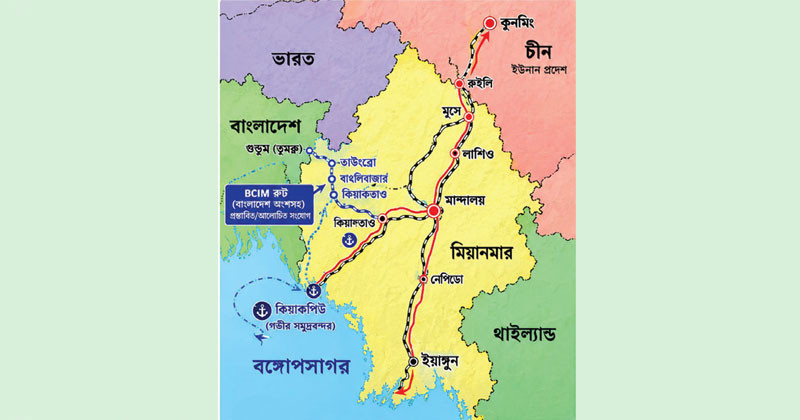
Possible route of the corridor
The possible route of the CMBEC, the three country mega link project, is not yet final. But experts and policymakers are studying it. The main links on the Bangladesh side may run through greater Chattogram, Cox’s Bazar, Ukhia and Ghumdhum into Myanmar. Chattogram Port has special weight here. In future, it may join a bigger logistics network with Matarbari Deep Sea Port, Mongla Port and other ports and shipping. People have also talked about a feeder service, with small container vessels, from Kyaukphyu deep sea port in Myanmar to Chattogram Port.
The corridor will link Yunnan in China to Cox’s Bazar and Chattogram in Bangladesh through Myanmar. The route runs from Kunming in Yunnan province of China to Ruili, Muse and Mandalay in Myanmar. Then it runs from Mandalay through Kyaukphyu sea port to Chattogram. The total length of the joined land and sea corridor may be from 1,400 km to at most 2,000 km. A recent analysis puts the distance from Yunnan in China to the Myanmar coast at about 1,700 km.
There are different views on the distance inside Myanmar. One view says the road corridor from Ruili through the Muse border link to Mandalay is about 450 km. Mandalay to Kyaukphyu Port is about 700 km. Depending on the layout, the planned expressway from Minbu through Ann to Kyaukphyu is about 350 km. The sea route from Kyaukphyu Port to Chattogram Port is about 367 km. The proposed railway from Muse to Mandalay in Myanmar is 431 km long. Officials are preparing the Mandalay to Kyaukphyu railway project.
The most important part of the route from Chattogram to China is Rakhine province in Myanmar. In a large part of Rakhine, the Myanmar government and security forces are not in control. The Arakan Army controls it. A recent report says the Arakan Army controls 14 of the 17 townships in Rakhine province. So to build a road, rail and water route from Chattogram and Cox’s Bazar to Kyaukphyu through Rakhine, officials must solve the Rohingya problem and the public safety crisis. A lasting answer is possible through China’s mediation.
Myanmar is an important neighbour for Bangladesh, just as it is for China in building the corridor. The reason is geography. Myanmar lies east of Bangladesh. Once the route crosses Myanmar, it enters the huge market of South East Asia directly, and the gate of wide “eastward” chances opens. Bangladesh must also join Myanmar with its “eastward” economy, diplomacy and security policy.
Chattogram Port and Matarbari Port link directly to the goal of Bangladesh’s “Look East” policy. The possible geo economic and strategic picture is this: Chattogram, and so Bangladesh, becomes the gateway to East Asia through the Bay of Bengal. Then comes India, Nepal and Bhutan. On the other side, a new world of great chances to build a bridge between South Asia and South East Asia through Myanmar, right next to Bangladesh, remains open. This horizon will open with the corridor.