Three Defence Pacts: Five Muslim Countries Move Towards Self-Reliance in Defence
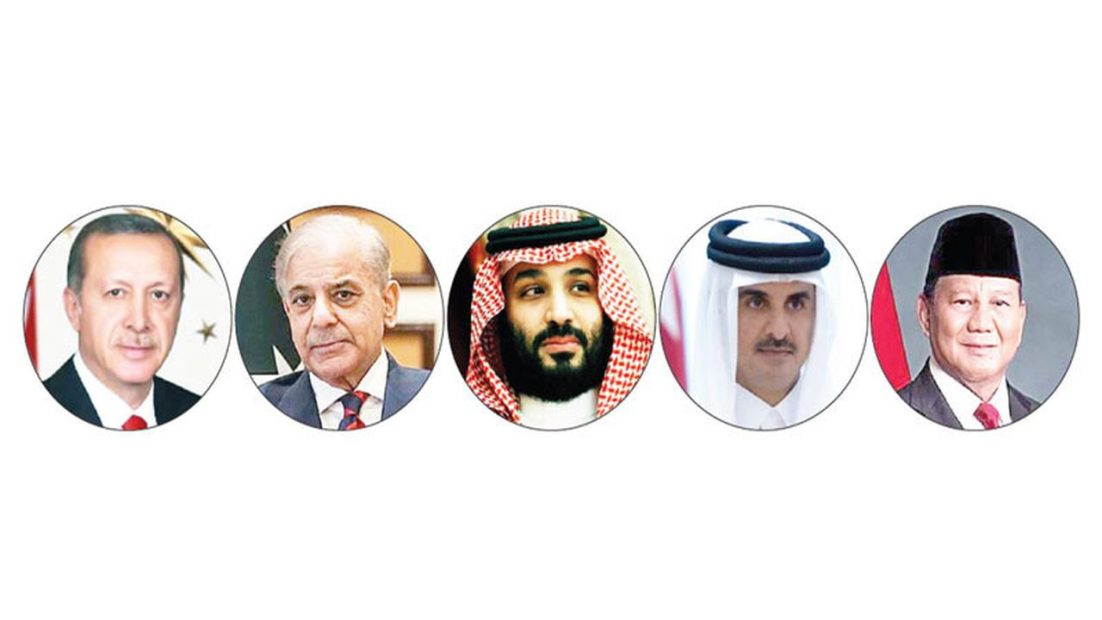
From September last year to October this year, a significant turning point has emerged in the security and defence landscape of the Muslim world. A new strategic equation is taking shape, stretching from Saudi Arabia to Turkey, a country spanning Europe and Asia, and Indonesia in Southeast Asia.
The process began with a bilateral defence agreement between Saudi Arabia and Pakistan in September last year. The second development was the Mecca Agreement, signed on August 7, 2026, involving Pakistan, Turkey and Saudi Arabia. Most recently, the Badr understanding was reached in October among Pakistan, Turkey, Qatar and Indonesia.
These three agreements and understandings have brought five Muslim countries under a common security and defence framework. They include Saudi Arabia and Qatar, both wealthy countries with vast oil resources; Turkey, a major military power with advanced technology; Pakistan, a strong military power with nuclear weapons; and Indonesia, the world’s most populous Muslim-majority country.
Indonesia is an archipelagic nation covering 1.904 million square kilometres, or 735,530 square miles, with a population of around 287 million. These three agreements are not offensive military alliances. Rather, they can be viewed as arrangements for collective defence. One of the most significant features of the Saudi-Pakistan defence agreement is that an attack on either country would be treated as an attack on both. If Saudi Arabia came under attack, Pakistan would consider itself attacked and come to its assistance. The same principle would apply if Pakistan were attacked.
The second agreement is the defence pact among Pakistan, Saudi Arabia and Turkey. Since it was signed in the holy city of Mecca in Saudi Arabia, it has been called the Mecca Agreement. Like the Saudi-Pakistan pact, it is a trilateral defence arrangement. If any one of the three countries were attacked, the other two would consider themselves under attack and assist the country concerned.
Turkey’s Growing Role
Turkey’s participation is a particularly significant feature of the agreement. As noted earlier, Turkey is a transcontinental country, with territory in both Asia and Europe. It is also the only Muslim-majority country that belongs to the Western military alliance NATO. Before President Recep Tayyip Erdogan came to power, Turkey was largely shaped by a Western-oriented political and institutional model.
Turkey covers 302,535 square miles. As of December 31, 2025, its population stood at 86,092,168. Its armed forces comprise around 480,000 personnel, with another 380,000 in reserve. The country has approximately 2,300 tanks and manufactures its own tanks and artillery.
The F-16 Fighting Falcon is among the notable aircraft in the Turkish Air Force. Turkey is also internationally known for its drones, which it manufactures domestically and exports to many countries. It also produces attack helicopters.
One of the most notable elements of Turkey’s air defence system is the Russian-made S-400 long-range missile system. Turkey’s purchase of the system also contributed to tensions between the United States and India. Among the five countries, Turkey has the strongest navy. It operates 14 submarines. One of the most important changes in its military capabilities is that it can now manufacture some of the weapons and equipment for which it previously relied heavily on foreign suppliers.
Turkish defence production covers aircraft and drones, radar and electronic systems, missiles, weapons, artillery and ammunition, tanks and armoured vehicles, as well as warships.
Indonesia’s Military Capabilities
Indonesia’s military strength has not reached the level that might be expected given its population and geographical size. Nevertheless, its existing capabilities are significant. The country has around 400,000 military personnel. Its tank inventory includes older models such as the Leopard, but Indonesia also manufactures its own armoured vehicles. Its air force is more modern than its land forces. It operates 33 US-made F-16 Fighting Falcons, Russian-made Su-30 and Su-27 aircraft, and 13 French-made Rafale fighter jets.
As an archipelagic nation, Indonesia also maintains a relatively strong navy. It has an aircraft carrier, a capability that, to the author’s knowledge, no other Muslim-majority country possesses. Indonesia also operates four submarines.
Pakistan and Saudi Arabia
I will refrain from discussing Pakistan’s military strength here because I have written about Pakistan and its military capabilities several times in this column in The Daily Inqilab. I have also discussed its nuclear weapons. There is no need to repeat those details today.
Saudi Arabia’s military capabilities, however, present a disappointing picture. For the past 10 years, the country has spent between $70 billion and $80 billion annually on its armed forces. Yet, at the time of writing, it does not operate any US-made F-16 Fighting Falcons. Its combat aircraft fleet includes F-15s and F-14s.
The United States has continued to benefit from Saudi Arabia’s huge defence spending without helping the kingdom develop a sufficiently strong and independent defence system. Even the Houthis have attacked Saudi airports, despite not being a state military power. Saudi Arabia has had to seek assistance from countries such as Pakistan for its defence
It appears that Saudi Arabia has finally recognised the need to strengthen its military capabilities. A few days ago, it expressed interest in purchasing fifth-generation F-35 fighter jets from the United States. Israel has opposed the proposal, while it remains uncertain whether the US Senate and House of Representatives will approve the sale.
Qatar’s Strategic Position
Qatar is a small country, covering 4,493 square miles, with a population of 3,370,611. Given its small population and territory, there is little reason to expect it to maintain a large military force. However, Qatar is wealthy because of its substantial oil and gas resources.
Western powers have long maintained a strong interest in the country because of its wealth. As a Muslim-majority country, Qatar has therefore joined security and defence partnerships with other Muslim countries.
Why the Badr Understanding Matters
According to a Reuters report, the Badr understanding aims to strengthen cooperation in military production, technical training, research and development, and the defence industry. Statements from Turkey’s defence industry authorities have also emphasised technology transfer and joint production rather than simply purchasing finished weapons.
Why could the Badr understanding prove particularly important in the long term?
A country can buy 100 military vehicles from abroad. But if it remains dependent on the supplier for spare parts, software, maintenance, ammunition, sensors and upgrades, its military independence remains limited.
By contrast, if several countries jointly develop technology and establish systems for production, testing and maintenance, they could reduce pressure on foreign exchange reserves, develop domestic industries and skilled workers, improve the reliability of spare-parts and ammunition supplies, and reduce the impact of foreign sanctions or political pressure. They could also create opportunities to export weapons and defence technology to third countries.
The most significant long-term development across these three agreements is the shift from relying on foreign powers for security towards building their own collective security and defence-production capabilities. The countries could move towards regular joint military exercises, intelligence sharing, air defence, counter-drone systems, maritime security and joint weapons production. Such cooperation could also reduce the burden of defence spending on individual countries.
They could cooperate in establishing joint factories, conducting research and exporting weapons, while retaining their independent foreign policies and military decision-making powers. This approach is most consistent with the stated industrial objectives of the Badr understanding.
Broad Partnerships, but Limited Implementation
The agreements are politically significant, but practical military integration may remain limited because of differences in national interests, funding shortages, technological constraints and regional disputes. In conclusion, over the past 80 years, Muslim countries have largely depended on either the Western world or the communist bloc for their defence needs. These three agreements may not make them self-reliant immediately. However, they mark a step towards achieving greater defence self-sufficiency through cooperation among Muslim countries.
Email: journalist15@gmail.com