Students Protest Jinnah, While Mujib, Surya Sen and Pritilata Halls Remain
Journalists and political commentators often face moments of intense deliberation over topic selection, torn between a complete absence of subjects or an overwhelming wave of competing historical and political developments. Today’s landscape presents the latter dilemma, with several significant news stories surfacing simultaneously across Dhaka University and the national political stage. Among these, two major occurrences at Dhaka University stand out: a controversial archival incident involving historical portraits and the ongoing process to alter the name of a prominent residential hall. Meanwhile, high-level diplomatic engagements in Dhaka and new revelations concerning kleptocratic networks during the past administration add further layers of complexity to the current political discourse.
At the DUCSU Archives, Abu Taher Habildu, who has remained a student at Dhaka University for twenty-four years after enrolling in the Department of Urdu in 2002, stirred widespread controversy on the inauguration day. Habildu, often described as a classic example of an ‘Adu Bhai,’ publicly tore down and trampled a portrait of Mohammad Ali Jinnah. Curiously, a portrait of Sheikh Mujibur Rahman hanging on the very same wall remained completely untouched and intact during the incident. Newspaper reports have yet to clarify the exact stance or role of DUCSU, while the positions of dominant student factions like Islami Chhatra Shibir and Bangladesh Jatiotabadi Chhatra Dal (JCD) remain equally ambiguous.
Concurrently, a separate controversy has emerged at Shahid Osman Hadi Chhatra Hall, where official steps have reportedly been initiated to revert the facility’s name to Sheikh Mujibur Rahman Hall. On Wednesday, September 30, workers began erasing the name ‘Shahid Osman Hadi Hall’ from the main entrance gate around noon, following reports in two national dailies on October 1. The original name of Sheikh Mujib had previously been replaced with Shahid Hadi Hall late one night in December 2025, following intense demands from general students.
The proposal to restore Sheikh Mujib’s name reportedly gained traction within the University Senate, with professors Lutfar Rahman and Samina Yasmin linked to the initiative under the indirect encouragement of Vice-Chancellor ABM Obaidul Islam. In explicit protest against this move, five DUCSU Senate members staged a dramatic walkout from the session, including VP Sadiq Kayem, GS SM Farhad, AGS Mohammad Mohiuddin, Transportation Secretary Asif Abdullah, and member Sabikunnahar Tamanna. Political analysts note that if Sheikh Mujib’s name is officially reinstated over Hadi’s, it will inevitably reopen settled revolutionary questions and trigger broader national debate.
This attempt to reinstate Sheikh Mujib’s legacy directly reopens fundamental questions surrounding the outcome of the August 5, 2024 revolution. Analysts actively question why a massive statue of Sheikh Mujib was pulled down near the Rangs Building during the uprising, and why over 4,000 murals and statues were demolished nationwide during the interim government if his honor is now being restored. These observations do not imply opposition to the post-revolution policies, but rather highlight deep political contradictions within institutional decision-making processes.
The post-revolution trajectory has consistently sought to dismantle the personality cult built around Sheikh Mujib over the previous fifteen years. Following the political transition, the interim government led by Dr. Muhammad Yunus canceled the public holiday on March 17 as well as the National Mourning Day on August 15, both of which have been maintained by the elected government under PM Tarique Rahman since taking office on February 17. When journalists previously asked Dr. Yunus about the tarnishing of Mujib’s image, his succinct response was, ‘Ask his daughter’, a statement reflecting deep political accountability.
Despite these executive policy shifts, significant legal contradictions and constitutional loopholes persist twenty-five months after the revolution. Although the High Court invalidated the 15th Amendment, Sheikh Mujib’s March 7 speech and declaration of independence remain in the constitutional schedules, and Article 4A continues to legally designate him as the ‘Father of the Nation ‘. This statutory requirement to display his portrait across public institutions creates the exact loophole currently being leveraged to remove Hadi’s name and restore Mujib’s.
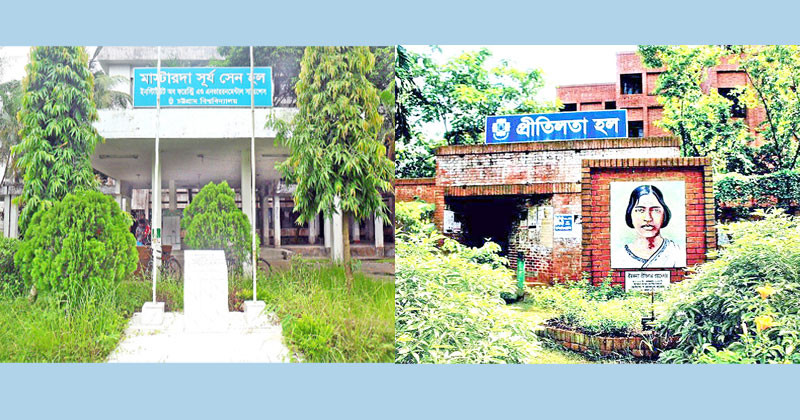
A broader examination of historical naming conventions in educational institutions reveals selective memory regarding pre-independence figures. Student halls across Dhaka University and Chittagong University remain named after revolutionary figures like Surya Sen, who died in 1934, and Pritilata Waddedar, who died in 1932, years before the 1947 partition. Similarly, Iqbal Hall was renamed after independence, even though the poet Allama Iqbal died in 1938 and remains widely respected across South Asia for literary compositions such as ‘Sare Jahan Se Accha.’
During the 1969 Mass Uprising, figures like Sergeant Jahurul Haq were martyred by military gunfire, prompting the naming of halls in their honor to commemorate the democratic struggle. In contrast, the treatment of early historical figures like Mohammad Ali Jinnah often lacks complete context regarding their democratic interactions with student groups. Historical records document how political leaders navigated student opposition during the formative months of the post-colonial state.
When Jinnah delivered his address regarding the state language at Curzon Hall on March 24, 1948, students openly shouted ‘No, No!’ in protest. Rather than deploying police force, ordering lathi charges, or making arrests, Jinnah met with student representatives that evening to explain his stance on a national lingua franca while assuring them that Bengali would remain East Bengal’s official language. Following that meeting, he returned to Karachi and never spoke on the language issue again before his death in September 1948.
These historical accounts were documented by Tofazzal Hossain Manik Mia, the founder-editor of The Daily Ittefaq and a close associate of Suhrawardy and Sheikh Mujib. The contrast between Jinnah’s historical tolerance toward protesting students and the post-independence governance under Mujib, marked by the paramilitary actions of the Jatiya Rakkhi Bahini and the imposition of one-party Bakshal rule, underscores the complexity of the ongoing archival controversy.
Beyond university campuses, significant diplomatic developments unfolded as India’s National Security Advisor, Ajit Doval, made a brief, secretive visit to Dhaka on Saturday, September 17. During his stay, Doval held high-level discussions with Army Chief Waker-Uz-Zaman and DGFI Director General Major General Kaiser Rashid Chowdhury. Notably, Doval concluded his official engagements and returned to New Delhi the same day without holding a formal meeting with Prime Minister Tarique Rahman.
Finally, political attention remains focused on the economic legacy of Sheikh Hasina’s administration, characterized by widespread kleptocracy, plutocracy, and clientelism. Sensational revelations continue to surface regarding early oligarchs, most notably Akhtaruzzaman Chowdhury and his son, former Land Minister Saifuzzaman Chowdhury, who accumulated massive overseas real estate portfolios worth thousands of crores. Facing this influx of heavy political, historical, and diplomatic developments, newsrooms continue to navigate which stories demand primary coverage.