
Zero Tolerance for Awami League’s Hasina Propaganda
Baul singer Abdur Rahman Boyati’s popular song says, “You turned the key and left it open; it has been going on throughout my life.” Sheikh Hasina, who fled to Delhi after being sentenced to death, appears to have adopted a similar strategy. Sitting in Delhi, she announced on August 5 that she would return to Bangladesh in December. Since then, there has been continued publicity about her return, while preparations are also underway to prevent her return and stop any disorder by the Awami League, whose organisational activities have been banned. Sheikh Hasina, who has become politically irrelevant, is once again being brought into the political discussion.
With what the article describes as encouragement from Hindutva-oriented India, Sheikh Hasina held a press conference and announced that she would return in December. However, the Bangladesh government had been seeking her return long before that. The previous interim government made two requests through diplomatic channels, while the elected BNP government made one request for her return. Last month, Indian High Commissioner Dinesh Trivedi met Foreign Affairs Adviser Humayun Kabir. During the meeting, it was reportedly made clear that Prime Minister Tarique Rahman would visit Delhi only if Sheikh Hasina were returned to Bangladesh.
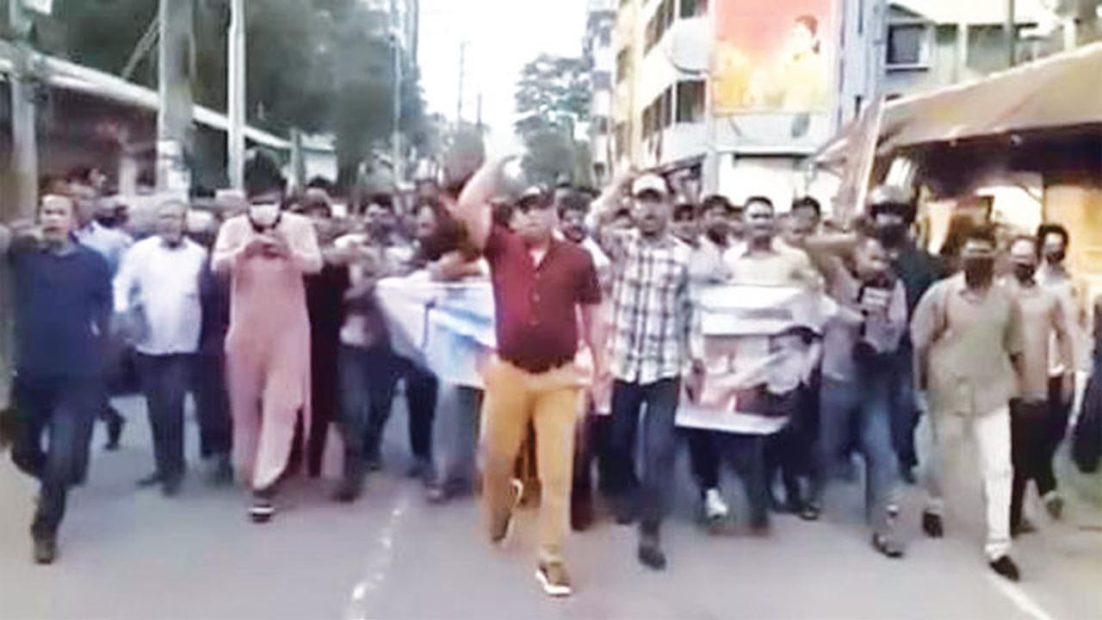
It is not clear whether Ms. Hasina will be brought back under the 2012 Extradition Act or whether she might attempt to return secretly through a border. However, her announcement of a return has created considerable political discussion. Some Awami League supporters have suddenly started holding processions in the hope that Ms. Hasina will return. At the same time, some officials within law enforcement agencies are reportedly waiting for her return. One police officer faced criticism after allegedly suggesting that law enforcement agencies would be unable to take action if Hasina returned.
Some ministers, state ministers, MPs and officials in a so-called progressive group within the ruling administration are also reportedly hoping for Ms. Hasina’s return and for the BNP government to face political difficulties. According to the article, they consider pleasing Delhi more important than the success of the BNP government. However, responsible BNP leaders and senior police officials have taken a firm position to prevent any disorder by the Awami League, dismissing the claim of Hasina’s return in December as unrealistic.
BNP Acting Secretary General Ruhul Kabir Rizvi said yesterday that ousted political forces were working in various ways to put an elected government in trouble and destabilise the country. He urged everyone to remain alert. He also expressed doubts about how a top criminal could escape from a police van.
Several BNP leaders and intellectuals believe that Jamaat’s long march programme may be part of an attempt to create conditions for Ms. Hasina’s return in December. They have questioned why efforts are being made to create political instability through a long march at a time when Prime Minister Tarique Rahman is trying to attract foreign investors to Bangladesh.
Several attempts to create disorder in Bangladesh have allegedly been made since Sheikh Hasina was ousted in the July uprising and fled to India. At different times, these included claims of persecution of minorities, an alleged revolt by civil servants and alleged militant activities. According to the article, these attempts failed because of resistance from the government, political parties and the people.
Later, attempts were reportedly made by several foreign countries, sections of the administration and a particular security force to form a “refined Awami League”. That effort also failed. The article says that Sheikh Hasina later announced her return in December to strengthen Awami League leaders and activists inside Bangladesh ahead of the upcoming local elections.
Initially, Delhi appeared to have indirectly encouraged Ms. Hasina’s position. However, India came under pressure after Bangladesh strongly protested her virtual address at a press conference on August 5. Bangladesh took a firm position and used diplomatic channels to pressure India. Later, several attempts to hold Awami League meetings in Delhi under Ms. Hasina’s leadership were reportedly stopped by Indian law enforcement agencies.
According to the article, Delhi now wants to build relations with the people of Bangladesh and is eager to bring Prime Minister Tarique Rahman to Delhi. As a result, India’s previous position in favour of Ms. Hasina has gradually weakened.
At an international seminar held at a hotel in Dhaka last week, Indian High Commissioner Dinesh Trivedi said, “India had no alternative but to provide Sheikh Hasina with shelter at that time. However, the legal process to hand Sheikh Hasina over to Bangladesh is continuing.”
Meanwhile, the United States has said it does not want to comment on the Ms. Hasina issue. The Donald Trump administration has made it clear that Bangladesh and India will decide on Sheikh Hasina and the future of Awami League politics. Washington will not interfere in the matter.
Bangladesh has repeatedly requested India to return Sheikh Hasina under the extradition agreement. Ms. Hasina, who has been sentenced to death for crimes against humanity, responded with what the article describes as a political stunt by announcing her return in December.
Several government ministers have repeatedly told her, “Sheikh Hasina, please return to the country; take legal assistance; the gallows are ready for you.” Following Ms. Hasina’s announcement, leaders and activists of the banned Awami League have started becoming active. The article says that various preparations are underway within the party, whose leaders and activists had largely remained underground, in anticipation of Ms. Hasina’s possible return.
Although there has been little visible activity on the streets, efforts are reportedly continuing on virtual platforms to distribute organisational responsibilities, activate affiliated and allied organisations, and keep leaders and activists active through regular meetings and seminars. Thousands of members of the party’s social media network have reportedly been activated.
Awami League-linked journalists, content creators, intellectuals and civil society figures in Bangladesh are also reportedly campaigning in favour of Ms. Hasina on television talk shows. The article portrays their position as suggesting that Ms. Hasina could simply return to Bangladesh and regain control of politics.
However, the article says that although the extradition agreement does not create a major obstacle to Ms. Hasina’s return, there are legal and administrative complications regarding how she can return. This has raised several questions in political circles. Through what process will Ms. Hasina return? To what extent will a government decision or permission be required? If Sheikh Hasina, who is currently in India, decides to return on her own, what role will the Bangladesh government have? And how realistic are the preparations being discussed by Awami League leaders?
Political analysts and lawyers say Ms. Hasina cannot simply return whenever she wants. According to them, her announcement is part of a political strategy aimed at preserving the existence of the party and maintaining political influence. The article says that Ms. Hasina is trying to use those she left behind in danger after fleeing the country with members of her family for her own political interests.
However strongly Ms. Hasina may declare that she will return, her eventual return will depend on legal and government procedures. Constitutional experts said, “The arrest of Sheikh Hasina after her return to Bangladesh would be a separate legal matter. However, the government would have to be directly involved in the process. She currently does not have a passport or valid travel document. If she wants to travel by air from another country, she will need a travel document, which must be issued by the Bangladesh High Commission. The High Commission will not take any action outside the government’s instructions.”
Sources said some Awami League leaders and activists have been trying to become active following Ms. Hasina’s announcement that she would return in December. In addition to social media activities, the banned Awami League and its affiliated and allied organisations have reportedly identified seven important locations in Dhaka where they plan to gather on November 13.
Large amounts of money are reportedly being spent to activate leaders and activists of the Awami League and its affiliated organisations, including Jubo League, Chhatra League, Jatiya Sramik League, Tanti League and Matsyajibi League.
As part of these activities, two buses were set on fire in Dhaka, while another bus was set on fire at night. Seven crude bombs were reportedly detonated at four locations. There have also been attempts to create fear among the public through sudden torch processions and stick processions in Dhaka while avoiding police surveillance.
Despite differences among the ruling BNP, the opposition Jamaat and the NCP over various issues, all the major political parties are united against the Awami League, according to the article. Several NCP leaders said that although political parties have differences on various issues, they would not accept the rehabilitation of the Awami League under any circumstances.
The Prime Minister’s Political Assistant Rashed Khan said the Awami League was plotting from India to create disorder during the upcoming Durga Puja celebrations. He said the government had information that the Awami League was conspiring against the elected BNP government. Dhaka Metropolitan Police Detective Branch chief and Additional Police Commissioner Md Shafiqul Islam has announced that any illegal activities by the banned Awami League around December would be dealt with strictly.
At a briefing at the Dhaka Metropolitan Police media centre yesterday, he was asked about the possibility of Sheikh Hasina returning in December and concerns over Awami League programmes or acts of sabotage. He said, “No prohibited activities will be allowed under the law. Those who have been banned by law will not be allowed to carry out any prohibited activities in the country. We are taking a very strict position on this matter and will take appropriate legal action.”
He also acknowledged the authenticity of a leaked audio recording involving former Cantonment Police Station Officer-in-Charge Rakibul. The article concludes that the acknowledgement has raised questions about whether there are still individuals within the police administration who may be working against the government’s position.










