The Ghost of Protests Haunts the BJP Government, Leaving It Sleepless
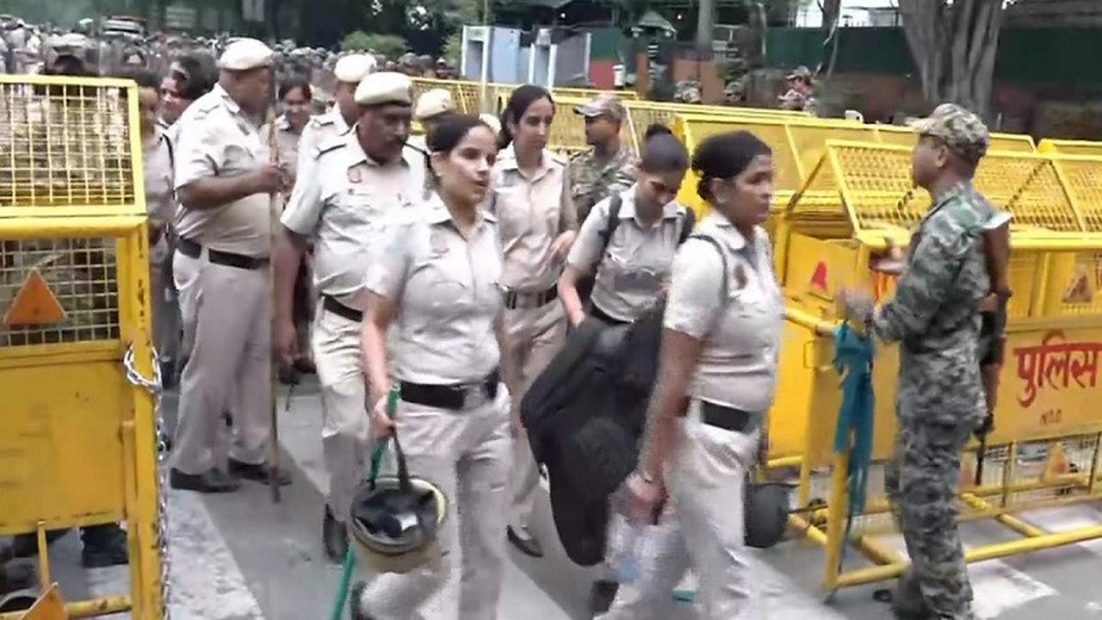
Those who are afraid are the ones who threaten slogan-chanting protesters with batons and guns. Yet the slogans continue to ring out. The government may plug its ears with bullets to avoid hearing them, but everyone else can hear them clearly.
The scenes on Delhi’s streets on October 10 made one thing clear: the Bharatiya Janata Party (BJP) government would no longer be allowed a moment of peace by the people. The government has lost its sleep. It sees opponents everywhere. The ghost of protest is haunting it.
Tall barricades at road entrances and hundreds of alert police officers made it almost impossible for ordinary pedestrians to pass without being questioned. Anyone whose answers raised even the slightest suspicion was turned away.
In effect, every pedestrian appeared to be a suspect in the eyes of the police. My students told me that police picked them up while they were eating pakoras near Minto Bridge. They also saw a young man being dragged out of a public toilet where he had gone to relieve himself.
My wife and I live on the North Campus of Delhi University. We were trying to figure out how to reach the protest site, knowing that it would be almost impossible. I also had to catch a flight to Kolkata, so risking detention by the police did not seem wise. Yet we were eager to be part of the protest.
Our day began with a message from a friend asking whether we were safe. The friend had also contacted several others but received no replies. I suggested that they might have switched off their phones because the police were looking for known dissenters. Soon afterwards, a senior lawyer friend called to ask how he could reach Jantar Mantar. He said he would walk if his car could not get through.
A little later, we received a call from Geeta Sahgal, daughter of the renowned writer Nayantara Sahgal. She wanted to know how the day was unfolding in Delhi. This distinguished Indian woman had called to offer her blessings to the young people fighting against this monstrous injustice.
What were we supposed to do? We knew that police in Delhi, West Bengal, Gujarat, Madhya Pradesh and other states and cities were already moving through neighbourhoods. Whenever they saw a young person on the street, they scrutinised them, wondering whether they were heading to the October 10 protest at Jantar Mantar.
Every Citizen Was a Potential Protester
Delhi Police appeared to be tracking the movements of everyone on the streets, looking for signs that they were heading towards Jantar Mantar. In the government’s eyes, every citizen seemed to be a potential protester.
Large parts of Delhi had been turned into something resembling a military base. Additional police personnel were brought in urgently from West Bengal, Jammu and Kashmir, and Chhattisgarh. Around 20,000 paramilitary personnel were already deployed in the capital, with another 12,000 being brought in. According to the latest information, around 221 companies of the Central Armed Police Forces (CAPF) had been placed at the disposal of Delhi Police.
Ten temporary detention centres were prepared to hold those who would be arrested. Cab companies such as Ola and Uber were reportedly told not to operate on Delhi’s roads around October 10. Hotels were instructed not to accommodate guests. Two major railway stations in the city were completely shut down, and train services were cancelled. Fifty-seven metro stations were closed. Barricades appeared on almost every road, while shops and restaurants were ordered to close early.
Internet services were suspended across large parts of Delhi. Classes at Delhi University colleges were moved online. But how could online classes continue without internet access? No one seemed to have an answer. Heavy police deployments surrounded university campuses. The government feared that allowing students onto campus could turn colleges and universities into centres of protest. Classes were therefore shifted online. Police also maintained a strong presence around the offices of political parties.
Meanwhile, several YouTubers alleged that police had called them and asked them to go to Jantar Mantar to make videos supporting the government, offering them money in return. The message was clear: the government no longer trusted ordinary citizens. Its supporters, some of whom were accused of receiving money, were openly making videos and moving around Jantar Mantar. They threatened to teach the government’s opponents a lesson.
Why were the police not arresting these men who were allegedly trying to provoke violence? Ordinary people were being picked up from their homes simply on suspicion that they might join the protest, while these alleged troublemakers were allowed to move freely. Was it because they were loyal to the police? These were the very people chanting: “Delhi Police lathi charge, we are with you.”
Those carrying batons were free, while those committed to ideas and principles were behind bars. Hundreds of young people had been detained, and the actual number could have been much higher because the police were picking up people wherever they found them.
Police personnel were also occupying numerous homes. This was entirely unlawful. Officers were entering homes and staying there without court orders. Over the past 13 years, such actions appear to have become routine.
Even the courts seemed untroubled by this. When a habeas corpus petition challenging alleged unlawful detention was filed in the Madhya Pradesh High Court, the judges dismissed it. They said the police should return the detained people to their parents.
Consider what this means: adults can be taken away by the police without due legal process, yet the court sees nothing wrong with it. Instead, the petitioners were told to wait until October 13. In simple terms, the police could make you disappear for as long as they wished.
The Supreme Court, too, appeared to consider the government’s decision to bring Delhi to a standstill entirely reasonable. The right to freedom of movement seemed to carry little weight, as the courts appeared more concerned with protecting the government’s ability to remain in power. The court made it clear that a protest without permission was illegal and that the government could take any steps necessary to stop it. Bringing an entire city to a standstill also appeared acceptable.
But what does it prove when an entire state brings all its power to bear against its own people? Who is stronger, and who is more afraid? Those who are afraid are the ones who threaten slogan-chanting protesters with batons and guns. Yet the slogans continue to ring out. The government may plug its ears with bullets to avoid hearing them, but everyone else can hear them clearly.
We understood the situation more clearly when we took the metro from Model Town. The gates at the University metro station were closed. On the train, we met two young people who were also trying to reach Jantar Mantar. They had already spent more than an hour looking for an exit near the protest site. We eventually got off at AIIMS station. A kind auto-rickshaw driver agreed to take us as far as he could. All four of us climbed aboard, and he skilfully navigated smaller roads to avoid police checkpoints. The journey took longer, but the route was manageable.
The Government Is Frightened by the Roar of Silence
We were finally stopped at the intersection near Kasturba Gandhi Marg. Perhaps the police took pity on us because of our grey hair, allowing us to continue as far as the Press Club. Along the way, we had to show our identity cards at three different checkpoints and explain why we were out on the streets on such a difficult day. The Press Club’s main entrance was closed, so we had to enter through the back gate.
Inside, journalist friends were exchanging information. Then one of them received a phone call and told us that Neha Bora was about to begin a march from Dilli Haat. My wife looked at the time and warned me that I would miss my flight to Kolkata if I did not leave immediately.
A journalist friend named Biswadeep offered to take me to AIIMS, where I could catch the metro to the airport. Near the Dilli Haat flyover, we became stuck in traffic. I knew why. Soon, I recognised several familiar faces. We exchanged glances and waved at one another.
My phone rang. It was Ali Shan, who jumped into our car. He told us that Neha and Yogendra Yadav had been detained. Dipankar Bhattacharya was speaking to the media, while some young people had sat down on the flyover. The car moved slowly, but for the first time that day, I did not mind being caught in Delhi traffic.
I was happy that at least I had passed through a route alive with the energy of protest. My friends Atul Sood and Nabsharan were standing there. I regretted that I could not get out of the car and join them. Purba called to say that a friend named Alka had eventually reached the Press Club. They had walked around the area but could not cross the police barricades. After spending an hour trying, they boarded a bus to Punjabi Bagh.
The question remains: Was this a protest, or was it not?
The government may claim victory because it managed to turn Jantar Mantar into a “silent zone”. But there can be little doubt that the deafening roar of that enforced silence is what has left the government deeply frightened.
Source- The Wire