A Congestion-Free Bangladesh Through Planned Public Transport: Drawing Lessons from London
Traffic congestion has become one of the biggest daily problems in Bangladesh’s major cities. Every day, countless people spend long hours on the roads travelling to work, taking their children to school, seeking medical care or running essential errands. This wastes personal time and affects professional and family life, as well as the country’s overall productivity.
Traffic congestion should not be seen simply as a problem caused by too many vehicles. It is closely linked to urban planning, public transport management and people’s access to reliable travel options. Living in London often makes me think about the cities of Bangladesh. The realities of the two countries are different, but some features of London’s public transport system could be adapted to Bangladesh’s needs. Reducing congestion requires more than building new roads and flyovers. It also requires better planning of existing roads, bus operations, drivers’ working conditions and passenger services.
Planned Public Transport Can Drive Change
London has an organised system for bus routes, service standards and passenger information. Although private companies operate buses, service quality is managed through established rules, contracts and monitoring.
From route planning and timetables to passenger information, the system follows a coordinated structure. Bangladesh could develop a similar approach suited to local conditions. Bus ownership may remain private, but key routes, schedules, safety standards, fare collection and passenger services should be managed under a common framework.
This would help make bus operations more organised and reduce inconvenience for passengers. The system could first be introduced on a few busy routes in Dhaka on a trial basis. After reviewing the results, it could be expanded to other routes and major cities.
Clear Bus Colours, Route Numbers and Signs
Each bus route should have a distinct identity to help passengers recognise the right bus easily. London’s buses are generally red, although different route-identification colours and stop signs have been tested in some areas to make routes and destinations easier to identify.
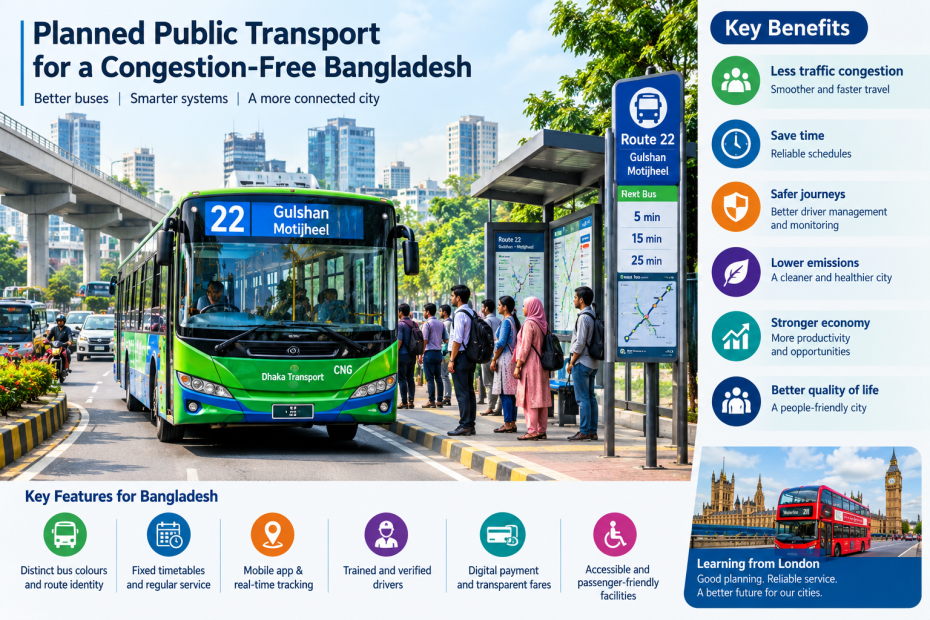
Bangladesh could introduce a similar system. Buses operating on the same route could have a common colour scheme or clear route identity. Large, readable route numbers, destinations and major stops should be displayed on the front, sides and rear of each bus. Bus stops should carry matching colours, route numbers and destination signs.
This is particularly important because not everyone can read easily, and many passengers are unfamiliar with every road, route or destination in a city. First-time visitors may board the wrong bus simply because they cannot identify its direction. This wastes time, causes inconvenience and can increase travel costs.
A consistent colour scheme, combined with clear route numbers and destination names, would make buses easier to identify. Simple symbols and audio announcements could provide additional help. Matching signs at bus stops would also help passengers who have difficulty reading long text.
At the same time, colours should not be the only means of identification. Clear route numbers and destination names are essential to prevent confusion between similar colours. A unified system would also make it easier to set schedules, track buses and evaluate service quality.
Fixed Timetables and Regular Bus Services
Increasing the number of buses is not always the answer. Authorities need to determine how many buses each route requires and when they should operate. On busy routes, a target of one bus every 15 minutes could be considered, with more frequent services where passenger demand is higher.
Reliability is the key. If buses arrive at regular intervals and passengers know when the next bus will come, missing one bus will cause less uncertainty. Publishing a timetable alone is not enough; authorities must regularly monitor whether operators follow it. Passengers should also receive advance information about delays caused by traffic or other problems.
Printed timetables, route maps and, where possible, digital displays showing estimated arrival times should be available at bus stops. GPS-based tracking could help authorities identify service gaps and determine where schedules need adjustment.
Designated bus stops and safe boarding and alighting areas are also essential. Rules must be supported by the necessary infrastructure. Coordinated traffic signals and priority bus lanes at suitable locations could further improve service efficiency.
Reliable Bus Services Can Reduce Dependence on Private Vehicles
An important question is why people use private cars, taxis, CNG-run auto-rickshaws, Uber, Pathao and other transport options. They do not always choose these services simply for comfort or personal preference. Often, they lack confidence that a bus will get them to work, school or an urgent appointment on time.
Uncertainty about bus arrival times, waiting periods and delays encourages people to spend more on private cars or hired vehicles. If buses are reliable, arrive at regular intervals and provide real-time location information, they could become a more convenient option for many people.
In London, people consider parking availability, costs and traffic when deciding whether to use private cars. Public transport can often be easier because passengers can access information in advance about bus and train arrivals and how to reach their destinations.
Bangladesh could create similar conditions. A mobile app showing a bus’s location, estimated arrival time and route would allow passengers to plan their journeys. Knowing when the next bus will arrive would also reduce the need to search for alternative transport after missing one.
This could encourage more people to choose buses instead of private cars or hired vehicles, reducing pressure on roads. However, the change would depend on punctuality, safety, comfort, affordable fares and the ability to meet passengers’ needs. The goal should be to build a public transport system that gives people confidence in choosing buses rather than forcing them to seek other options to save time.
Consistent Rules for Driver Recruitment and Bus Operations
Clear policies are also needed for recruiting bus drivers. A person should not be allowed to drive a passenger bus simply because an owner or operator has hired them, without proper checks. Authorities should verify valid driving licences, training, experience, medical fitness and safe driving records. Drivers’ working hours and rest periods should also be recorded to ensure that they do not work beyond permitted limits.
Regular training and performance assessments could strengthen safe driving practices. The purpose is not to blame any individual or group. It is to establish a system in which drivers work in safe conditions, passengers travel with confidence and transport operators follow clear rules.
Technology, Transparent Fares and Better Passenger Services
Electronic tickets, smart cards and digital payments could make fare collection more efficient. Keeping records of every journey would improve transparency in revenue and expenditure. Passengers should also have an accessible way to submit complaints, with a system to ensure that those complaints are properly resolved.
Printed timetables and clear signs should remain available alongside mobile apps. Buses could announce upcoming stops, display destination information clearly and provide facilities for passengers with disabilities. London’s bus services include live travel information, stop announcements and wheelchair ramps. These are among the features Bangladesh could consider adapting to its own circumstances.
A Step-by-Step Approach Is the Most Practical Option
Bangladesh should begin by selecting a few busy routes instead of attempting to change the entire system at once. A pilot programme could introduce standardised bus colours and route identities, regular timetables, driver shifts and rest periods, GPS tracking and transparent fare collection.
Authorities should then assess punctuality, passenger waiting times, accident and safety records, drivers’ working conditions and public satisfaction. Necessary changes could be made before expanding successful initiatives to other routes and cities.
Not every feature of London’s transport system will suit Bangladesh directly. However, planned routes, clearly assigned responsibilities, adequate driver rest, effective use of technology and proper monitoring can be adapted to local needs.
Building a Congestion-Free Bangladesh
A city’s development should not be measured only by the number of roads or major infrastructure projects it builds. How easily people reach their workplaces, how safely students travel to school and how much time residents save during daily journeys are also important measures of progress.
My experience of living in London has convinced me that planned public transport, safe working conditions for drivers, regular bus services, effective technology and responsible management can work together to improve people’s travel experience.
The goal should not simply be to increase vehicle speeds. It should be to save people’s time, reduce road accident risks and ensure safe and dignified mobility for everyone. With practical planning, consistent monitoring and gradual reforms, Bangladesh can move towards a more effective public transport system. A congestion-free Bangladesh is not merely a dream of better roads; it is a vision of a well-planned, safe and people-friendly urban life.
The author is a politician and columnist.