31 Years On: Chatkhil Municipality’s Waste Management Negligence Exposes Residents to Severe Health Risks
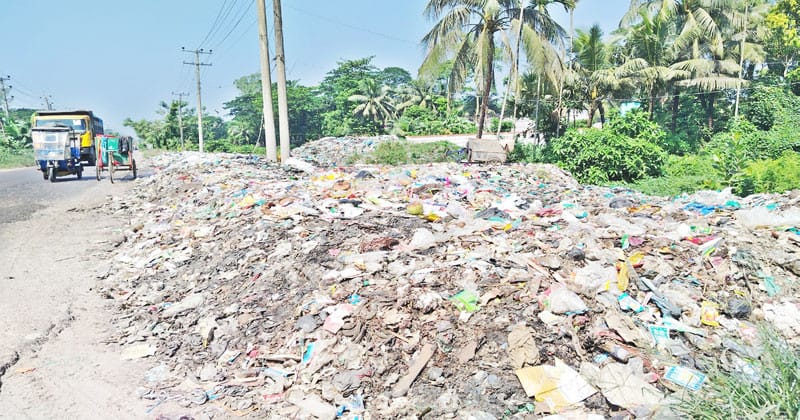
Despite being designated as a first-class municipality since its establishment in 1995, Chatkhil Municipality in Noakhali has failed to construct a permanent waste management facility over the past 31 years. Lacking a dedicated dumping yard, municipal authorities have resorted to piling up garbage along major roads and near densely populated residential zones. The situation is most difficult in Ward No. 2 near the 11-No. Pole area, where roadside garbage heaps have grown into small mountains, polluting the surrounding environment and creating severe health hazards for locals.
The daily dumping of market and household refuse has generated an intolerable stench, turning daily commutes into a nightmare and driving an alarming surge in mosquitoes and flies. Distressed residents report that keeping doors and windows closed offers no relief from the foul odor and pest infestation. A resident named Rima, who lives roughly 100 cubits from the main dump site with her large family, shared that the toxic conditions severely affect her children’s appetites and frequent illnesses. Local commuter Mohammad Shamim Hossain added that breathing normally, sleeping, and eating have become daily struggles, urging officials to relocate the site immediately.
Educational institutions are also bearing the brunt of the crisis, with a local madrasa situated right beside the expanding waste pile. Habibur Rahman, a teacher at the madrasa, highlighted that young students suffer constantly from asthma, allergies, coughing, and stomach ailments due to the overwhelming fumes. He noted that fearful parents are increasingly withholding their children from attending classes. Although the madrasa management committee formally submitted written applications demanding urgent relief to both the municipal office and the Upazila Nirbahi Officer (UNO), no effective remedial action has been taken so far.
Addressing the public outcry, Saiful Islam, Assistant Engineer of Chatkhil Municipality, acknowledged that dumping waste in populated zones lacks legal grounds but explained it was temporarily chosen on government land due to a lack of suitable alternatives. Furthermore, Mizanur Rahman, Municipal Administrator and UNO, expressed regret over the ongoing distress, assuring that plans for a permanent facility are underway. He revealed that government land has been designated and financial support requested from the World Bank for a modern dumping yard, while bleaching powder and mosquito control sprays are currently being applied.
Health experts and environmental academics have issued stark warnings regarding the long-term consequences of this unmanaged municipal solid waste. Dr. Shahrin Akter, Chatkhil Upazila Health and Family Planning Officer, warned that indiscriminate waste disposal is triggering widespread respiratory infections, diarrhea, and mosquito-borne diseases like dengue, placing pregnant mothers and young children at elevated risk. Meanwhile, Shamima Akter, Assistant Professor of Biology at Chatkhil Women’s Degree College, emphasized that the municipality should transition toward sustainable practices by segregating waste to produce organic fertilizer, biogas, and electricity.
The ongoing crisis in Chatkhil highlights an urgent need for immediate municipal intervention to mitigate severe environmental and public health threats. While long-term projects like the proposed World Bank-assisted facility offer hope for a permanent solution, the immediate reality for residents remains defined by hazardous living conditions. Municipal authorities must expedite short-term relief measures and accelerate the construction of the official dumping yard to restore clean, livable conditions and safeguard the well-being of the local population.