China, Myanmar and Bangladesh corridor is a new horizon of possibility
Dr. Mahruf Chowdhury
In the twenty first century, countries at the center of connectivity will gain the most, both in economy and in strategy. In international development studies, infrastructure links are not seen only as better transport. They are seen as a key condition for wider markets, lower trade costs, higher productivity and a place in regional value chains. A corridor can turn the limits of its geography into an economic chance, especially when it links a seaport with landlocked or distant production and market centers. So in the modern world, the question “where is a country located” matters less and less. The question “how well is the country connected to which regions” matters more and more.
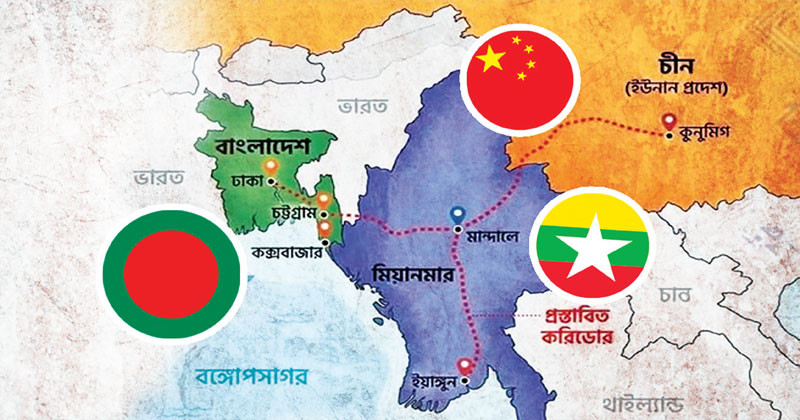
For Bangladesh, a land link with China through Myanmar is part of this bigger picture. It is not only about building a road or a railway. It is closely tied to Bangladesh’s future economy, regional trade, industry, supply systems and geopolitical chances. If good land and multi mode links grow between China’s Yunnan province, central and western Myanmar, and the ports and economic zones around Chattogram, a new economic axis could form. It would join south west China with the Bay of Bengal.
This would not only give Bangladesh a new way into the Chinese market. Bangladesh could also become a key link in a larger regional network of production, trade and logistics. But we cannot see the real meaning of this chance if we treat it as a simple infrastructure project. A corridor makes economic sense only when border management, customs, cargo transport, warehouses, logistics, digital trade systems, investment, industry and regional markets work together. A road can start a corridor, but a corridor economy grows only when a full system of production, trade and services forms around it.
So the land link with China through Myanmar is a transport project, a trade chance and a long term geo economic strategy at the same time. This is where the new horizon for Bangladesh lies. To turn this chance into real economic strength, we must give equal weight to the chances and to the geopolitical, infrastructure, security and institutional challenges.
China’s Yunnan province, in the south west, has long faced a geographic limit because it has no direct access to the sea. China’s eastern coastal areas are highly developed, but Yunnan and nearby inland provinces are far from seaports. For international trade, they depend largely on ports on China’s eastern and south eastern coast. This makes it important for China to develop its inland areas, cut transport costs and build other supply routes for foreign trade.
China has a long term policy to make the growth of its west and south west more balanced with its eastern coast. A south facing regional link is closely tied to this policy. One key goal of China’s long term strategy is better contact with the Indian Ocean region through south facing links, and new routes beside the existing trade routes. This is not only about cutting distance. It also involves a wider range of supply chains, energy security, entry to regional markets and the economic inclusion of west and south west China.
With this goal, China has invested in Myanmar’s Kyaukphyu port, oil and gas pipelines, economic corridors and many links across Southeast Asia. Kyaukphyu is especially important. It lies on the coast of the Bay of Bengal, and the port and its related infrastructure can link Yunnan with central Myanmar. It can also give China a direct geo economic gateway toward the Indian Ocean region. It also fits the larger plan to link China’s south west with Indian Ocean markets and transport systems through Myanmar.
In this setting, Bangladesh is a natural possible partner. Geographically, Bangladesh is a key meeting point between south west China, Myanmar, South Asia and the Bay of Bengal. But its importance does not come only from its place on the map. It also comes from Chattogram and other seaports, its growing industry, its large consumer market and its possible trade link between South Asia and Southeast Asia.
If a good land route can link Yunnan with Bangladesh through central and western Myanmar, it will do more than carry goods between two countries. It can become part of a wider regional network of production and trade. Suppose good road and rail links grow from Kunming to Mandalay, then through western Myanmar and Rakhine to the Chattogram region. Then Bangladesh’s economy could enter a completely new reality.
With such a corridor, Chattogram could become more than Bangladesh’s import and export port. It could become a regional transit and logistics hub. Goods from south west China could reach world markets through Bangladesh’s seaports. In the same way, Bangladesh’s industrial goods, farm goods and other exports could reach regional markets quickly by land.
This corridor can help Bangladesh widen its export markets. Today, Bangladesh’s exports depend mainly on Europe and North America. These markets are very important, but too much dependence on them brings risk. A global slowdown, a change in trade policy, a swing in consumer demand, a political change or a geopolitical crisis can all hurt. So market diversification must be a key part of Bangladesh’s export strategy.
Better links with Asian markets can open new chances for Bangladesh. These include south west China, Myanmar and the fast changing consumer and production markets of Southeast Asia. Besides garments, sectors like farm goods, processed food, medicine, leather and leather goods, jute and jute goods, light engineering goods and digital and professional services could also gain from this wider market.
Second, this corridor can move economic activity away from the capital. Bangladesh’s growth has long revolved around Dhaka and Chattogram. As a result, other regions have had fewer chances for industry, jobs and infrastructure investment. A good regional corridor can help change this concentration. Suppose the corridor is built and joined well with Bangladesh’s inner roads, railways, waterways and ports. Then Cox’s Bazar, Chattogram, Bandarban, Rangamati and the wider eastern region could become new centers of economic activity.
Growth in industry, warehousing, transport, tourism and other services could give new life to local economies. This could ease the pressure of jobs and investment on the capital and a few big cities. It could also reduce gaps between regions. In the language of development economics, it would use infrastructure not only as a tool for growth but also as a tool for inclusive, place based development.
Third, Bangladesh may get a chance to emerge as a transit and logistics hub. Many successful economies in the world did not rise on natural resources. They turned their geographic position into economic wealth through good infrastructure, ports, trade services and logistics strength. The examples of Singapore, Dubai and the Netherlands show that a strategic location is not wealth by itself. To turn it into wealth, a country needs strong institutions, infrastructure, skilled people, trade friendly policy and long term state planning.
The same logic applies to Bangladesh. Bangladesh has the Bay of Bengal coast, Chattogram and other ports, inner waterways and a spot between South and Southeast Asia. If it links these with a joined up logistics system, it could be more than a place where its own imports and exports begin or end. It could become a center for regional cargo transport and trade services. This could create far more economic value than transit fees alone. It could come from port services, warehousing, container handling, insurance, banking, packaging, repair, transport and other support services.
So the real value of the Myanmar corridor is not just in getting a new route. It lies in how far Bangladesh’s own logistics economy can grow around that route. One basic point must be kept in mind here. A corridor is not a goal. It is a means. The goal is national prosperity. So we should not judge a link project only by how many kilometers of road or rail are built, how much cargo moves or how much transit revenue comes in.
We must see how far the link raises Bangladesh’s industry, jobs, exports, investment, technology transfer, entry to regional markets and overall productivity. We must also count its environmental, social, security and financial risks. The success of a project will not depend on the size of its infrastructure. It will depend on its net gain to national development.
For this reason, a historic chance has come before Bangladesh’s policymakers. They can leave the country’s location as a plain fact on the map. Or they can turn it into economic strength and a strategic asset through the joined use of infrastructure, trade, industry, skilled people and diplomacy. The land link with China through Myanmar is part of that larger chance. But to use this chance, Bangladesh’s policy should be neither too hopeful nor too suspicious.
Instead, Bangladesh should move step by step, based on a balanced view of the chances, costs, risks and national interest. Bangladesh should be ready if Myanmar’s situation turns favorable. It should also avoid extra risk if the situation does not turn favorable. This double readiness can be the base of a realistic policy. In the end, this is the real importance of the Myanmar corridor. It is not only a possible new route to China. It is a key test of how Bangladesh can turn its geography into long term economic strength and strategic independence.
The most important lesson for Bangladesh is that the gains from a corridor should not stay limited to goods passing over its land. In the past, corridor projects were built in many parts of the world, but the countries involved did not always gain the same economic value. If a country cannot link its own industry, ports, logistics, skilled people, technology and policy strength fast enough to the corridor, it may become just a transit land. So Bangladesh must plan two steps together. One is “from corridor to economy” and the other is “from economy to value addition.”
A historic chance has come before Bangladesh’s policymakers. The country’s location can stay just a fact on the map. Or it can be turned into economic strength and a strategic asset through the joined use of infrastructure, trade, industry, skilled people, diplomacy and regional cooperation. A land link with China through Myanmar is a key part of that larger chance. It also deserves thought in the setting of the present world order.
But the path to this chance is not simple, and its timing is uncertain. So the wisest step for Bangladesh may be to build the home strength needed for a possible link. It should study possible routes and backup routes, raise port and logistics strength, and modernize border infrastructure. At the same time, it should keep a close watch on Myanmar’s political and security situation.
The China, Myanmar and Bangladesh corridor is not only a chance for a new land route to China. It is a big chance and a test of how Bangladesh can turn its geography into economic strength. So the question for Bangladesh is not just “will a link with China happen.” The more important question is “if a link is built, how much of its value can Bangladesh turn into growth for its economy, industry and people.”
If Bangladesh moves ahead by joining national interest, economic reality, security and long term development plans, this possible link from the Bay of Bengal to Yunnan could open a new regional economic horizon. Geography will then be more than a location. With well planned state strength, it can become one of the main bases of Bangladesh’s economic power.
Author: Visiting Faculty, University of Roehampton, United Kingdom.