Mockery over Dhaka’s Interest in Joining the Mecca Pact
Indian Media Accused of Spreading Misinformation and Inciting Tensions over Execution of Two Bangladeshis in Saudi Arabia
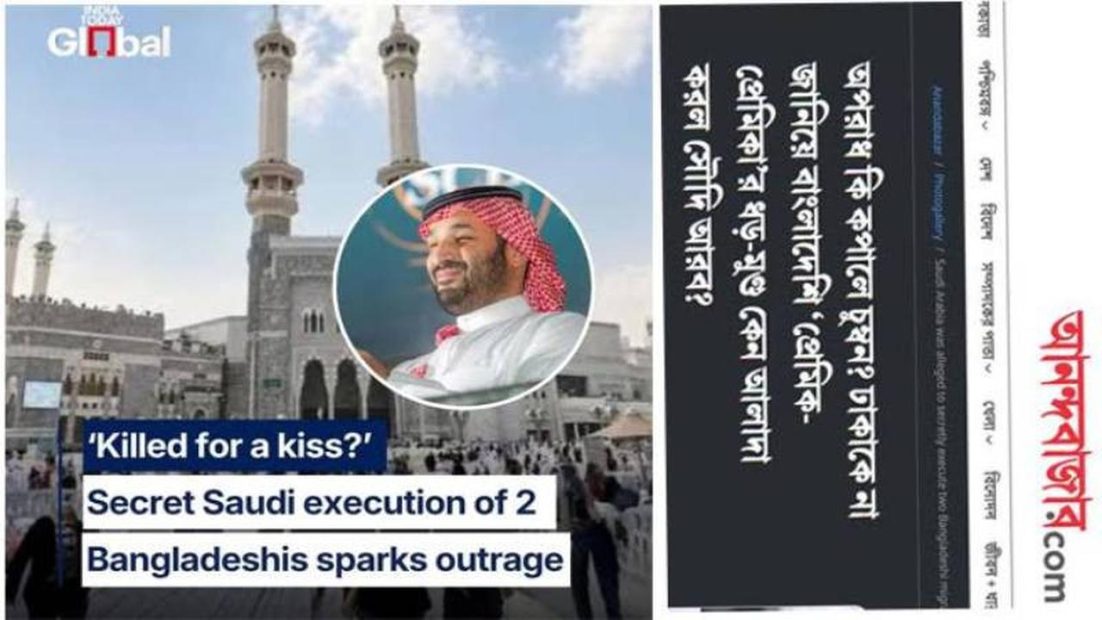
Indian media outlets have been accused of spreading misinformation and deliberate propaganda following the execution of two Bangladeshi nationals, a man and a woman, over a criminal offence committed inside the Grand Mosque in Makkah, Saudi Arabia. Reports published by outlets such as Anandabazar Patrika and India Today have been criticised for allegedly distorting the incident, with observers viewing the coverage as an attempt to undermine the strong bilateral relations between Bangladesh and Saudi Arabia. They have also alleged that the reports sought to cast doubt on Islamic Shariah law, the Saudi judicial system and the sanctity of the Grand Mosque.
In a report headlined “Was the Crime a Kiss on the Forehead? Why Did Saudi Arabia Separate the Heads of Bangladeshi ‘Lovers’ Without Informing Dhaka?”, Kolkata-based Anandabazar Patrika brought the Mecca Pact into the discussion and mocked the Bangladesh government’s interest in joining it. The report also made exaggerated claims that relations between Dhaka and Riyadh had deteriorated.
According to the report, Bangladesh has attached considerable importance to Saudi Arabia since Tarique Rahman became prime minister. Mocking this approach, the newspaper described the BNP government’s interest in joining the Mecca military pact as “overenthusiasm”. It further claimed that the executions, which reportedly took place just before Tarique Rahman’s anticipated visit to Saudi Arabia, had created serious diplomatic pressure between Dhaka and Riyadh.
The report stated, “Sometimes there is strong condemnation of Houthi attacks. At other times, there is a show of eagerness to join the Mecca military pact. Since Tarique Rahman became prime minister, Dhaka has been attaching considerable importance to Saudi Arabia. Suddenly, however, there has been a disruption. Riyadh has surprised everyone by executing two Bangladeshis. Moreover, the move was taken without informing them, leaving Bangladesh, its eastern neighbour, in considerable discomfort.”
Meanwhile, India Today’s report, titled “Killed for Kiss in Mecca Mosque? Secret Saudi Execution of Bangladeshis Sparks Outrage”, has been accused of disseminating provocative, exaggerated and misleading information. Analysts believe the coverage could confuse and anger people in Bangladesh and be used to create divisions in the longstanding, brotherly relations between Dhaka and Riyadh.
Although the two executed individuals were reportedly involved in an illicit sexual act inside the Grand Mosque, one of Islam’s holiest sites, India Today allegedly downplayed the incident by circulating unsubstantiated social media speculation that they were a married couple who had merely “kissed on the forehead”. The report also sought to portray Saudi Arabia’s Shariah-based judicial system as opaque and unlawful, describing the case as a matter of “criticism” and an “extreme failure of justice”.
The Indian outlet also invoked the Vienna Convention and consular notification requirements to highlight alleged diplomatic tensions between Bangladesh and Saudi Arabia, which critics say could undermine the two countries’ longstanding relationship.
The report allegedly made extensive efforts to portray the convicted individuals as innocent and Saudi Arabia and its judicial system as barbaric. It also highlighted statements praising Mr. Nazrul’s character and conduct by Maulana Naimur Rahman, superintendent of his madrasa, alongside allegations of a conspiracy involving a Pakistani colleague who was reportedly identified as Indian. In addition, posts by individuals described as anti-Islam, left-wing and Indian agents were quoted and presented as reflecting the anger of ordinary Bangladeshis.
On Tuesday, an investigative report published by The Daily Inqilab examined the allegations of misinformation and propaganda. It argued that claims circulating on social media in the name of freedom of expression were deliberately misleading.
According to the report, neither of the two individuals sentenced to death was a couple who had travelled to Saudi Arabia to perform Umrah. Both worked as cleaners inside the Grand Mosque. Their relationship developed over time, and they were eventually involved in an illicit sexual act in a secluded area near the King Fahd Gate inside the mosque. The report stressed that the incident was not a simple matter of kissing.
The report further stated that the incident took place in 2023. Before engaging in the act, the pair allegedly asked another colleague to keep watch. The colleague reportedly recorded the incident on video. The footage later circulated amid disputes or tensions among those involved and eventually came to the attention of the authorities. The person who recorded the video is also reportedly in prison.
On October 14, Saudi Arabia announced that it had executed two Bangladeshi nationals, Nazrul Islam Abdul Basir and Siti Akhtar. A court had convicted them of engaging in an “immoral act” inside the Grand Mosque. Their sentences were carried out following decisions by higher courts and a royal order under the ta’zir category, which allows judges discretion in determining punishment.
Analysts have expressed serious concern over what they describe as deliberate and coordinated misinformation on social media intended to turn the incident into a major controversy and damage the historically significant relationship between Riyadh and Dhaka.
They point out that Saudi Arabia is a major destination for Bangladeshi migrant workers and a crucial source of remittances for Bangladesh. Nearly three million Bangladeshis live and work in the kingdom, making bilateral cooperation on labour migration, consular protection and workers’ welfare essential for both countries. They argue that the current controversy should not be exploited to damage longstanding bilateral ties.
They also warned that failure to impose exemplary punishment for such offences could undermine the sense of security enjoyed by millions of women travelling to Makkah for Umrah and Hajj.
Regarding the judicial proceedings against the two Bangladeshis, Islamic scholars in Bangladesh have argued that, although unmarried individuals would ordinarily face 100 lashes, the death penalty imposed under ta’zir was appropriate given the location and circumstances of the offence. They contend that the Saudi court considered the act far more serious than an ordinary criminal offence because it took place at the sacred House of Allah.
According to the scholars, under Shariah, when an offence severely undermines public order or the sanctity of religion, a judge may impose the maximum punishment, including the death penalty under the doctrine of ta’ziran qatl, in the public interest and as a deterrent. On this basis, they have defended the executions as a judicial decision. They have also dismissed social media criticism framed around human rights as misplaced.
Mufti Abdullah Firozi, senior muhaddith at Jamia Siddiqia Jadur Char Madrasa, said that zina (unlawful sexual intercourse) was among the gravest major sins. He said the Saudi court treated the offence as far more serious than an ordinary crime because it occurred in a sacred place such as the Baitullah.
He added that although unmarried individuals would ordinarily be subject to 100 lashes, the judge had ordered the maximum punishment, ta’ziran qatl, or execution by beheading, because the act had gravely violated the sanctity of the Grand Mosque in Makkah and because of the public interest. He described the decision as fully consistent with Shariah and appropriate.
Analysts reiterated that Saudi Arabia is a major source of employment for nearly three million Bangladeshi expatriates and one of Bangladesh’s principal sources of remittances. They said the controversy should not be used to damage the two countries’ longstanding brotherly relations.
They also stressed the importance of sending a strong deterrent message against offences that could compromise the safety of women visiting Makkah for Umrah and Hajj and undermine respect for sacred sites. They urged the public to assess the matter on the basis of verified information rather than assumptions or speculation.
Islamic scholars also cautioned against spreading unverified claims on social media. They said those making allegations without knowing the actual facts could be committing a serious moral wrong.
One scholar appealed to the public to refrain from circulating claims that the two individuals had travelled for Umrah, were a couple or had merely kissed, describing such statements as unjustified misinformation.