United Strength of Imams and Islamic Scholars Must Be Mobilised for National Welfare
Imams, Islamic Scholars Played a Major Role in Martyred President Ziaur Rahman’s Rise: A M M Bahauddin
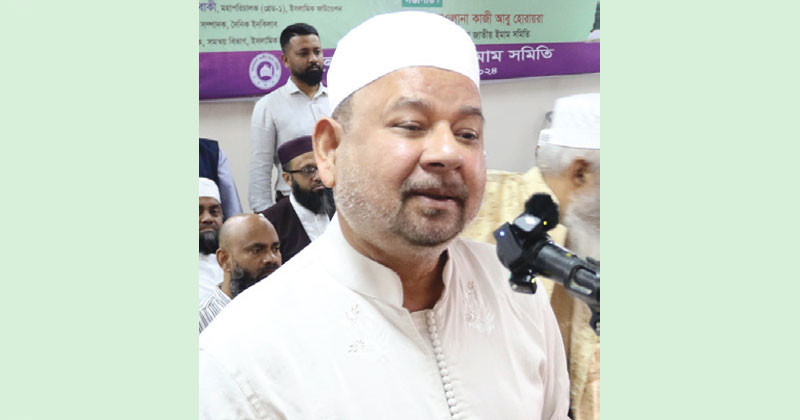
Mr. A M M Bahauddin, editor of Daily Inqilab and president of Bangladesh Jamiatul Modarresin, has called for uniting imams and Islamic scholars. He wants their social influence and organisational strength used for the national good. He said Martyred President Mr. Ziaur Rahman understood the value of imams and scholars. He said imams in villages and towns also played an important role in his political rise.
He said the strength of the imam community is needed for the country’s social stability, growth of moral values and facing future crises. Mr. Bahauddin spoke yesterday as a special guest at the central council and national imam conference. The Bangladesh National Imam Association held it at the Islamic Foundation auditorium in Agargaon.
The Inqilab editor said Mr. Ziaur Rahman saw the importance of building a deep bond with the scholars. In 1976, he held several meetings with leading scholars of the country at Bangabhaban. He stressed uniting Muslims of different views and schools. He also stressed strengthening Islamic society while protecting the rights of people of other religions.
He said that before the BNP was founded, public opinion had already formed across the country in favour of Mr. Ziaur Rahman during the 1978 presidential election. At that time, village imams motivated farmers, workers and ordinary people to back him. He said this role of imams was important in building public support for Mr. Ziaur Rahman. Their social acceptance and close contact with ordinary people helped shape political opinion.
Describing the reach of imams in present day Bangladesh, the editor of Daily Inqilab said a huge number of people gather in mosques every Friday. Through Friday sermons and religious talks, messages on morality, family duty, social order and the result of wrongdoing can reach them. He said it is hard to reach people at that level even by spending huge money on meetings and seminars. But mosque based communication can make it possible.
He said local worshippers and ordinary people have helped build the mosques’ structures and facilities across the country. Public money and local efforts played an important role in setting up facilities such as microphones, sound systems, solar power and air conditioning. He said the organisational role of imams and people’s trust in them should also be kept in mind.
Speaking of the social service of imams and scholars, he said religious institutions play a role in education, care and help for poor people. These include orphanages, Hifz schools, Lillah boarding homes, and Alia and Qawmi madrasas. He said they especially help in educating and caring for the children of workers in sectors such as readymade garments and textiles. For working parents, paying for child care is often hard.
He said the help religious and social institutions give should be seen as part of the wider social safety net. He said it is urgent to properly value the role of institutions that add to social support and human resource building along with economic progress. If we see only economic growth or big income as the single measure of development, many important activities going on inside society stay hidden.
Stressing the value of moral education in stopping the spread of drugs and crime, Mr. Bahauddin said law enforcement agencies and law enforcement work are not enough. He said it is also urgent to awaken people’s conscience and sense of duty. Regular sermons and religious talks by imams can play an effective role in teaching people to meet their duty to family, neighbours and society, to protect others’ rights and to avoid wrongdoing. This influence of religious and moral education should be used to bring a positive change in people’s behaviour.
He said scholars should not be stuck in political or ideological divisions. Unity and mutual cooperation among them must grow. It is urgent to create a chance for scholars of Alia, Qawmi and other streams to work together. This is because imams have close contact with mosques, madrasas, religious institutions and people from all classes and professions in society. It is hard to bring effective and lasting change by ignoring this wide social base.
Hinting at Prime Minister Mr. Tarique Rahman, the editor of Daily Inqilab said he must see the value of the united strength of imams and scholars for the country’s larger interest and work with them in a coordinated way. He said the government should not depend on any one group or circle. It should involve a wide section of the scholar community. It should take steps keeping in mind the mosques, madrasas, religious institutions and social networks behind them.
Warning about the country’s future, he said Bangladesh has potential for development, but it also faces the risk of social disorder and various crises. The government, political leaders, imams and scholars, and ordinary people must work together to face these challenges. He said that if social unity, morality and mutual cooperation can be strengthened, it will be easier to face possible crises and bring the benefits of development to people.
Near the end of his speech, he said it is not enough to sign big deals and adopt development plans. Joint efforts and effective implementation are needed to ensure their benefits. If religious and social forces can be used for the country’s good, above divisions, the path to national development, social stability and prosperity will grow stronger.