Symbol Controversy in New Academic Year’s Textbooks, ‘Boat’ Across Bengali Books, ‘Scales’ in ICT
The excessive use of political symbols in free textbooks printed for the 2027 academic year has sparked intense controversy. Widespread debate has emerged in the education administration over the irrelevant inclusion of numerous “boat” illustrations in the primary Bengali textbooks of classes 1 and 3, as well as the use of the “scales” symbol in the class 6 Information and Communication Technology (ICT) book. The matter has reached top government levels, including the Ministry of Education and the Prime Minister’s Office. To resolve the situation and correct printing errors, the National Curriculum and Textbook Board (NCTB) held an emergency meeting on Saturday with printing house owners.
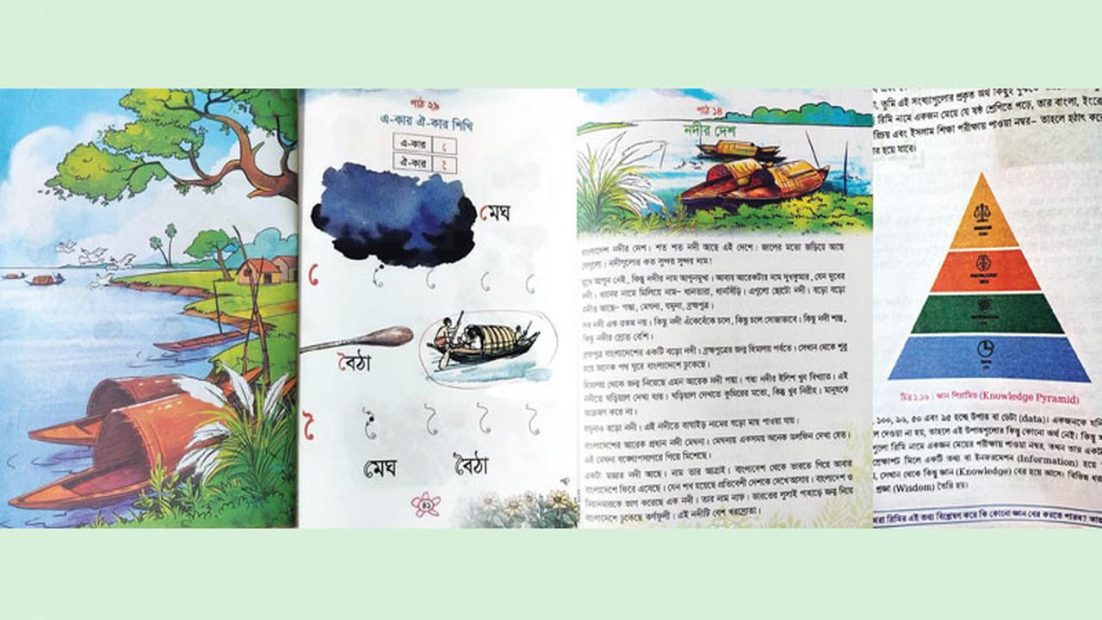
A review shows that at least 34 boat images appear in the class 1 Bengali textbook (Amar Bangla Boi), while at least 24 appear in the class 3 book. Education experts noted that although boats are natural symbols for riverine Bangladesh, the sheer volume and manner of their use in these textbooks is irrelevant, glaring, and out of place.
A page-by-page review of the class 1 textbook reveals multiple boats starting right from the inside cover illustration. Boats are further inserted beside words like choi (page 29) and boitha (page 41), alongside multiple boat illustrations on page 44. A boat is also included on page 47 with the sentence “It rains in the month of Asharh,” despite having no direct connection to the lesson. Similar unrelated boat images appear on page 48 under the word “Asharh,” page 54 with the line “Clouds rumble and algae float,” page 60 alongside Kazi Nazrul Islam’s famous poem Bhor Holo, and on pages 69 and 71 within discussions about the country.
A similar pattern is visible in the class 3 Bengali textbook. Beyond boats on the inner cover, images are placed on page 37 in the passage Baluchore Ekdin, page 38, page 42 alongside the poem Amader Gram, pages 45–46 in the chapter Nodir Desh, page 65 under the poem Ajikar Shishu, and page 83 alongside Rabindranath Tagore’s poem Taalgachh. Within the NCTB, questions have been raised about whether these additions were an attempt to project a specific political symbol into young minds.
Alongside the primary textbook controversy, strong dissatisfaction has arisen over the “scales” symbol in the class 6 ICT book. In chapter 1, within the “Knowledge Pyramid” model covering data, information, knowledge, and wisdom, the scales symbol is used to represent “wisdom.” A comparison across recent editions reveals shifting edits:
- 2025 edition: Used the scales symbol to represent “wisdom” (proggya).
- 2026 edition: Replaced proggya with buddhi (intelligence) and swapped the scales for an illustration of a human brain.
- 2027 edition: Reverted the term to proggya and restored the scales symbol.
Senior education officials expressed sharp displeasure that these symbols surfaced only at the final printing stage, following substantial public expenditure. During the emergency meeting, NCTB directed printers to swiftly modify controversial sections, replace questionable images, and reprint corrected sections (formes) where necessary.
An anonymous NCTB official explained that a textbook passes through manuscript drafts, editorial boards, and expert panels before reaching the printing press. Following the controversy, the Education Minister requested a list of all involved panel and editorial members, which has since been submitted for ministerial review.
NCTB also stated that printers were instructed to recall textbooks already dispatched to upazilas, replace the disputed sections, and redistribute the corrected books. Printing owners agreed to carry out these changes quickly. Prof. Md. Iqbal Haider, NCTB Member (Primary Curriculum), declined to comment.
Dr. A.N.M. Ehsanul Hoque Milan, Minister for Education and Primary & Mass Education, stated that instructions to revise the textbooks were issued immediately upon noticing the issue. He added that the NCTB has submitted the names of those responsible, and further decisions will be made after reviewing individual accountability.