
The Prophet (PBUH) Can Be Seen in the Mirror of the Heart
A wise traveller was once asked, “You have visited many countries, cities and towns throughout your life. Tell us, which city is the most beautiful?” He replied, “The place where my beloved lives.”
Yes, the two most beautiful cities in the world are the holy cities of Makkah and Madinah. Makkah is home to the Holy Kaaba, which Allah (SWT) Almighty has called “My House.” About 350 miles (436.6 kilometres) north of Makkah lies the golden city of Madinah, the spiritual home of every believer. The person closest to the hearts of Muslims rests in Madinah. He is the Prophet Muhammad (PBUH), the Messenger of Allah (SWT). To believers, he is dearer than their own selves. Allah (SWT) Almighty says, “The Prophet (PBUH) is closer to the believers than their own selves, and his wives are their mothers.” (Surah Al-Ahzab, verse 6)
A mother is generally considered the person closest to a human being. The wives of the Prophet (PBUH) are the mothers of the believers. The Holy Quran forbids calling the Prophet (PBUH) their father, but he is more compassionate than a father. He feels deep sorrow when believers suffer even the slightest hardship. He sincerely wishes them well and seeks their welfare. He is also exceptionally kind and merciful towards them. Allah (SWT) Almighty Himself says, “There has certainly come to you a Messenger from among yourselves. Your suffering is distressing to him; he is deeply concerned for you, and to the believers he is most kind and merciful.” (Surah At-Tawbah, verse 128)
Madinah is the destination of those who long to be close to the beloved Prophet (PBUH). The city was formerly known as Yathrib, a name associated with an idol in the pre-Islamic era. After the Prophet’s (PBUH) migration, the city’s name changed from Yathrib to Madinah. The city is blessed by the presence of the Prophet (PBUH), known as Rahmatul lil Alamin, or a mercy to all the worlds. That is why Madinah is forever known as Tayyibah, the pure, and Munawwarah, the illuminated.
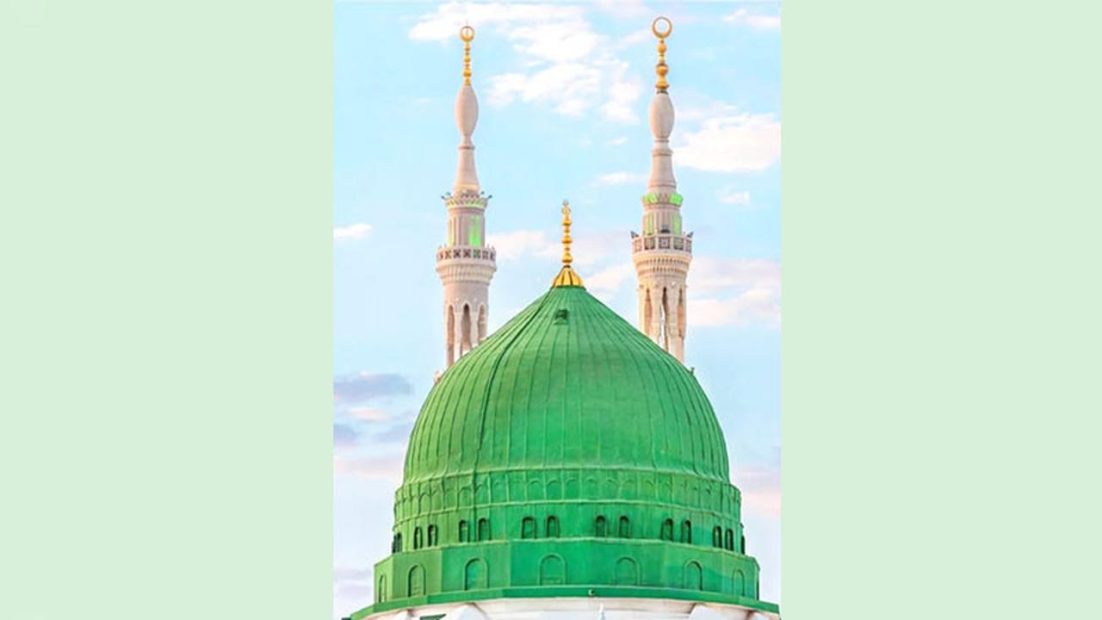
The city is home to the Prophet’s (PBUH) blessed resting place, Rawdah Mubarak. Its green dome stirs deep emotions in the hearts of believers, even when seen from a distance. The vast sky reflects the boundless mercy of Allah (SWT) Almighty. Countless blessings seem to play hide-and-seek in its blue expanse, as if the heavens themselves have bowed towards Madinah with their gifts of mercy. During the Ottoman era, a Turkish artist, inspired by his love for the Prophet (PBUH), imagined the sky bowing respectfully to kiss the Prophet’s (PBUH) feet. This vision took the form of the Green Dome.
The very sound of the word “Madinah” strikes a chord in the hearts of believers. Their souls seem to take flight like birds and seek shelter in the arches beneath the dome.
Beneath the dome rests the Prophet (PBUH), whose life continues in the special state known in Islamic belief as Hayat-un-Nabi. From distant lands, believers offer him greetings of peace and recite blessings upon him. According to Islamic belief, angels carry these greetings to his blessed resting place, just as sound and images travel through the air to radio and television screens. The Prophet (PBUH) responds to the greetings of his sinful followers.
During prayer, after every two rakats, Muslims sit and recite the Tashahhud, saying, “Assalamu alaika ayyuhan-nabiyyu wa rahmatullahi wa barakatuhu”—“Peace be upon you, O Prophet, and the mercy of Allah (SWT) and His blessings.” In the final sitting, they also send blessings upon the Prophet (PBUH) and his family. Through Allah’s (SWT) grace, their prayers and worship are accepted.
Today, standing before the Prophet (PBUH) in Madinah Munawwarah and offering greetings at his blessed resting place is an occasion for humble devotion and heartfelt surrender. The Quran declares that martyrs do not die. They receive sustenance from Allah (SWT). The Prophet (PBUH) holds a rank far beyond that of martyrs. He rests in his blessed chamber, hears the greetings offered to him and responds to them.
The word Rawdah means garden. The Prophet (PBUH) said that the area between his house and his pulpit is one of the gardens of Paradise. The Prophet (PBUH) rests in what was the room of our mother Aisha (may Allah SWT. be pleased with her). The area extending from his chamber to the pulpit in the adjoining mosque is known as Riyadul Jannah, or the Garden of Paradise.
The trees, streams and fountains of Paradise are not visible there in their worldly form. They will become apparent when this world is transformed into the Hereafter. Today, almost every household has a small device with a screen. Although the screen does not show the whole world on its own, connecting it to electricity and the internet allows the world to appear before us.
In the same way, the Prophet (PBUH) can be seen in the mirror of the heart in Riyadul Jannah, a piece of Paradise. The places where the Prophet (PBUH) led prayers and delivered sermons from his pulpit have been identified and preserved. Historical accounts state that he used to lead prayers in front of a pillar. During the time of Umar ibn Abdul Aziz (may Allah have mercy on him), regarded by many as the fifth rightly guided caliph, work began on constructing a semicircular, arched mihrab in front of that pillar.
However, the dimensions made it impossible to build the mihrab wall with the pillar in the middle. The pillar was therefore placed about one cubit to the south-west, or to the right and in front of the mihrab. As a result, the imam’s position shifted to the left and further back. The place where the Prophet (PBUH) prostrated came to lie beneath the mihrab wall. Thus, according to the account, no one would step directly on the spot where the Prophet (PBUH) prostrated.
Today, anyone praying along the right-hand wall of the mihrab will prostrate at a place where the Prophet (PBUH) stood with his blessed feet while praying. Near this spot, beneath the Prophet’s pulpit, lies the dried trunk known as Ustuwanah Hannanah. It is said to have wept inconsolably when the Prophet (PBUH) moved away from it.
The lower portions of the pillars inside the mosque have been painted white to mark the boundaries of Riyadul Jannah. Praying on the white carpet and prostrating there gives believers a sense of closeness to Paradise. Turkish artisans have inscribed different names on the pillars, expressing their devotion through their craftsmanship.
The Persian word ustun or sutun, meaning pillar, is rendered in Arabic as ustuwanah. The pillar beside the Prophet’s (PBUH) chamber bears the inscription Ustuwanah Aisha. The Prophet (PBUH) used to observe i’tikaf, a period of religious retreat, there during Ramadan. Another pillar is known as Ustuwanat al-Wufud, where the Prophet (PBUH) used to sit and receive delegations arriving from outside Madinah.
There is also the place associated with Abu Lubabah (may Allah be pleased with him). Overcome with remorse after failing to fully comply with the Prophet’s instructions during the campaign against Banu Qurayza, he tied himself to a pillar inside the mosque. When Allah revealed that his repentance had been accepted, the Prophet (PBUH) personally untied him. That pillar became known as Ustuwanah al-Tawbah, or the Pillar of Repentance.
A raised platform inside the mosque marks the Suffah, where poor Companions who had left their homes and families for the sake of Islam used to stay. The area behind the pulpit, within the mosque’s later extension, was once the residential quarters of the Prophet’s (PBUH) wives.
The Prophet’s (PBUH) lifelong companion and the first caliph of Islam, Abu Bakr Siddiq (RA), is buried beside him in the Rawdah. Out of respect, Abu Bakr’s head was positioned level with the Prophet’s (PBUH) shoulder. When the second caliph, Umar (RA), was martyred by an assailant, he too was buried nearby, with his head positioned level with Abu Bakr’s shoulder.
Standing before the three consecutive gold-plated openings in the grille of the Rawdah brings a believer a profound sense of closeness to the Prophet (PBUH) and his two companions. The door in front, known as Bab Jibril, or the Gate of Gabriel, is where the angel Jibril (peace be upon him) used to enter the Prophet’s (PBUH) presence with revelations from Allah. Outside the mosque lies Jannatul Baqi, the cemetery where countless Companions, their successors, Islamic scholars and pious people are buried.
The air of Madinah seems to carry the fragrance of the beloved Prophet (PBUH). Visiting the city offers an opportunity to connect with the history of Islam as a whole. Nearby lies the plain of Uhud and the trench associated with the Battle of the Trench. Farther away is the battlefield of Badr. Masjid Quba, where the Prophet used to go for prayer every Saturday, also stands as an important historical landmark. The city is also associated with the groves of Ajwa dates, which the Prophet (PBUH) loved, and many other memories of his life.
Although many priceless historical landmarks in Madinah have been lost over time, partly due to the hostility of those who opposed their preservation, the city remains a living record of Islamic history. Those who stand at this historic centre, offer greetings of peace to the Prophet (PBUH) and remain faithful to their commitment throughout their lives are promised the Prophet’s (PBUH) intercession and the glad tidings of Paradise.
The writer is Amir of Islami Oikya Andolan.










